






 Portuguese
  Spanish


Chinese spacecraft reached the Tiangong space station in a few hours, carrying research on microgravity, solar cells, rice cultivation, and prolonged human stay in space.
China launched the manned mission Shenzhou-23 on May 24, 2026, from the Jiuquan Satellite Launch Center in the northwest of the country.
On board were Zhu Yangzhu, Zhang Zhiyuan, and Li Jiaying, also called Lai Ka-ying in Cantonese. The group headed to the Tiangong space station, where they will conduct scientific and technological research.
The main highlight will be the stay of one of the astronauts for approximately one year in orbit. The experience will allow observation of the physical and medical impacts caused by long periods in microgravity.
-
The FIRE movement, which advocates for financial independence and early retirement, has gained momentum in Brazil and attracts investors who save extremely to live off income before the age of 60.

-
3,000-year-old tomb discovered in southern Egypt surprises archaeologists near Luxor, preserves architectural traces in the courtyard and may reveal details about Paser, a man linked to the 19th and 20th dynasties, while the country uses historical finds to rekindle cultural tourism.

-
Xiaomi launches floor cleaner with 18,000 Pa suction, 45-minute autonomy, self-cleaning brush, and drying at 100°C
-
The silver economy, driven by Brazilians aged 60 or older, already moves around R$ 2 trillion per year and accounts for 20% of national consumption, in a demographic that has grown from 22 to 34 million people.


Shenzhou-23 quickly reached the Tiangong space station
The spacecraft was launched by a Long March-2F Y23 rocket at 11:08 PM Beijing time.
A few hours later, Shenzhou-23 completed the automatic docking to the Tiangong space station, whose name means “Heavenly Palace.”
The procedure used Chinese navigation and autonomous control systems. Thus, the approach occurred without the need for a pilot to manually command all stages.
The operation also reinforced China’s strategy to expand its technological independence. The Beidou navigation system, completed globally in 2020, is part of this plan.
First astronaut from Hong Kong participates in the Chinese mission
The mission also made history with the participation of Li Jiaying, the first person from Hong Kong sent to space by the Chinese program.
A former police inspector and forensic computing specialist, she serves as a payload specialist on the mission. Her participation expanded Hong Kong’s representation in the national space program.
Li Jiaying also became the fourth woman to work on the Chinese space station.
Commander Zhu Yangzhu serves as a flight engineer. Meanwhile, Zhang Zhiyuan participates as the spacecraft’s pilot.
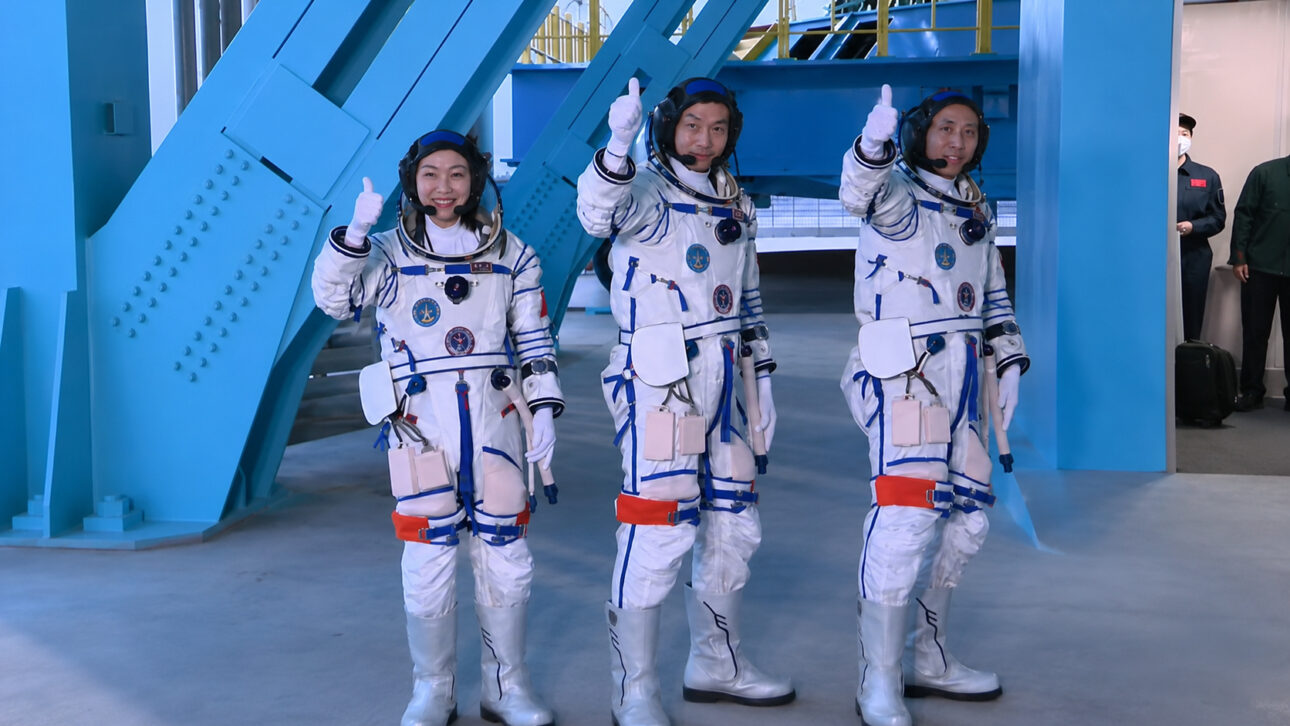
Astronauts faced extreme isolation before launch
The crew’s preparation included physical, technical, and psychological training.
Among the most demanding exercises was a stay of six days and five nights inside a cave.
The environment had a temperature close to 8°C, 99% humidity, absence of light, and few external references.
The activity simulated the isolation found in prolonged space operations. After weeks of preparation, the astronauts developed integrated communication to handle emergencies and routines in orbit.
Spacecraft received reinforced window after space debris issue
The Shenzhou-23 also incorporated improvements developed after an incident involving the Shenzhou-20 mission.
Space debris hit the previous capsule and caused a crack in the window intended for the crew’s return.
China had to launch the unmanned spacecraft Shenzhou-22 as part of the contingency operation. The new capsule then began to use three layers of glass in the window.
The change aimed to increase the structure’s resistance against small objects that circulate at high speed around the Earth.

Experiments study liver, solar energy, and rice in space
The mission transported nine scientific experiments, in addition to 54 kilograms of samples and equipment.
One of the studies will analyze how microgravity alters liver cells. The results may help researchers understand cellular changes associated with fat accumulation in the organ.
Another test involves perovskite solar cells, considered lightweight, flexible, and cheaper. The technology could eventually power satellites and lunar installations.
The crew will also attempt to grow rice in orbit, expanding agricultural experiments previously conducted on Tiangong.
Mission integrates China’s plan to take astronauts to the Moon
The Shenzhou-23 is part of a broader space strategy.
China intends to send humans to the lunar surface by 2030, while developing vehicles, modules, and technologies for prolonged missions.
Before boarding, the astronauts took photographs, family letters, and small gourds associated with luck in Chinese culture.
The crew also transported fresh fruits and vegetables for colleagues already at the station.


