Portuguese
  Spanish


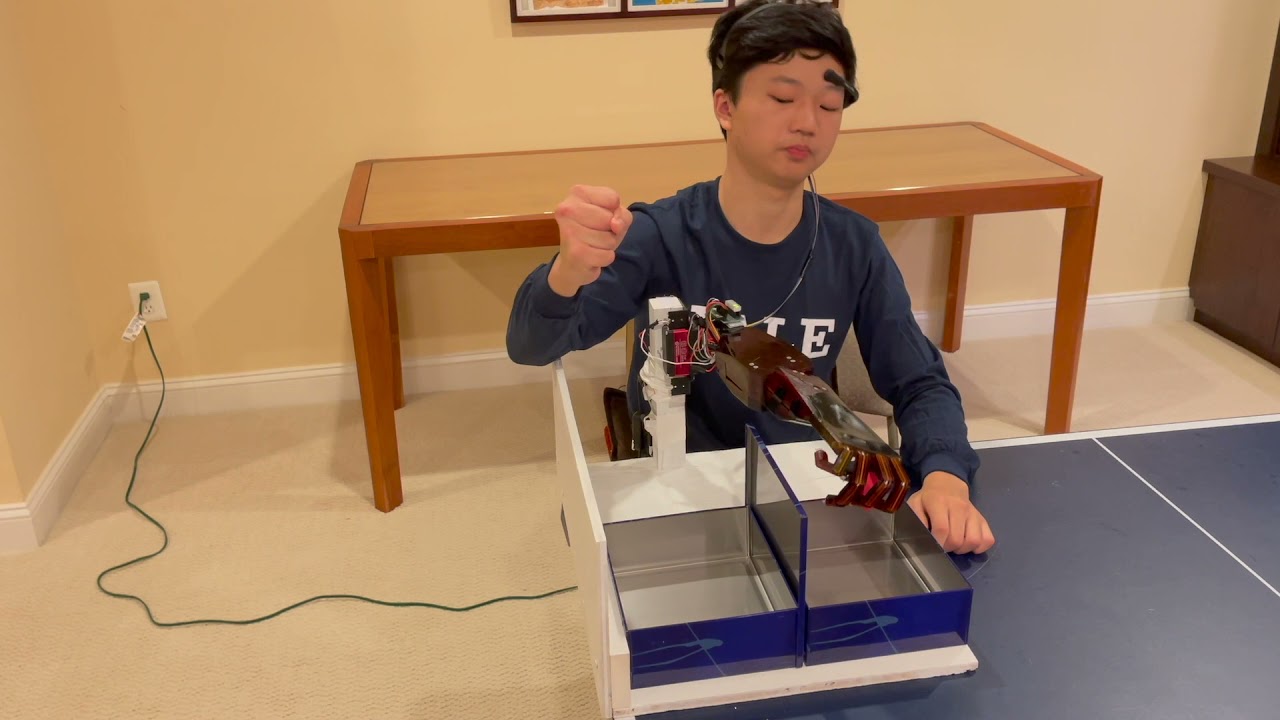

Young man created a prosthetic arm controlled by brain waves using 3D printing, AI, and simple components at low cost.
In 2022, American student Benjamin Choi, then 17 years old, caught the attention of the scientific community by presenting a brainwave-controlled prosthetic arm that cost about US$ 300, an extremely lower amount compared to advanced neural prostheses that can exceed hundreds of thousands of dollars. According to a report published by Smithsonian Magazine in May 2022, the project began during the COVID-19 pandemic when laboratories closed, and the student decided to turn the ping-pong table in his basement into a small improvised laboratory.
What made the invention different was not just the reduced price. Choi managed to create a functional prosthesis without resorting to the invasive surgeries normally associated with more sophisticated neural interfaces. Instead of implanting sensors inside the brain, he used a system based on electroencephalography (EEG), a technology capable of capturing brain electrical activity from external sensors placed on the head.
Benjamin Choi created the first version of the arm using a home 3D printer and manually assembled parts in his basement
According to Smithsonian Magazine, Benjamin Choi got the idea after watching a report on the program “60 Minutes” about mind-controlled prostheses as a child. At the time, he was impressed by the ability to move a robotic arm using thoughts but also realized that the technology relied on highly invasive and extremely expensive brain surgery.
-
Nuclear Fusion Study Proposes Transforming Mercury into Gold Using Tokamak Neutrons, but Real-World Application Remains Uncertain

-
Brazilian Researchers Develop Floor Tiles That Convert Student Footsteps into Electricity to Reduce University Energy Costs

-
Cambridge Scientists Achieve Solar-Powered Plastic Recycling, Converting Waste into Valuable Chemicals Without Fossil Fuels, Paving the Way for a Low-Carbon Circular Economy

-
In Ghana, Makafui Awuku Turns 250-300 Water Sachets Into Each 30-Year-Lasting School Desk, Lifting Children Off Classroom Floors


Years later, in 2020, during the closure of laboratories caused by the pandemic, Choi decided to try to develop a less invasive alternative.
He used his sister’s 3D printer, valued at just US$ 75, along with fishing line and simple components to create the first structure of the robotic arm.
Since the printer could only produce small parts, he had to print dozens of separate pieces and manually join them with screws, rubber bands, and improvised adaptations.
The process took months of solo study until finally developing a functional robotic arm
The process was not quick. The student worked for months in an improvised laboratory set up on a ping-pong table in the family’s basement, spending up to 16 hours a day developing prototypes. The first version took about 30 hours just to be 3D printed.


Previous experience in robotics helped a lot. Choi had been participating in engineering competitions since elementary school and had self-taught programming languages like Python and C++.
Even so, the challenge was enormous: he needed to create not only the physical structure of the arm but also a system capable of interpreting brain signals in real-time.
System uses external EEG sensors to capture brain waves without the need for invasive surgery
The technical differential of the project lies precisely in the form of control. Instead of using brain implants, the arm uses external EEG sensors to capture electrical activity from the brain. This technology is already used in medicine for neurological monitoring and diagnosis of conditions like epilepsy.
In the system created by Choi, a sensor is attached to the earlobe as a base reference, while another sensor is positioned on the forehead to capture brain signals related to movement. This information is transmitted via Bluetooth to a microchip installed inside the prosthetic arm.

From there comes the most complex part of the project: the artificial intelligence developed by the student himself. The algorithm interprets the electrical patterns generated by the brain and tries to convert these signals into physical commands to move the prosthesis.
The system also uses head gestures and intentional blinks as complementary control and stop mechanisms.
The goal was to avoid exactly the biggest problem of the most advanced neural prostheses available today: the need to open the skull to implant electrodes directly into the motor cortex. These procedures are expensive, risky, and restricted to a few specialized medical centers worldwide.
Artificial intelligence created by the student uses more than 23,000 lines of code to interpret brain signals
The computational part ended up becoming one of the most impressive areas of the project. According to the Smithsonian Magazine, the algorithm created by Choi has more than 23,000 lines of code, seven new sub-algorithms, and about 978 pages of applied mathematics.
To train the artificial intelligence, the student worked with six adult volunteers. Each participant spent about two hours performing hand-closing and opening movements while EEG sensors recorded the brain patterns associated with these actions.
17-year-old Student Created His AI
With this data, the system learned to distinguish different neural signals related to movement intention. Choi himself stated that the algorithm continues to learn as the user utilizes the prosthesis, allowing gradual adaptation to individual brain patterns.
According to the tests released by the student, the system achieved an average accuracy of approximately 95%, a number higher than the standard cited for similar systems used as a reference in the technical literature of the time, which revolved around 73.8%.
Advanced Neural Prostheses Can Cost Hundreds of Thousands of Dollars While the Project Was Close to US$ 300
One of the points that most boosted the project’s impact was the extremely reduced cost compared to advanced market prostheses. According to the Smithsonian Magazine, a basic mechanical upper limb prosthesis can cost about US$ 7,000, while sophisticated neural systems reach approximately US$ 500,000.
The arm developed by Benjamin Choi was around US$ 300 to manufacture. In some initial versions released online, the student himself estimated costs close to US$ 150 depending on the components used.
Choi’s project aims to tackle exactly this economic barrier using cheap components, home 3D printing, and proprietary software. The idea was not to immediately compete with high-precision commercial medical prostheses but to show that part of these technologies could be developed much more affordably.
Robotic Arm Went Through More Than 75 Versions to Achieve a Structure Capable of Supporting Large Loads
Another fact that drew attention was the structural evolution of the arm throughout development. According to published reports, the system went through more than 75 different versions to reach a model made with industrial-grade materials.
The first versions were extremely simple and limited, but the project gained more resistant components as the student received financial support and access to better materials. At a certain point, the company PolySpectra provided funding and more robust 3D printing materials to aid in development.

According to the tests released by Choi, the latest versions of the arm were able to withstand loads equivalent to approximately four tons without structural failure in the main materials. I cannot independently confirm the exact conditions of this resistance test, but the information appears in reports published about the project.
Even with this high structural resistance, the system still needed to evolve in aspects such as ergonomics, miniaturization, and direct adaptation to everyday use by amputees.
The arm created by a teenager shows how homemade engineering can challenge million-dollar technologies
What turned Benjamin Choi’s story into a global headline was not just the engineering involved, but the almost improbable contrast between scale and result. A teenager working alone in a basement managed to develop a functional neuroprosthetic system using cheap 3D printing, his own artificial intelligence, and relatively simple external sensors.
Although the arm is still far from fully replacing advanced medical prostheses used in hospitals and research centers, the project showed that part of the technology can be democratized with creativity, programming, and accessible engineering.
The question that began to arise after the case’s repercussion is how far independent projects like this can go in the coming years, especially now that 3D printing, embedded AI, and biomedical sensors are becoming cheaper and more accessible for students, makers, and small labs around the world.