Portuguese
  Spanish


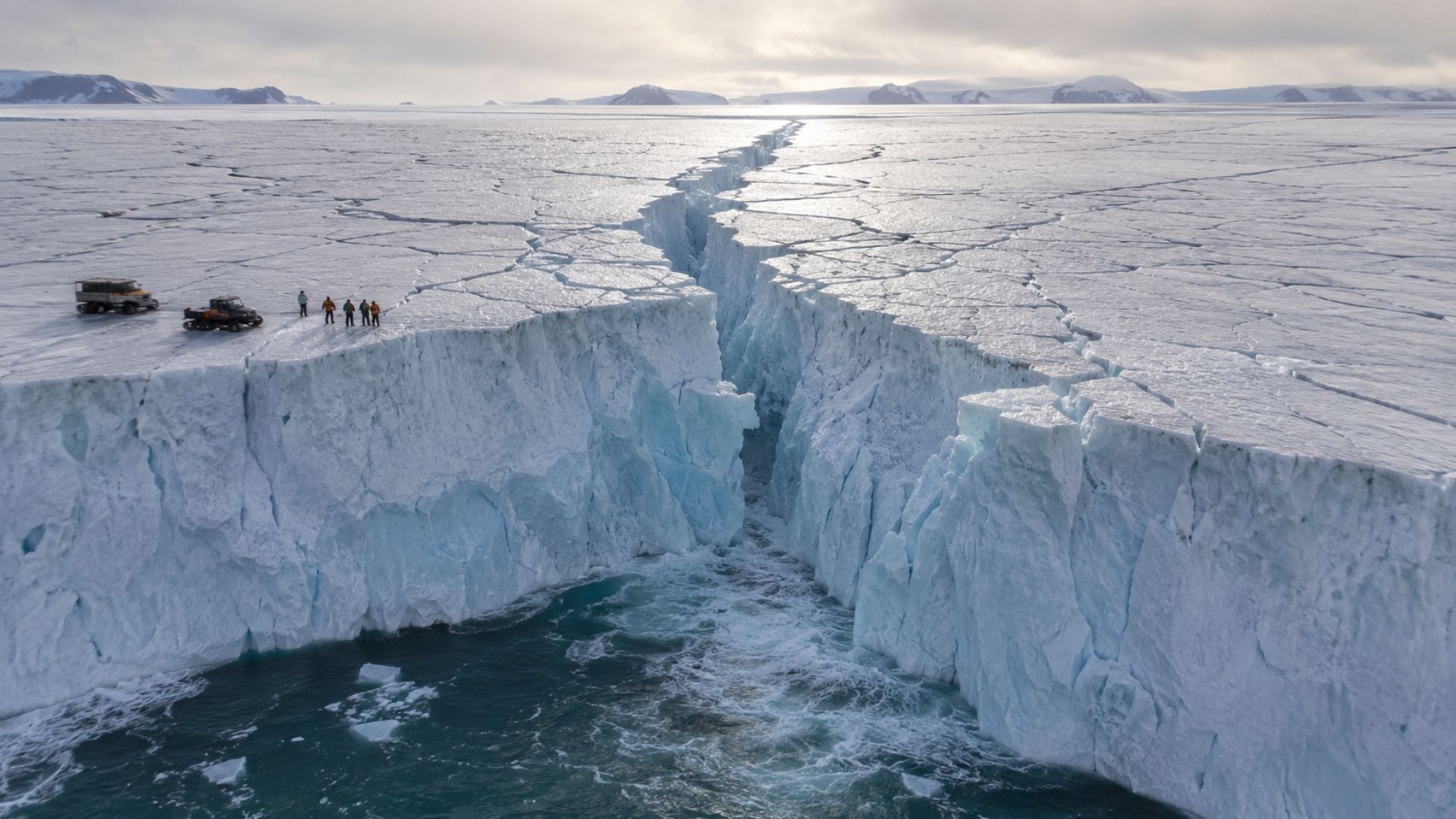


Expansion of liquid water over Antarctic ice concerns scientists for increasing pressure on platforms that help contain continental glaciers and directly influence sea level, according to high-resolution climate projections published in an international study in the journal Nature Communications.
Researchers have discovered that the surface melting of Antarctica is expected to spread over a larger area of the continent throughout this century and increase pressure on ice platforms essential for containing the advance of glaciers towards the ocean, according to a study published on March 30, 2026, in the journal Nature Communications.
Signed by Yaowen Zheng, Nicholas R. Golledge, Alexandra Gossart, and Shoujuan Shu, the research indicates that the threat to Antarctic ice is not limited to ocean warming beneath the platforms, as the formation of liquid water on the surface can also weaken floating structures and increase the risk of instability.
Surface melting is expected to advance in Antarctica
To estimate how surface melting might evolve under different emission trajectories, the authors used climate projections with a resolution of 1 kilometer, indicating that, in the SSP3-7.0 scenario, the area subject to the phenomenon is expected to grow by more than 10% by 2100.
-
Brazilian Engineer Who Grew Up Without Electricity Develops Software, Expands AltoQi to 67,000 Clients, Aiming for $21 Million by Digitizing Brazil’s Construction Industry

-
Spain Launches World’s Largest Floating Dry Dock: 56-Meter Giant Produces Massive Concrete Structures in A Coruña Using Technology Proven in Brazil

-
AI-powered toys that talk, recognize faces, and collect data face scrutiny from Brazilian government over children’s privacy concerns

-
4,000-Year-Old Child’s Skull Unveils Ancient Burial in 7,500-Year-Old Norwegian Rock Shelter, Impressing Archaeologists




Although this advance does not indicate that all of Antarctica will begin to melt uniformly, the data shows that regions currently less exposed to liquid water may enter a higher risk zone in the coming decades.
Among the areas considered most sensitive are the Western Antarctic Peninsula and the Amundsen Sea Bay, regions where increased surface melting could compromise ice platforms responsible for slowing the flow of continental glaciers towards the sea.
Liquid water can expand fractures in the ice
Connected to the continent, ice platforms are floating extensions that, despite already being over the ocean, function as natural barriers capable of reducing the speed at which land-supported ice advances towards the sea.
As these structures lose stability, the glaciers located behind them begin to flow more easily, a process considered relevant because continental ice, upon reaching the ocean, directly contributes to sea level rise.
Furthermore, the liquid water accumulated on the platforms can penetrate cracks and trigger the mechanism known as hydrofracture, which increases pressure within the crevices and deepens existing fractures, reducing the ice’s resistance in vulnerable areas.
Change in albedo accelerates new stages of melting
Another point highlighted by the study involves changes in the Antarctic surface’s ability to reflect sunlight, as clear snow and ice return an important part of the radiation to space, while wet or darkened areas start to absorb more energy.
Known as albedo reduction, this alteration can favor new stages of melting, causing the surface to stop acting only as a passive layer and start participating in processes capable of increasing local instability.
For years, much of the concern regarding Antarctica was focused on melting from the base of the platforms, caused by interaction with warmer ocean waters, but the new research broadens this scenario by showing that the atmosphere can also act on the glacial system from above.
Low emissions scenario reduces the phenomenon’s advance
Among the scenarios evaluated by the researchers, only SSP1-2.6, associated with lower emissions, manages to stabilize the future rate of surface melting expansion at current levels, while in the other paths analyzed, the exposed area continues to advance throughout the century.
The difference between the scenarios indicates that the emissions trajectory directly influences the pace of transformation in Antarctica, as in a more controlled warming context, the phenomenon does not disappear but stops advancing at the same speed.
In scenarios of greater warming, the formation of liquid water reaches broader areas and intensifies pressure on regions where the platforms play a structural role, although the study does not treat the process as an inevitable collapse, but as an increase in physical vulnerability.
Detailed climate models help identify vulnerable areas
With a resolution of 1 kilometer, the study allowed researchers to observe contrasts that broader climate models usually smooth out, especially in coastal regions and ice platforms, where small variations in relief, temperature, and atmospheric circulation alter melting behavior.
This level of detail helps identify areas where the expansion of liquid water requires closer monitoring and also allows distinguishing regions with a higher chance of hydrofracture, avoiding treating the Antarctic continent as a homogeneous block.
According to the research, surface melting can also affect habitats adapted to extreme cold and alter local conditions in coastal areas, although the main alert remains related to the stability of ice platforms and their direct connection to sea level.
Antarctica holds enough ice volume to influence coastal zones on a global scale, which is why regional changes involving platforms and glaciers have a significant impact on coastal cities, coastal infrastructure, and long-term climate planning strategies.
With the advance of liquid water over the ice, the need to monitor Antarctica as a system influenced by simultaneous processes grows, as the ocean can warm the base of the platforms while the atmosphere increases melting and favors the emergence of fractures.