





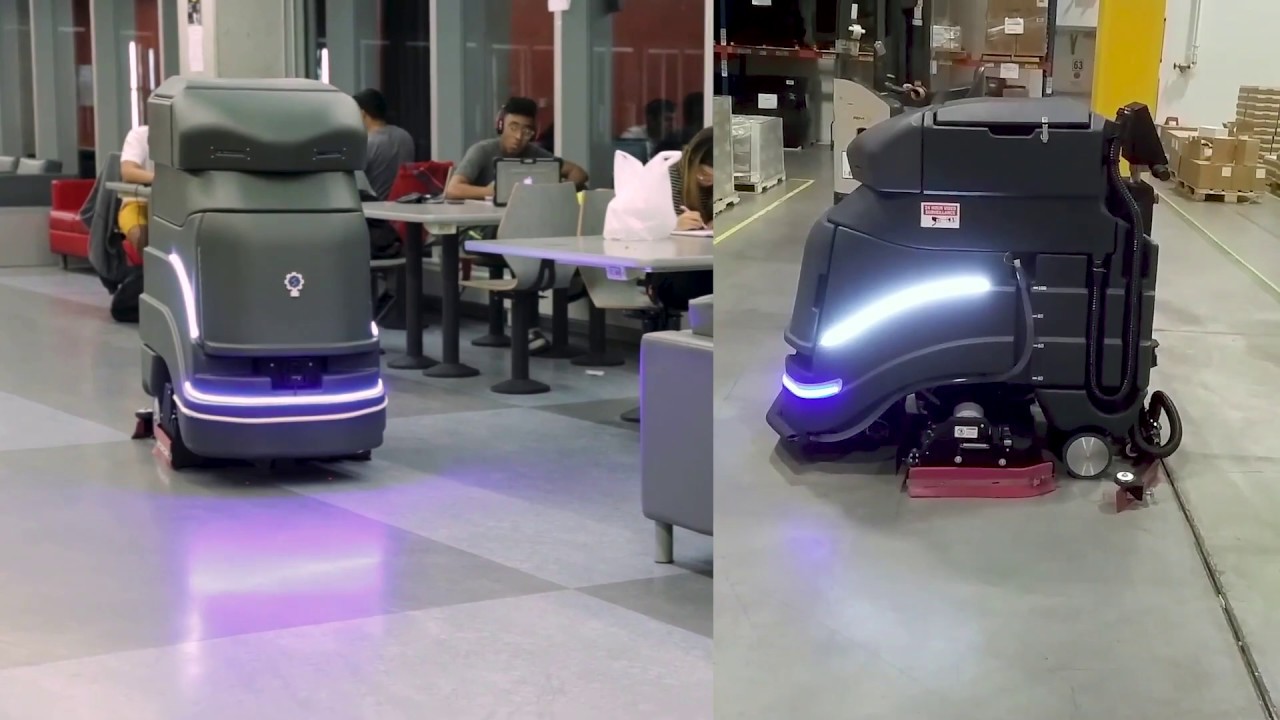

Autonomous cleaning robots already operate in airports, hospitals, and large buildings, automating repetitive tasks and changing the sector.
For decades, cleaning large buildings relied almost entirely on human teams operating floor scrubbers, industrial vacuums, and other professional equipment. This scenario began to change with the expansion of autonomous cleaning robots in environments such as airports, hospitals, offices, shopping centers, and warehouses.
In Singapore, for example, Changi Airport adopted floor cleaning robots from Avidbots to increase team productivity and reduce costs. The company claims that these machines take over the cleaning of large floor areas, while workers can focus on other activities within the operation.
Autonomous cleaning robots already operate in airports, hospitals, and high-traffic commercial buildings
The adoption of these systems is no longer sporadic and has started to appear in different types of infrastructure. An academic survey from 2024 indicates that, since the 2020s, cleaning robots have been found more frequently in office buildings, shopping centers, airports, hotels, and healthcare facilities, performing tasks such as sweeping, vacuuming, and floor washing.
-
Xiaomi Launches Compact Photo Printer with Bluetooth, Extra Black Ink, and Augmented Reality Photo Printing

-
Teen Invents AI-Powered Traffic Light to Assist Elderly Pedestrians by Extending Crossing Time

-
NASA Plans Telescope That Can Be Repaired by Robots 1.5 Million Kilometers from Earth
-
China Launches First Oceanic Medical Rescue Ship with Advanced Facilities to Serve Remote Regions




In the case of Changi, Avidbots reported that their robots were deployed to handle the cleaning of large surfaces in one of the busiest airports in the world.
The company also states that its fleet was already present on five continents, serving airports, healthcare centers, shopping centers, and other large spaces.


This expansion helps explain why cleaning robotics has started to gain ground in the professional sector. In extensive environments, with continuous circulation of people and the need for a predictable routine, automation has become more attractive for repetitive and standardized tasks.
LiDAR sensors, RGB-D cameras, and autonomous navigation enable operation in complex and busy environments
The professional models used in these spaces are more complex than domestic robots. A study on an autonomous cleaner for large public areas describes a system with 3D and 2D LiDAR, two RGB-D cameras, and a stereo camera, a combination aimed at detecting people, obstacles, dirt, and objects on the floor.
According to this study, the sensors allow the robot to detect and track dynamic objects, such as pedestrians, while identifying static elements and dirt in the environment.
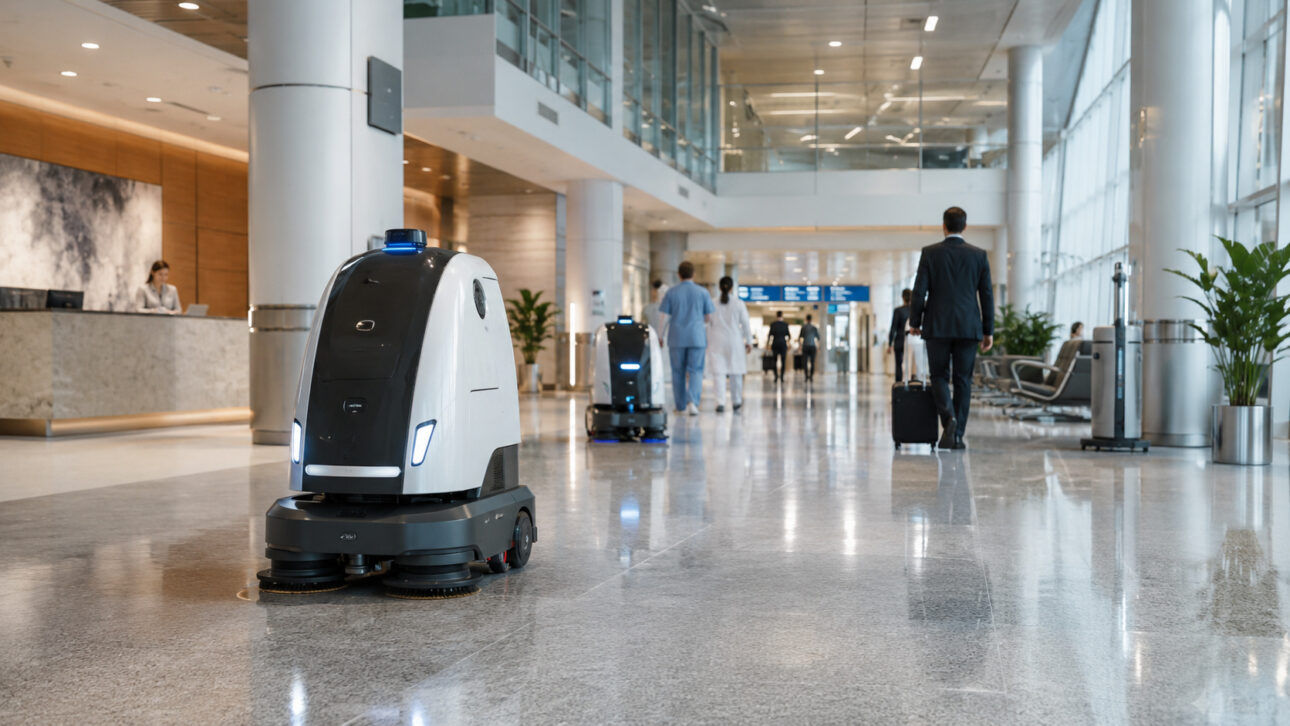
The same system was tested with data collected in supermarket, warehouse, and airport, three scenarios that help illustrate the type of space for which this technology was designed.
The most recent literature also highlights that autonomous navigation has improved with the combination of distance sensors, collision detection, and algorithms like SLAM, which has made robots more capable of operating in large and dynamic areas. This advancement was decisive for the migration of robotic cleaning from the domestic environment to large-scale commercial use.
Professional cleaning automation advances to take on repetitive tasks and free teams for more complex services
In practice, the main role of these robots today is not to completely replace teams, but to absorb the more repetitive routines.
Avidbots states that, in airports and hospitals, their systems are designed to handle continuous floor cleaning, while professionals are free for other tasks within the operation.

In the healthcare area, the company says that robots like Neo and Kas were designed for high-flow environments that operate 24 hours a day, helping to increase cleaning frequency and redistribute team effort to higher-value activities.
The company also associates these systems with reducing exposure to workforce issues, such as absenteeism and turnover.
This rearrangement helps change the routine of the professional cleaning sector. Instead of concentrating labor on long floor washing routes, the trend is to shift part of the human work to inspection, detailed sanitization, operation supervision, and handling areas that require more flexibility.
Labor shortage and pressure for productivity accelerate the adoption of autonomous cleaning robots
The automation of cleaning is also being associated with a broader structural problem. The academic survey on cleaning robots in public spaces states that these solutions have the potential to address challenges such as labor shortage and maintaining cleanliness in public areas.
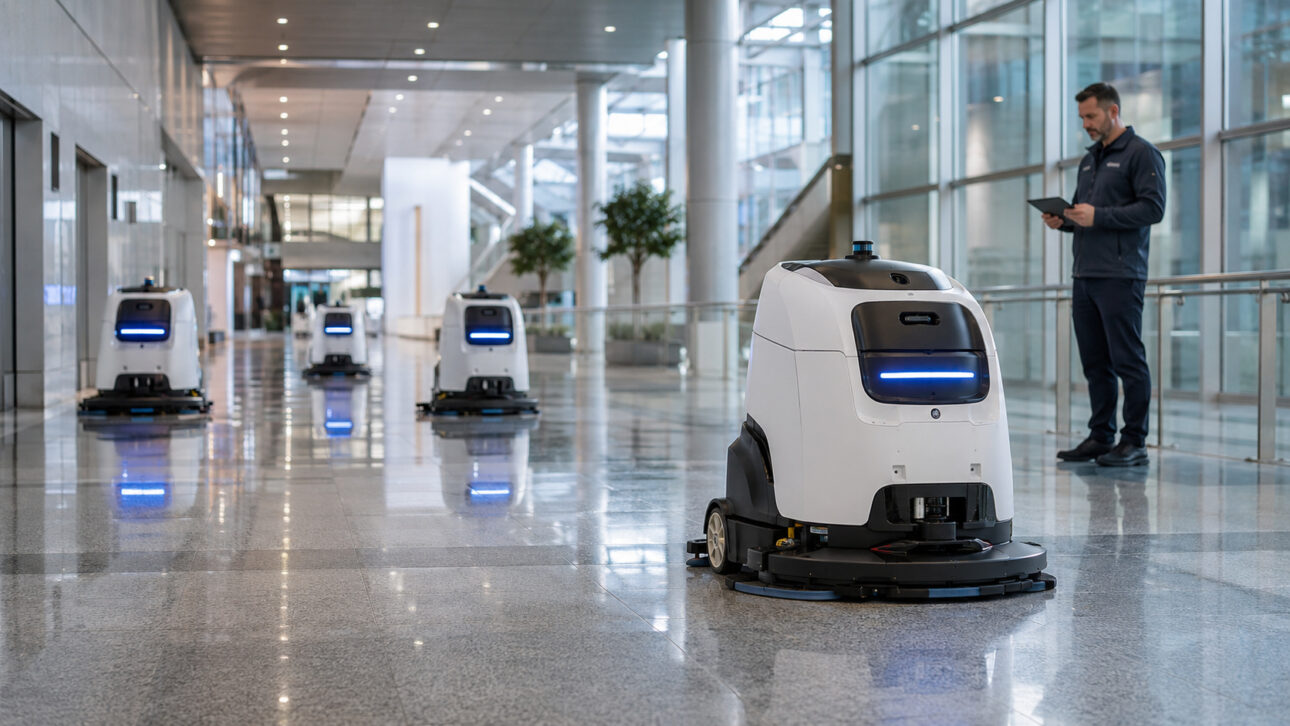
The avidbots research highlights that the advancement of sensors, artificial intelligence, and connectivity has increased the efficiency, adaptability, and autonomy of commercial systems. It also notes that battery capacity has increased and now allows for several continuous hours of operation in tasks such as washing and dust removal.
This set of factors helps explain the growth of cleaning robots in large facilities. When the need is to keep extensive areas clean for many hours, with a constant standard of execution, automation is seen as operational reinforcement and not just a technological experiment.


