Portuguese
  Spanish


The Megatrem 2025 from Manos, developed with Kennedy Trailers, has arrived in forest transport in Mato Grosso do Sul and Minas Gerais. With 50 meters, 240 tons, 13 axles, and six stacks of wood, the implement aims to increase productivity, stability, and efficiency in heavy Brazilian log transport.
The Megatrem 2025 began operations in Brazil after Manos Implementos delivered the first two units of the new version to clients in the forestry sector in Mato Grosso do Sul and Minas Gerais. The information was published on September 12, 2025, by the Blog do Caminhoneiro.
According to the Blog do Caminhoneiro and institutional information from Manos Implementos, the implement was developed by Manos, a Brazilian manufacturer focused on forest transport, in partnership with the Australian Kennedy Trailers. The new configuration is 50 meters long, with a GVW of 240 tons, 13 axles, and the capacity to transport six stacks of wood per trip.
Megatrem was created for off-road forest operation
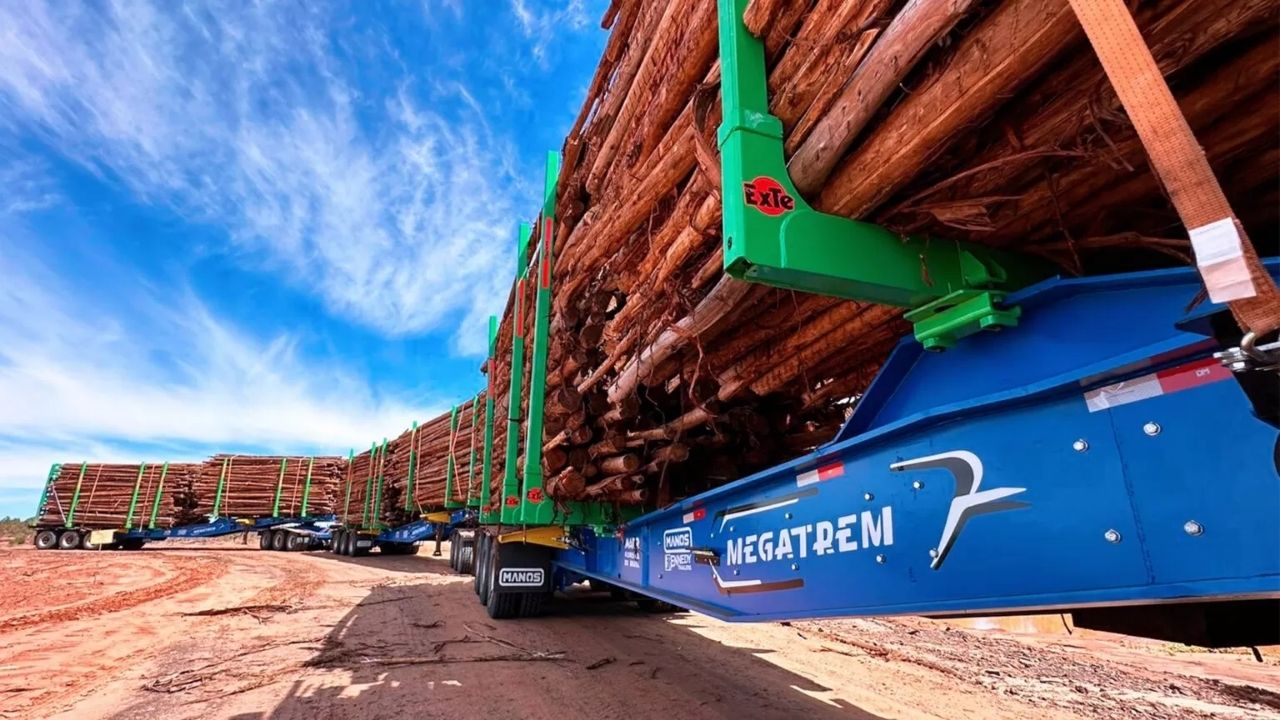
The Megatrem was not born as an adaptation of a common road implement. According to Manos, the proposal was to create a specific solution for heavy forest transport, prepared for off-road routes, from the forest to the industry.
-
From Cars and Motorcycles to 15-Meter Truck Operator: She Works at 4,800 Meters in Argentina’s Veladero Gold Mine, Where 16% of Workers Are Women

-
1,600-Year-Old Byzantine Christian Lamp Shaped Like a Sandaled Foot May Have Biblical Origins

-
Brazilian Researchers Develop Cassava Starch and Grape Peel Packaging That Changes Color to Indicate Spoilage of Meat and Fish
-
Revolutionary Air Fryers: New Models Offer Up to 12 Liters Capacity, 10 Functions, and 90% Less Fat Starting at $80


The logic is to transport more wood per trip and reduce the need for several smaller sets circulating on internal roads. In large forestry operations, this can impact productivity, consumption, maintenance, and the organization of the flow between the field and the industrial unit.
The 2025 version was delivered to clients in Mato Grosso do Sul and Minas Gerais, two states with a strong presence of forestry and industrial operations. The text does not provide the names of the purchasing companies, only that the units were destined for the forestry sector.
With a length of 50 meters, the set requires planned operation and an adequate environment. Therefore, the Megatrem is treated as a large-scale solution for controlled use, especially on internal routes and dedicated applications.
Six stacks of wood change the logic of the journey
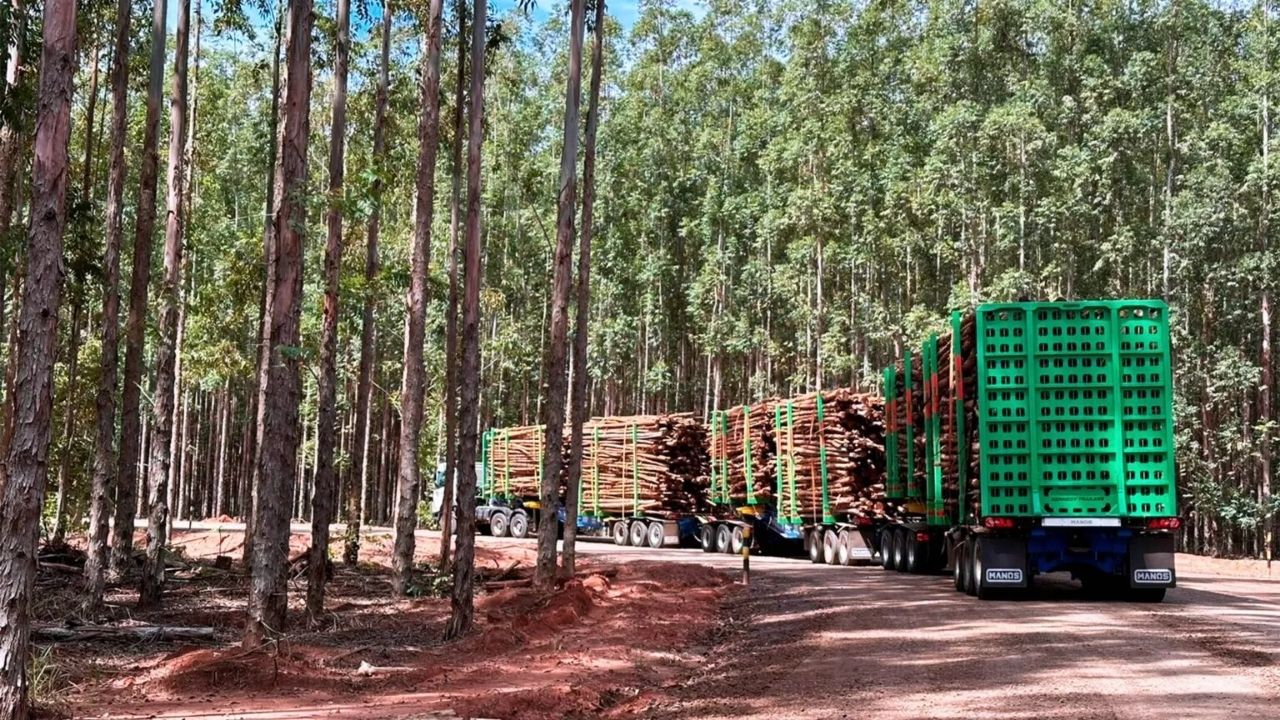
The new version of the Megatrem was designed to transport six stacks of wood per trip, distributed across three semi-trailers. Each semi-trailer carries two stacks, with logs between 7.5 and 8 meters.
This design allows for better filling of the cargo boxes, taking advantage of the chassis and weight distribution. Instead of simply extending the set, the engineering seeks to balance transported volume, stability, and equipment lifespan.
The Blog do Caminhoneiro reports that the chassis was designed to distribute the net load evenly, avoiding concentrated efforts. This feature is important in an operation where weight, uneven terrain, and frequency of use demand structural strength.
The GVW of 240 tons places the Megatrem among the largest forestry implements in the country. Manos also states that, upon consultation and operational feasibility assessment, the set can operate above this limit.
New version reduced axles compared to the previous model
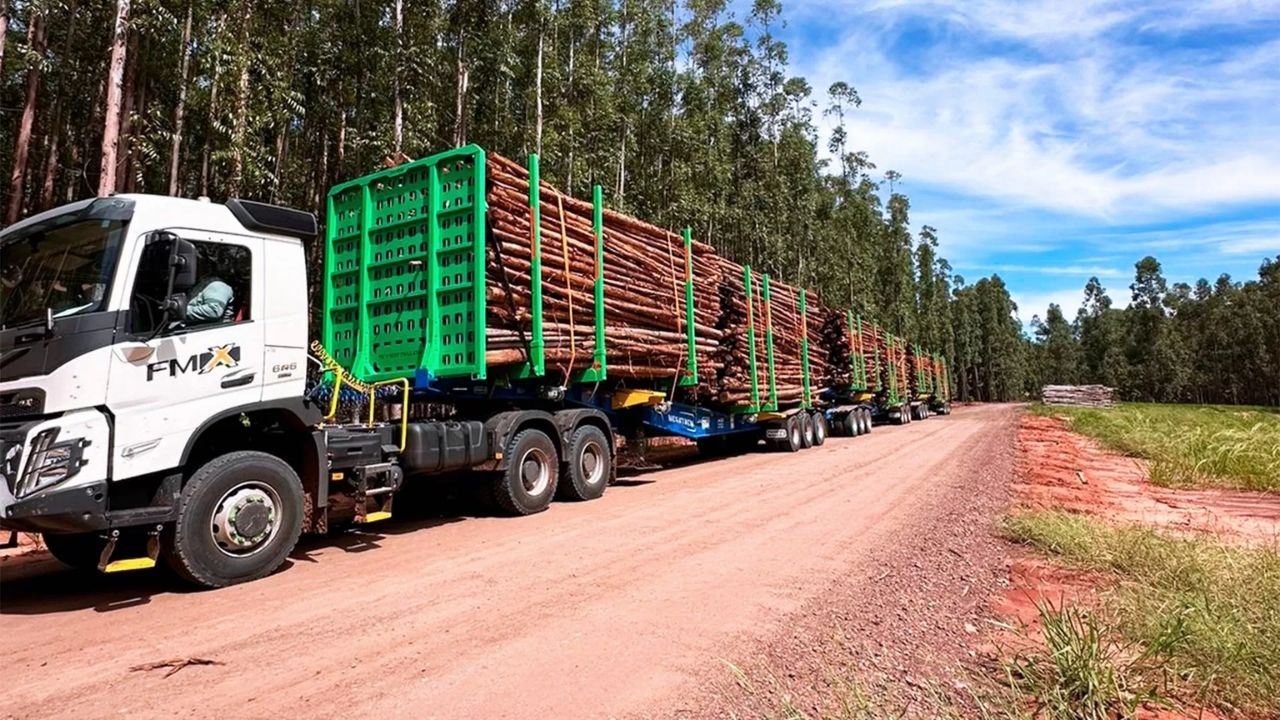
One of the changes in the 2025 version is in the number of axles. The Megatrem went from 15 to 13 axles compared to the first version, using two-axle dollies.
This change aims to make the composition more efficient, with fewer components in the set and greater agility in movements. Fewer axles can also mean a reduction in tires, parts, and maintenance points throughout the lifespan.
According to the source, the new configuration provides more driving stability, smoother maneuvers, and productivity gains in transportation. In forestry operations, where the equipment works at an intense pace, these improvements can weigh on the total cost.
Manos itself had already highlighted, in a previous project presentation, the importance of reducing chassis, axles, tires, brake kits, and coupling points compared to other compositions. The 2025 version follows this logic of operational simplification.
Australian technology entered the project with Kennedy Trailers
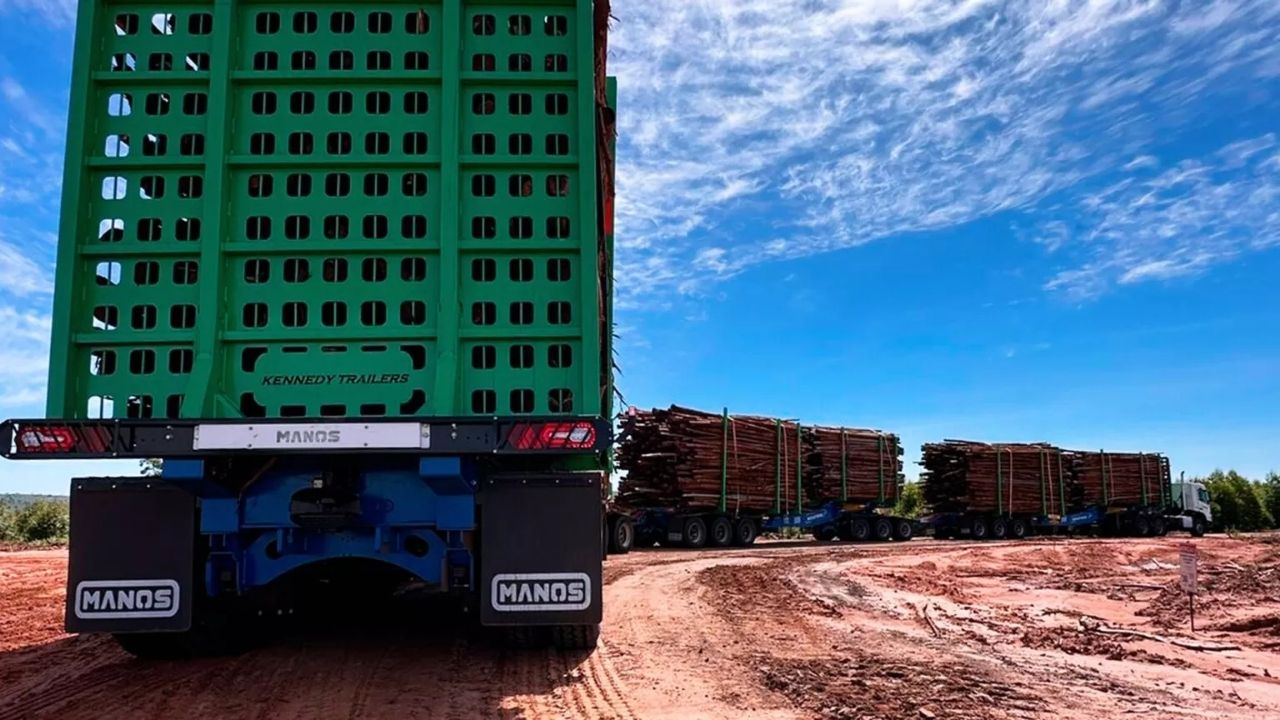
The Megatrem was developed within the Manos Service Cycle, a method used by the company to create solutions with clients and partners. In this project, international collaboration occurred with Kennedy Trailers, an Australian manufacturer known for robust equipment.
Kennedy Trailers has experience with road train configurations, common in Australia, where high-capacity compositions have been circulating on specific networks since 1986. According to Manos, these systems can support from 120 to 500 tons.
The partnership brought reference from a country accustomed to long distances, high loads, and operations in harsh environments. In Brazil, the adaptation was made for the reality of heavy forestry transport.
This technology transfer does not mean copying the Australian highway model. The Brazilian Megatrem was presented as an off-road solution, aimed at moving wood between forest areas and industrial units.
Heavy-duty chassis and lowered suspension seek stability
The equipment was designed with a heavy-duty chassis and super lowered suspension. The intention is to lower the center of gravity in relation to the ground, improving stability and grip on difficult terrains.
This detail is relevant because transporting logs in large volumes requires control of the set on climbs, curves, irregularities, and maneuvers. The lower and more balanced the center of gravity, the lower the risk of instability in operation tends to be.
The curved design of the chassis was also mentioned by Manos as part of the solution to optimize the cargo boxes. With this, the set can accommodate the stacks of wood more efficiently, without relying solely on a brute increase in size.
Besides stability, the company highlights the pursuit of greater operational availability. The 2025 version received features developed by Manos engineering to prolong the useful life and facilitate intensive use in the field.
Faster maintenance aims for lower total cost
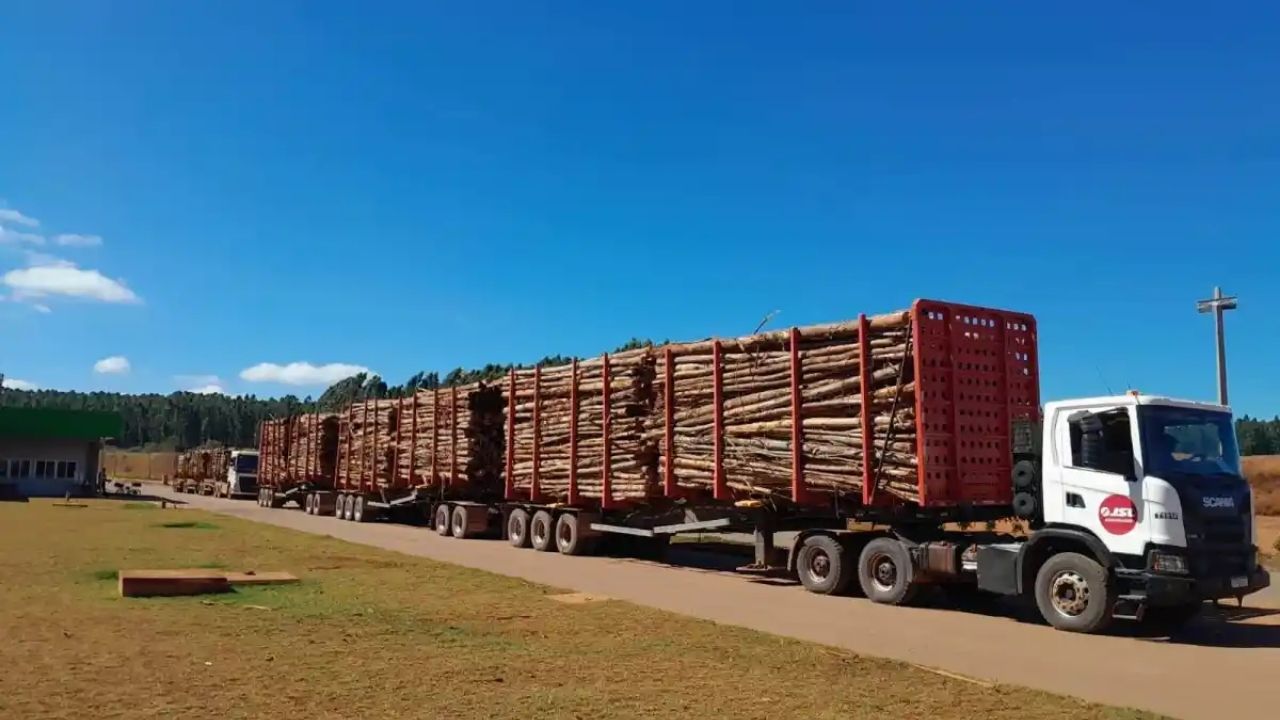
Each part of the Megatrem 2025 was designed to facilitate inspections and speed up the replacement of wear parts. According to Thiago Patrício de Oliveira, Director of Engineering and Innovation at Manos, the intention is to reduce downtime in the workshop and increase daily productivity.
In forestry operations, maintenance is not a detail: it is part of the economic outcome. A stopped set stops transporting wood, interferes with fleet planning, and can cause delays throughout the chain.
The source states that the new version seeks to improve the Total Cost of Ownership, also known as TCO. This involves not only the price of the implement but also maintenance, availability, tires, parts, consumption, and productivity over the years.
The reduction of components compared to previous configurations also aligns with this goal. Fewer axles and fewer wear elements can simplify the maintenance routine, provided the operation is suited to the equipment’s design.
Large size can reduce circulation of internal trucks
Manos argues that large compositions help reduce the volume of trucks circulating in operations, optimizing costs and maintenance. In the case of the Megatrem, the ability to carry six stacks of wood per trip reinforces this logic.
Fewer trips to transport the same volume can mean less internal traffic, less exposure to risks, and better logistical organization. This is an important argument in large farms and forest areas, where operational distances are significant.
The company also relates this type of solution to ESG principles, citing reduced accident risks, lower fuel consumption, and reduced emissions when transportation is optimized.
This relationship, however, depends on the actual operation. The environmental and economic gain needs to be measured according to route, load, type of truck, terrain, distance, and frequency of use. What the Megatrem proposes is a technical basis to seek this efficiency.
Brazilian forest transport enters a new scale
The arrival of the Megatrem 2025 in Mato Grosso do Sul and Minas Gerais shows that Brazilian forest transport is advancing towards increasingly specific and high-capacity compositions. The goal is not just to carry more, but to operate with stability, planned maintenance, and productivity.
The project also shows how forest logistics is incorporating international engineering, local adaptation, and a focus on internal routes. The wood that goes from the forest to the industry depends on equipment capable of withstanding load, terrain, and heavy pace.
Manos presents the Megatrem as part of a strategy to open new possibilities in forest transport. The partnership with Kennedy Trailers reinforces the attempt to combine Australian experience in road trains with the Brazilian demand for off-road implements.
Even so, the set requires a feasibility analysis before each application. A 50-meter and 240-ton equipment is not a generic solution for any road or farm, but a tool for large-scale operations and specific planning.
Megatrem shows how giant farms can change logistics
The Megatrem arrives as a symbol of a silent change in heavy wood transport. Instead of multiplying smaller trucks, large forest operations are beginning to seek longer, more stable compositions capable of transporting more logs per trip.
With 50 meters, 240 tons, six stacks of wood, and technology developed with the support of Kennedy Trailers, the implement tries to prove that scale can also mean efficiency. The challenge will be to show, in practice, whether the reduction of axles and high capacity compensate for the complexity of the operation.
For giant farms and controlled internal routes, the proposal may represent a new stage in Brazilian forest logistics. For smaller operations, the model still depends on structure, route, and technical feasibility.
And you, do you think giant implements like the Megatrem are the future of forest transport or do they increase complexity too much on farms? Leave your opinion in the comments and say if more load per trip is worth the size of this set.