






 Portuguese
  Spanish


At USP, researchers created a packaging that changes color to indicate when food spoils: made from cassava starch and anthocyanin extracted from grape skin, the biodegradable film changes from purple to blue when meat or fish begin to deteriorate.
What if the packaging itself could indicate that the meat is no longer good? That’s exactly what researchers at USP have developed. They created a packaging that changes color when the food starts to spoil, eliminating the need for a smell test when in doubt. The secret lies in a biodegradable film made from cassava starch, enhanced with anthocyanin, a natural pigment extracted from grape skin. When the meat or fish deteriorates, the film changes from purple to blue, providing a color warning.
The research was published by the Jornal da USP, which detailed the work of the Food Engineering Laboratory at Poli. The packaging combines two advantages: it is made from plant-based raw material and agro-industrial waste, grape skin, and also functions as a visual freshness sensor. Instead of common plastic that turns into waste, a material that protects the food and communicates with the buyer.
From purple to blue when the food spoils
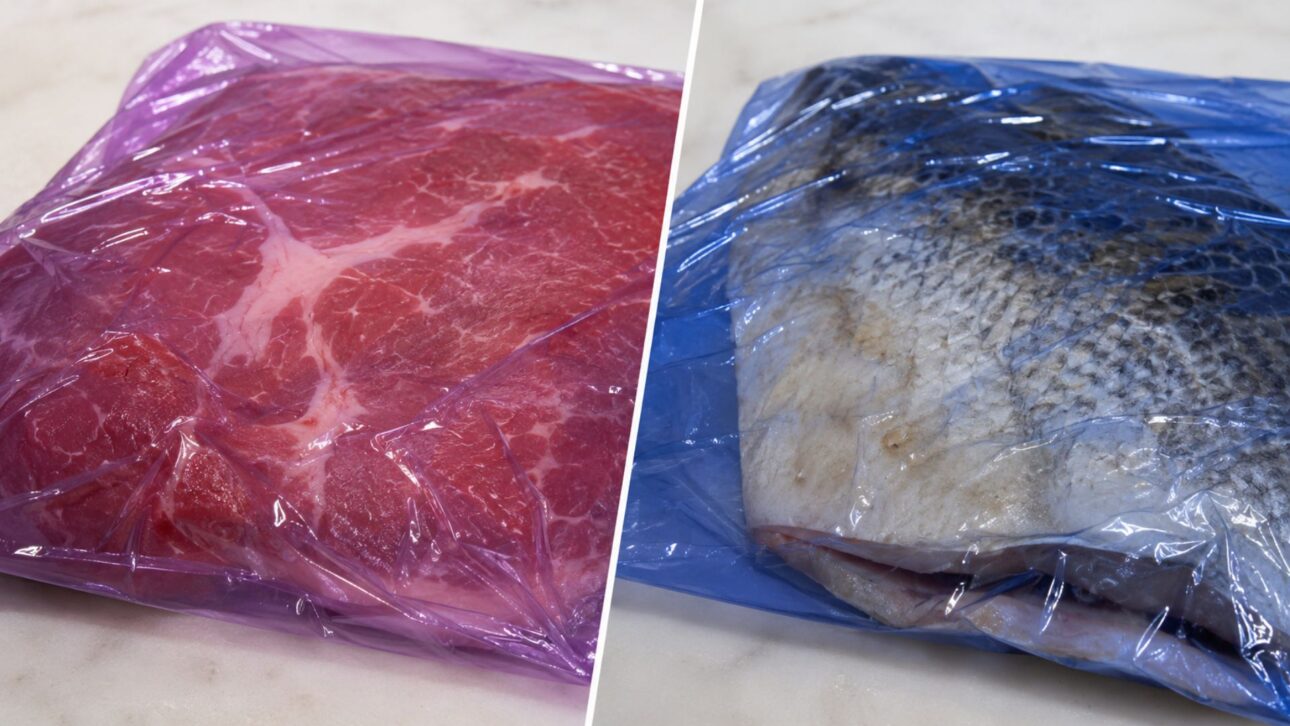
The color-changing packaging starts with a purple hue and, when the food inside deteriorates, turns blue.
-
Revolutionary Air Fryers: New Models Offer Up to 12 Liters Capacity, 10 Functions, and 90% Less Fat Starting at $80

-
New Helmet Rule in Brazil Requires Inmetro Digital Seal and QR Code from July 1, 2026, But Existing Helmets Are Exempt — Here’s What Changes and How to Verify Authenticity

-
Son of a traveling salesman, John D. Rockefeller used the 1873 financial crisis to acquire competitors, build an empire with 100,000 employees, and become the world’s first billionaire.

-
12-Year-Old Takes the Wheel After Mother Faints, Prevents Highway Tragedy in Brazil, Impresses Rescuers




No need to open, smell, or guess: the color of the packaging itself indicates if the meat or fish is still good. For the consumer, this means more safety when eating.
For the market, it means fewer people throwing away good food out of fear, and fewer people eating spoiled food by mistake. The color becomes an honest warning, right on the shelf.
Cassava Starch and Grape Peel
The recipe for the material combines two cheap and abundant ingredients in Brazil. The base is a flexible film made from cassava starch, a plant-based, biodegradable, and easy-to-produce raw material.
To this film, the researchers added anthocyanin, the natural purple pigment extracted from grape peel, which would normally be discarded by the industry. In other words, the grape peel left over from wine or juice becomes part of the solution.
Combining cassava starch with grape residue transforms two simple materials into a high-tech product. Sustainable from the base to the pigment.
Why Anthocyanin Changes Color
The magic of color has a chemical explanation. Anthocyanin, present in grape peel, is a substance that changes color according to the pH of the environment, that is, as the medium becomes more acidic or more basic.
When meat or fish starts to spoil, they release ammonia, which makes the environment more basic and turns the anthocyanin blue. This reaction transforms the film into a spoilage indicator.
Nature already gave the clue: the same substance that colors the grape now reveals spoiled food. Simple chemistry in the service of food safety.
The Researchers from Poli-USP
Behind the innovation is a team of women scientists. The work emerged from the Food Engineering Laboratory, LEA, at the Polytechnic School of USP, coordinated by Professor Carmen Cecilia Tadini.
Alongside her, researchers like Thaís Dale Vedove, a food engineer, and Bianca Chieregato Maniglia, a chemist, helped develop the biodegradable and smart packaging. The group studies how to use plant-based raw materials and agro-industrial residues to replace common plastic.
It’s Brazilian science, made at USP, targeting a global problem, and with researchers leading the way.
Active Packaging and Smart Packaging
The innovation fits into a frontier of the food sector. Modern packaging is divided into two types: active, which releases substances to better preserve food, and smart, which informs about the state of the food.
The color-changing packaging from USP is of the smart type because it detects spoilage and informs through anthocyanin, without any device. It’s not just a bag that protects; it’s packaging that communicates with the consumer.
This type of technology is seen as the future of the sector. And the Brazilian cassava film is precisely at this forefront.
Less plastic and less food waste
The impact of the idea goes beyond the pretty color. Being biodegradable and made from grape and cassava peel, the packaging reduces the use of common plastic, which takes centuries to decompose.
By indicating when the food is good or spoiled, it also helps cut down on food waste, one of the world’s biggest problems. Many people throw away still good food out of insecurity, and others eat what should have already been discarded.
A reliable visual indicator works on both sides. Less plastic in the landfill and less food in the trash, at the same time.
What the USP packaging shows
The biggest lesson is that sustainability and technology can fit in a small bag. The researchers at USP showed that it is possible to make packaging that changes color, is biodegradable, with cassava starch and grape residue.
Of course, it’s important to stay grounded. It is a technology developed in the laboratory, which still needs industrial scale and competitive cost to reach the supermarket in mass, so it is an advanced promise, not a product already on the shelves.
Even so, seeing a cassava film indicate, by color, that the meat is spoiled is the type of innovation that combines science, sustainability, and everyday utility. From discarded grape peel to an expiration sensor, USP transformed waste into a solution, and proved that the packaging of the future can be made of food and communicate with us.
And you, would you trust packaging that changes color to know if the meat is still good? Tell us in the comments what you think of this type of technology in food.


