Portuguese
  Spanish


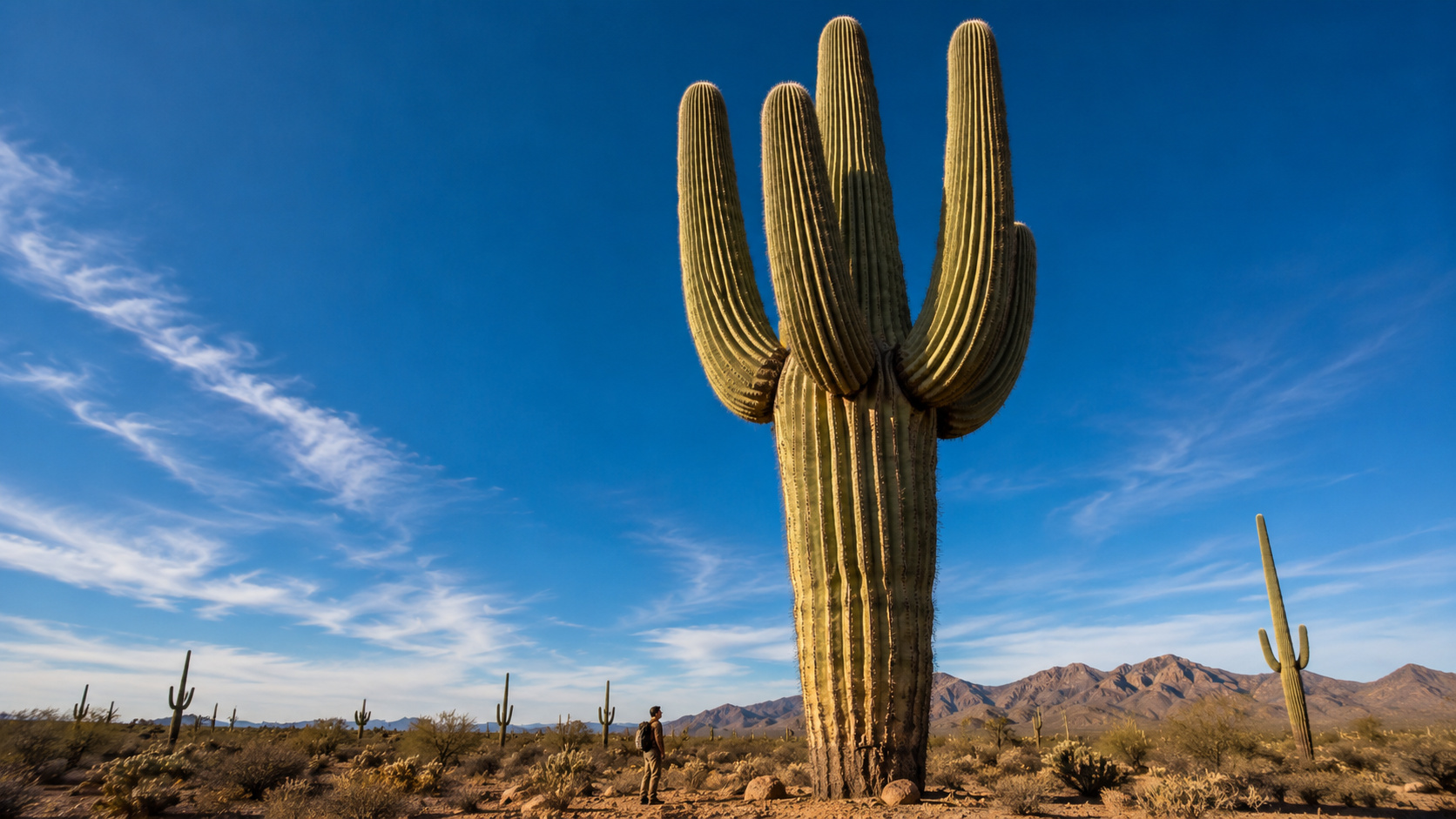

Saguaro is the largest cactus in the USA, can exceed 15 meters, weigh more than 2 tons, and store water to survive in the desert.
The saguaro, scientifically named Carnegiea gigantea, looks like a natural sculpture in the middle of the desert but functions as a true living reservoir. Native to the Sonoran Desert in the southwestern United States and northwestern Mexico, this giant cactus has become one of the most striking symbols of Arizona due to its size, longevity, and ability to store water in one of the harshest environments in North America. According to the National Park Service, the agency responsible for the national parks in the United States, the saguaro grows only in the Sonoran Desert, but not in all areas of this desert.
The appearance is impressive because the saguaro can reach about 50 feet in height, equivalent to just over 15 meters. According to the National Park Service, an adult specimen can weigh 2 tons or more and live, on average, from 150 to 175 years, although biologists believe some individuals may exceed 200 years.
Cactus can exceed 15 meters and weigh more than 2 tons when adult
The size of the saguaro is one of the main reasons the plant seems almost impossible. Unlike small garden cacti, this species grows like a giant green column, often with arms reaching upwards, forming the classic silhouette of North American western deserts.
-
Lifted by a delivery drone: in China, the same device that delivers your food order rescued a man trapped on the roof of a truck during a flood, securing the victim with a harness and taking him away from the water after a typhoon broke a dam in Guangxi.

-
China launches a 16-ton rocket that lands backwards, returns just 6 minutes after separation, and is captured by 4 hooks in a net at sea, challenging Elon Musk’s SpaceX technology.
-
Tired of seeing families sleeping on the street, São Paulo delivered 236 apartments and revealed who will receive the keys to a residential complex in the Center with nearby subway, full leisure facilities, and a structure that surprised the new residents.
-
Havan outside Brazil: Luciano Hang reveals hints about the first international store, mentions 2 countries, meeting with president, and logistical advantage that could accelerate the retailer’s historic expansion throughout Latin America


According to the Arizona-Sonora Desert Museum, the saguaro is the largest cactus in the United States and can grow from 10 to 40 feet in height, reaching in some cases up to 50 feet. The institution also informs that its roots can spread up to 100 feet in diameter, equivalent to about 30 meters, although they remain close to the surface.


This network of shallow roots is essential for survival. When rain falls, even in quick events, the saguaro can efficiently absorb water before the soil dries out again. Instead of relying on constant rain, it takes advantage of short windows of moisture to replenish its internal tissues.
The result is an organism adapted to scarcity. The trunk has folds similar to an accordion, which expand when the plant absorbs water and contract during dry periods. This structure allows the cactus to increase and decrease in volume as water availability changes.
More than 90% of the weight of a hydrated saguaro can be water
The ability to store water is the most impressive feature of the saguaro. The Arizona-Sonora Desert Museum reports that water makes up the majority of the plant’s weight and that a fully hydrated large stem can be more than 90% water, weighing about 80 pounds per foot, equivalent to approximately 120 kg per meter.
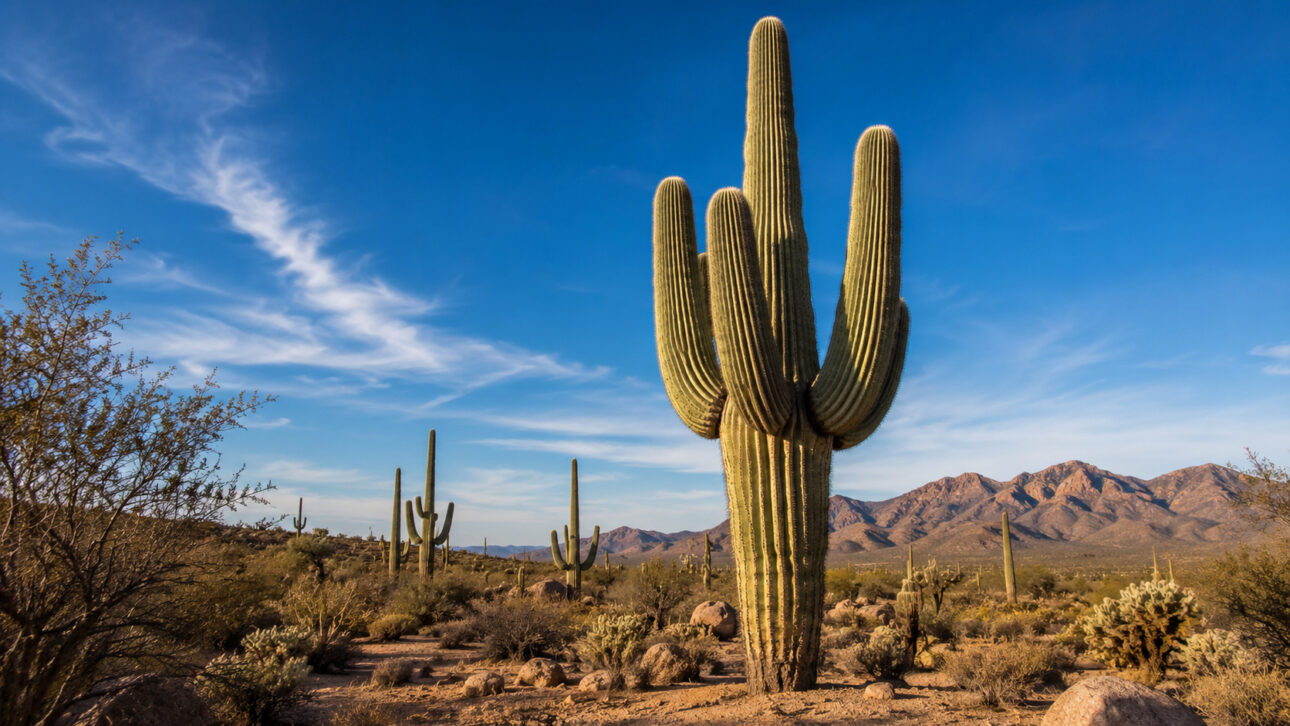
This fact helps explain why an adult saguaro can weigh over 2 tons. Much of this weight does not come from wood, but from living tissue full of water. In the desert, this internal reserve functions as a survival strategy against long periods without rain.
Protection against water loss is also on the outside of the plant. The Arizona-Sonora Desert Museum states that the saguaro has a waxy exterior, which helps retain stored water and makes the use of this resource more efficient.
The spines also play an important role, as they help protect the plant against thirsty animals and direct sun exposure.
Slow growth makes the saguaro take decades to develop arms
Despite its monumental size, the saguaro grows slowly. According to the National Park Service, in Saguaro National Park, studies show that the plant grows only between 1 and 1.5 inches in the first eight years of life. In approximate measurements, this means something between 2.5 cm and 3.8 cm in this initial period.
The development of arms also takes time. The National Park Service reports that arms usually start to appear between 50 and 70 years of age, but in drier regions, this process can take up to 100 years. Flowering begins around 35 years, and the saguaro is considered an adult around 125 years.
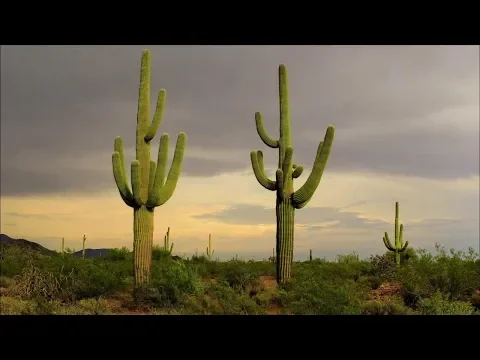
This means that many saguaros seen today in the desert began to grow before much of the region’s modern cities expanded. Some specimens were already alive when previous generations crossed Arizona on trails, wagons, and small communities in the middle of the arid environment.
This slow rhythm also makes the species vulnerable. The loss of adult specimens is not quickly replaced, because a new plant can take decades to occupy the same ecological role as a mature saguaro.
Flowers, fruits, and seeds sustain animals in the Sonoran Desert
The saguaro is not just a water reservoir. It also functions as an ecological base for various animals in the Sonoran Desert. According to the National Park Service, its flowers appear between late April and early June, open during the night, and close the following afternoon, needing to be pollinated in this short interval.
Pollination is done by nectar-feeding bats, birds, and insects. Then, the fruits form, and each can contain 2,000 to 3,500 small, dark seeds, according to the National Park Service. These fruits become an important food source in a landscape where water and food do not appear easily.
The Arizona-Sonora Desert Museum classifies the saguaro as a keystone species because many animals depend on it for food and shelter. The institution reports that birds, bats, tortoises, javelinas, coyotes, and other animals feed on its sweet red fruits. Some birds also dig cavities at the top of the plant to make nests.
These cavities can remain useful even after the first occupants leave. The Arizona-Sonora Desert Museum explains that the hardened interior of these cavities forms structures known as “saguaro boots,” which can later serve as shelter for other birds.
Arizona giant shows how life adapts to the lack of water
The saguaro draws attention because it combines three rare characteristics in a single plant: giant size, slow growth, and extreme drought resistance. It does not conquer the desert by trying to escape it but by using each rare rain as an opportunity to store water and stay alive for decades or even centuries.
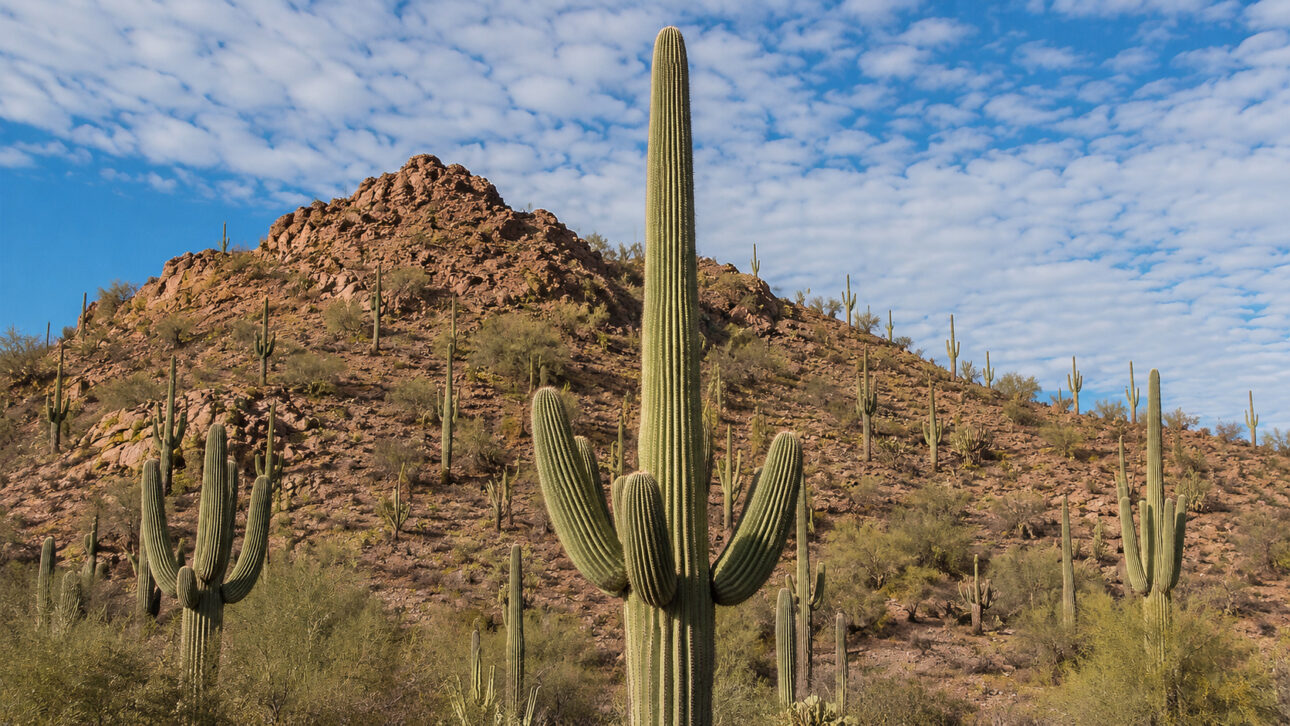
The image of a cactus over 15 meters tall standing in the middle of a dry landscape may seem just a beautiful scene, but it reveals sophisticated biological engineering. Shallow roots quickly capture rainwater, the expandable trunk stores liquid, the outer layer reduces losses, and the spines help protect the accumulated reserve.
For this reason, the saguaro has become more than just a visual symbol of Arizona. It is a central piece of the Sonoran Desert, sustaining animals, forming nests, producing fruits, and showing how life can adapt to environments where water appears infrequently, evaporates quickly, and is worth more than any other natural resource.