Portuguese
  Spanish


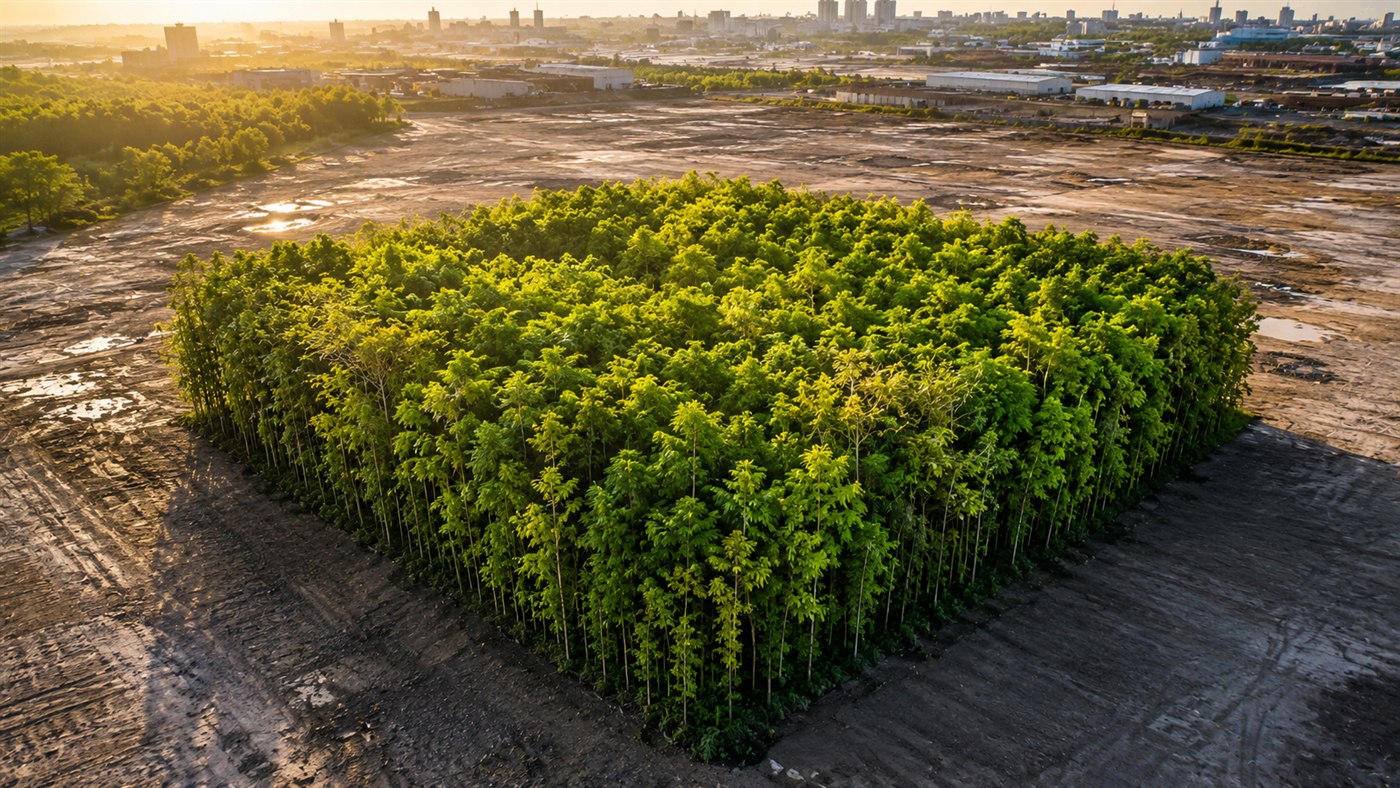

The record of Make Tech Future explores the idea behind the Miyawaki method, which botanist Akira Miyawaki derived from the sacred groves of Japan, the 3 years of intense care, the number that promises a mature forest in 20 years, and the scientific review of 2025 that put the legend to the test
Anyone who approaches one of the forests planted by Japanese botanist Akira Miyawaki discovers something strange: you can’t enter it. According to the channel Make Tech Future, in a documentary published in July 2026, the trees are so close together, shoulder to shoulder, that you would need to turn sideways to pass, and the Miyawaki method transformed areas of compacted industrial soil into dense green walls in about 20 years.
The number that opens the story is enough to startle any forestry manual. Where a commercial plantation places about 1,000 trees per hectare, the Miyawaki method manages to plant 30,000, sometimes 50,000, about 3 seedlings per square meter, and most are planted to die on purpose, as detailed by Make Tech Future. It is this competition for light that makes the survivors shoot upwards, and this is where the promise of a forest 10 times faster is born.
The grove behind the temples that kept the secret
The clue that started it all was hidden behind shrines. According to Make Tech Future, scattered around ancient Shinto temples are groves that the Japanese call Chinjuno Mori, deliberately left uncut, and the one behind the Kasuga Mountain shrine in Nara has been protected since the year 841, almost 1,200 years without logging.
-
Couple Converts Retired U.S. Navy Research Barge into Off-Grid Floating Home on Idaho Lake with DIY 3-Stage Water Filtration System Using UV Light

-
Brazilian Military Police Officer Turns Family Farm into Internationally Certified Guava Producer, Eyes Exports to UK, Portugal, and Canada After Cooperative Boosts Sales by 580%

-
Man Builds Entire Treehouse in 21 Days Without Spending a Cent, Using Free Wood Collected from the Forest, and Creates a Structure That Slowly Rotates Around Its Own Trunk
-
Latin America’s Largest Treated Water Reservoir Hidden Beneath São Paulo’s Coastal Hills Holds 110 Million Liters in Sugarloaf-like Rock Formation


This grove is a botanical time capsule. In about 250 hectares grow more than 175 species of trees, organized in four layers, from the broadleaf canopy to the ground of ferns, the most faithful portrait of what that land raises on its own when left in peace, as shown by Make Tech Future. For Miyawaki, these groves held the list of true native species of Japan, the basis of every native forest he would later attempt to recreate with the Miyawaki method.
The monoculture that replaced Japan’s native forest
Japan took the opposite path post-war. According to Make Tech Future, under a policy launched in the mid-1950s, teams planted between 100,000 and 110,000 hectares per year, often cutting down the native broadleaf forest to replace it with rows of two conifers, the sugi cedar and the hinoki cypress, cultivated solely for timber.
The result was a green desert. By the mid-1990s, the plantation covered about 10 million hectares, nearly 40% of all Japanese forests, but cheap imported wood took over the market, and today about 80% of the wood Japan uses comes from abroad, as Make Tech Future records. Without being cut, these shallow-rooted plantations poorly hold the slopes, the opposite of the service a true native forest provides.
30 thousand trees where a thousand would fit: the logic of the Miyawaki method

The turnaround came from a steel company. According to Make Tech Future, Nippon Steel wanted to forest the land of its plant in Oita, and Miyawaki proposed something that sounded reckless: no rows, but dozens of native species crammed as they grew around temples, left to compete for life.
Then he reversed almost everything forestry preached. Instead of a few species, the Miyawaki method uses 50 to 100 native plants in a single lot, divided into the same four layers of sacred groves, from the canopy to the ground, and the seedlings are planted small, about 80 centimeters, and absurdly close, an entire forest at once instead of a timber stock, as Make Tech Future explains. Before that, however, the dead and compacted soil receives straw and plant debris until the roots can go deep, the step that supports the native grove that will sprout there.
The 3 years of nursery and the exact moment to leave
The tightness has a labor cost in the early years. According to Make Tech Future, as soon as the seedlings are planted, the team covers the ground with a thick blanket of straw or wood chips that retains water, suffocates weeds, and rots into food, and for 3 years the lot is managed like a nursery, with deep watering, hand weeding, and replacement of dead seedlings.
The deadline has an exact explanation. Around the third summer, the canopies close into a continuous canopy, light stops reaching the ground, the weeds that need sun die, and the trees start feeding on their own fallen leaves, and it is at this point that Miyawaki leaves the land for good, never watering, weeding, or pruning again, as Make Tech Future shows. The native species of the Miyawaki method continue on their own because, crammed together, they can only grow in one direction, upwards, and they also create a humid microclimate that speeds everything up.
Grow 10 times faster: the number that divided science

The pace is the part that seems like fiction. According to Make Tech Future, seedlings of the Miyawaki method were timed growing about 1 meter in height per year, roughly 10 times a common plantation, and 20 to 30 years later, proponents claim to have something that behaves like a forest that would normally take two centuries.
The initial numbers silenced some of the criticism. The forests of the method reached in 20 to 30 years a condition that the common way took one to two centuries to approach, with survival near 90%, more density and more fauna, besides holding the soil and resisting storms and drought better, as Make Tech Future describes. It was this data collection that led the Miyawaki method to the Blue Planet Prize in 2006, the highest award in environmental science, the first given to a Japanese person.
The counterpoint: what the 2025 scientific review found
The legend, however, recently hit a brake. According to Make Tech Future, in December 2025 researchers gathered all the studies they found on the method, 51 documents, and saw that only about 41% provided hard numbers, only a third used proper control, and barely one in seven repeated the experiment to confirm.
The weak point appeared precisely in what matters most. Among the studies claiming these forests store more carbon, only two measured the carbon in the soil, and none found a clear advantage over the common plantation, while an estimate put a forest of the method in the UK at about 1.3 million dollars per hectare, against 143 dollars per hectare for just protecting the vegetation that was already struggling to return, as the Make Tech Future channel on YouTube reports. On the island of Sardinia, a long study saw most seedlings dead in 12 years, a reminder that results vary greatly with the hand and the place.
From Japan to the Amazon: 40 million trees and the microforests in Brazil


The scope of the work is difficult to discuss. According to Make Tech Future, throughout his career, Miyawaki guided the planting of more than 40 million native trees in about 1,700 locations, more than 1,400 of them in Japan and the rest spread across about 15 countries, from Borneo to the Amazon, from Kenya to the foot of the Great Wall of China, until he passed away in 2021, at the age of 93.
The echo reached Brazil and serves as a local connection. The Miyawaki method inspires urban microforests planted in Brazilian cities like São Paulo, small native groves the size of a room in schools, squares, and vacant lots, using the same recipe of squeezing native species to accelerate the native forest, a well-known environmental context in the country. Here, as there, the pocket forest works best in what the documentary itself points out as its strength, recovering small and degraded land where there was once vegetation, and not as a cheap silver bullet for any ground.
The video explores the sacred groves of Japan, the logic of 30,000 trees per hectare, the 3 years of care, the scientific review of 2025 and the legacy of more than 40 million trees.
Akira Miyawaki’s story shows that perhaps we overestimate how much nature needs us and underestimate the speed with which scorched earth recovers when given space. Tell us in the comments: would you plant a native microforest in your city’s land?