





 Portuguese
  English
  Spanish
  7 min of reading
  0 comments


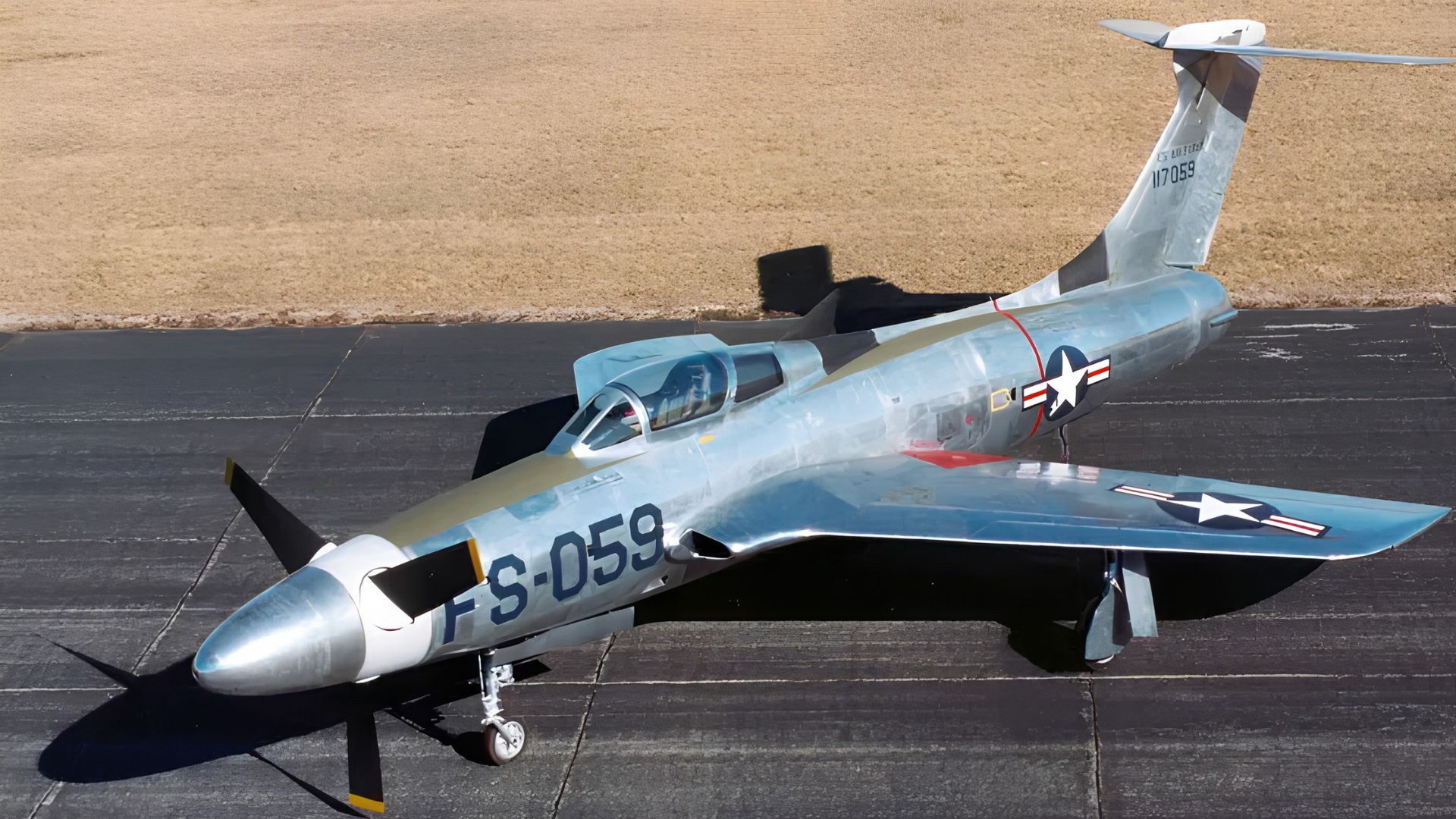
Republic XF-84H Thunderscreech was the loudest propeller plane ever tested, with blade tips at Mach 1.18, 12 flights, and 11 emergency landings.
In July 1955, the control tower at Edwards Air Force Base, California, began receiving complaints from residents due to extreme noise. The sound came from homes up to 40 kilometers from the base, and the plane responsible hadn’t even taken off: its engine was merely running on the runway, completing the mandatory 30-minute warm-up before flight. In the tower, operators noticed that vibrations were damaging sensitive components of the control equipment. To communicate with the ground crew, they began using light signals, as speaking over the radio had become practically impossible while the engine was running.
The aircraft was the Republic XF-84H Thunderscreech, recognized by Guinness World Records as probably the loudest aircraft ever flown. Between July 1955 and October 1956, it performed 12 test missions, 11 of which ended in emergency landings.
Republic XF-84H Thunderscreech was born from the attempt to combine jet speed with propeller endurance
To understand the Thunderscreech, one must observe the time it was conceived. In the mid-1950s, jets were redefining military aviation, while propeller fighters seemed doomed to the past.
-
Japan spent decades avoiding the export of major military assets, but is now negotiating the sale of used Asagiri destroyers to expand naval cooperation with Indonesia.

-
In 1902, hundreds of children planted 242 seedlings in the interior of São Paulo and created the first ecological act in Latin America, giving rise to a historic celebration, inspiring Arbor Day in Brazil, and transforming Araras into a national green symbol.

-
Beneath the streets of Rome, there was a 1,700-year-old Roman barracks with 39 rooms, mosaics, frescoes, and remnants of the imperial guard; the discovery altered the Line C metro project and forced engineers to dismantle the ruins to reconstruct them inside the station.
-
Iron beads found in pre-dynastic tombs in Egypt were made from metal that came from space, scientists confirmed by detecting nickel, cobalt, and germanium typical of meteorites, in material used in necklaces over 5,000 years ago, before the Iron Age itself.


The problem was that early jet engines consumed a lot of fuel. For long missions, such as bomber escort, maritime patrol, and naval force support, a turboprop aircraft could combine high speed and greater endurance.


Republic Aviation, manufacturer of the F-84 Thunderstreak, proposed an experimental turboprop version. The idea was to use the F-84F fuselage and wings, but replace the conventional jet with an Allison XT40-A-1 turbine of 5,850 horsepower.
XF-84H’s supersonic propeller made blade tips spin at Mach 1.18
The Allison XT40-A-1 engine spun at 14,300 rpm. Through the reduction gearbox, the propeller received this power and spun at approximately 3,000 rpm, with three blades and a diameter of 3.66 meters.
According to research by John Leonard of the Rolls-Royce Heritage Trust, the last 60 centimeters of the blades traveled at Mach 1.18, or 18% above the speed of sound, even at normal cruising rotation. This happened from the moment the engine was started until it was shut down.
In practice, each propeller tip produced continuous shock waves, like small sonic booms repeated at high frequency. With three blades in supersonic regime, the Thunderscreech created a constant curtain of acoustic pressure around the aircraft.
Thunderscreech’s sound caused vibrations, infrasound, and physiological risk to those who approached
The XF-84H’s noise was not just loud sound. The combination of turbine, supersonic propeller, and shock waves created an acoustic spectrum ranging from audible frequencies to infrasonic components, felt as physical vibration in the body.

This acoustic pressure field was strong enough to incapacitate nearby people. A Republic engineer suffered a seizure after approaching the aircraft with the engine running, according to records associated with the program.
The case suggests that the sound produced did not only affect hearing. Infrasonic waves could cause disorientation, nausea, imbalance, and neurological disturbances, effects incompatible with an operational air base.
Mechanic inside a C-47 was incapacitated during XF-84H engine test
One of the most cited episodes occurred during a ground engine warm-up session. The procedure lasted 30 minutes and was mandatory before each flight.
Next to the XF-84H was a parked Douglas C-47 Skytrain. Inside, a mechanic was performing internal cleaning and maintenance, unaware of the Thunderscreech team’s presence.
When the engine was shut down, the team heard noise coming from the C-47 and found the mechanic on the ground, incapacitated and disoriented. After this episode, the base determined that the XF-84H should be towed away from the main runway before starting the engine.
Test pilots rejected the Thunderscreech after unstable flights and severe vibrations
The XF-84H’s maiden flight took place on July 22, 1955, with test pilot Hank Baird at the controls. The flight confirmed that the aircraft could fly, but also immediately revealed the problems that would mark the program.

The engine required 30 minutes of warm-up, the gearbox was prone to failure, and the propeller pitch system showed instability. Additionally, vibrations generated by shockwaves affected the airframe and cockpit.
On one of the subsequent missions, pilot Lin Hendrix landed and told chief engineer Jim Rust that no one at Republic would be big or numerous enough to make him get back into that plane. It wasn’t a lack of courage, but a technical assessment of the flight condition.
Eleven emergency landings in twelve flights sealed the experimental aircraft’s fate
The Republic XF-84H performed only 12 test flights between 1955 and 1956. Of these, 11 ended in emergency landings, a rate that made the program virtually indefensible.
The problems mainly stemmed from the reduction gearbox, the propeller pitch control, and structural vibrations. When the pitch system failed, aerodynamic forces became difficult to control, requiring immediate pilot reaction.
Maintenance was also heavy after each flight. Components designed to last hundreds of hours degraded quickly, and the team had to work under severe restrictions due to the aircraft’s acoustic risk.
XF-84H was fast, but its record did not compensate for operational failure
Despite the problems, the Thunderscreech was genuinely fast. The official maximum speed recorded was 837 km/h, making the XF-84H the fastest single-engine propeller aircraft ever built up to that point.

The record stood for 34 years, until 1989, when the modified Grumman F8F Bearcat “Rare Bear” reached 850 km/h in an air race in Reno, Nevada.
The XF-84H’s problem was never speed. The aircraft achieved impressive performance, but the operational cost, extreme noise, constant emergencies, and unfeasible maintenance made the project impossible to continue.
Two XF-84H prototypes survived after program cancellation
Two XF-84H prototypes were built at the Republic factory in Farmingdale, New York, and shipped by train to Edwards Air Force Base. The first, serial number 51-9307, performed most of the 12 test flights.
The second, serial number 51-9308, was primarily used for static tests and ground engine evaluations. After the program’s cancellation, both aircraft were preserved.
The first prototype is displayed at the National Museum of the United States Air Force in Dayton, Ohio. The second was transferred to the California Aerospace Museum in Sacramento, where it also remains on display.
Thunderscreech became an extreme reference in aeronautical acoustics and high-speed propellers
The XF-84H did not directly influence any subsequent fighter. The concept of a very high-speed turboprop was abandoned when jets began to better solve range problems with external tanks and in-flight refueling.

Still, the program data was useful for studies of propellers in supersonic regimes and extreme acoustic behavior. The information helped researchers understand the limits of rotors, thrusters, and structures subjected to repeated shock waves.
The aircraft also went down in history as one of the greatest extremes of experimental aviation. No subsequent program seriously attempted to claim the title of the loudest aircraft ever flown.
Republic XF-84H Technical Specifications Reveal a Fast, Heavy, and Nearly Impossible-to-Operate Aircraft
The XF-84H was 15.67 meters long, had a wingspan of 10.18 meters, and stood 4.67 meters tall. Its empty weight was 8,115 kg, and its maximum takeoff weight reached 12,270 kg.
The Allison XT40-A-1 engine delivered 5,850 hp, driving a three-bladed propeller with a 3.66-meter diameter. The official maximum speed was 837 km/h, with a service ceiling of 12,192 meters and an estimated range of over 3,200 km.
The technical specifications seemed promising on paper. But the actual track record was devastating: 12 flights, 11 emergencies, and about six total accumulated flight hours across both prototypes.
The XF-84H Proved That Not Every Technical Record Becomes a Military Advancement
The Thunderscreech belongs to the category of projects that did not fail due to a completely absurd idea, but because they encountered physical limits that the theory of the time did not fully anticipate. Turboprops continued to be useful in aircraft such as the Tupolev Tu-114 and the Lockheed P-3 Orion.
The problem with the XF-84H was the specific combination of power, rotation, and propeller diameter, which pushed the blade tips into a continuous supersonic regime. This created an acoustic field incompatible with pilots, mechanics, air traffic control, and normal air base operations.
The aircraft set a speed record, actually flew, and demonstrated extreme power. But it also caused seizures in an engineer, incapacitated a mechanic, damaged equipment, and was canceled before becoming anything more than a historical warning: a supersonic propeller can work, but no one should build one without controlling the sound it creates.





Be the first to react!