Portuguese
  Spanish


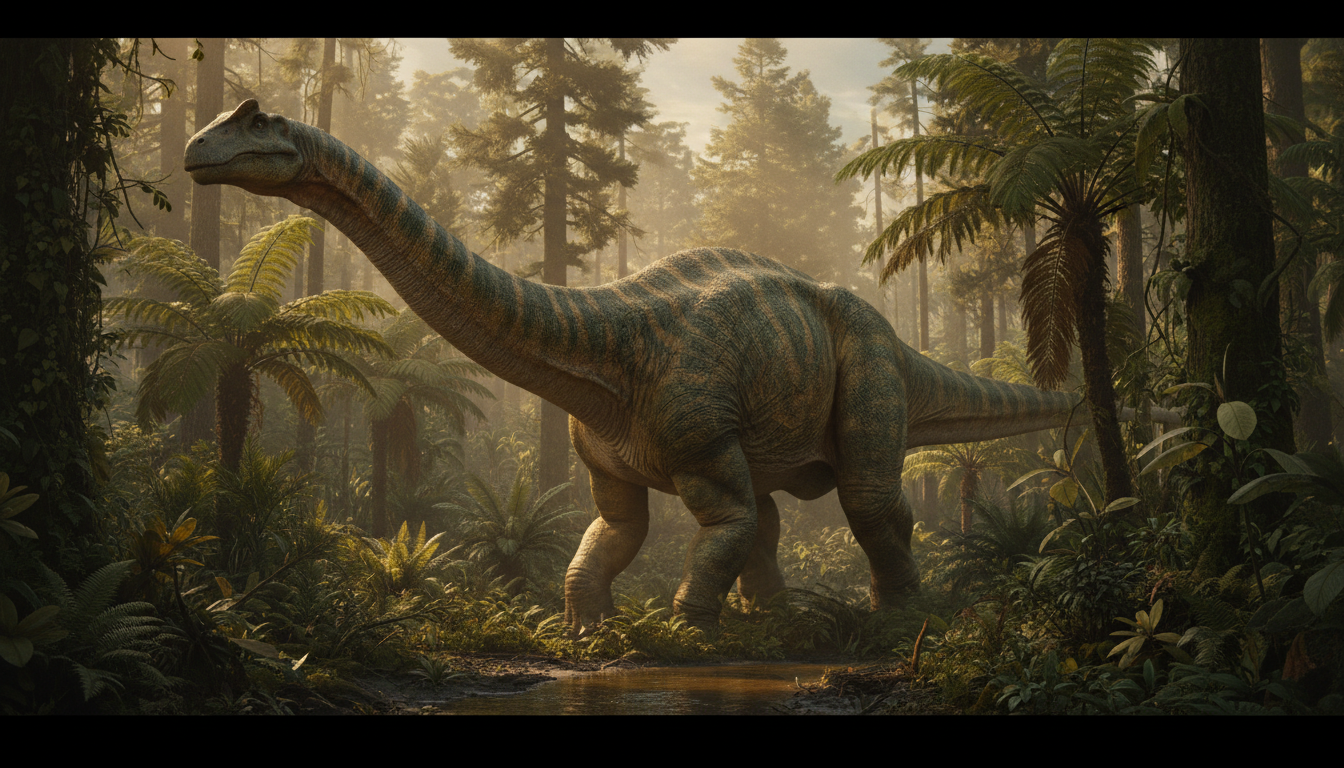

Naming of Dasosaurus tocantinensis, the 20-meter-long titanosaur with a 1.5-meter femur found by chance in 2021 during road-rail works in Davinópolis — and the analysis revealed a relationship with a Spanish species, proving that dinosaurs crossed between continents 120 million years ago
Workers found a 1.5-meter bone during the construction of a road-rail terminal in the interior of Maranhão. They called paleontologists. Days of excavation later, the team discovered that it was the femur of a giant dinosaur approximately 20 meters long that lived 120 million years ago.
The animal was named Dasosaurus tocantinensis and described in a study published in March 2026 in the Journal of Systematic Palaeontology. The research, led by paleontologist Elver Mayer from Univasf, revealed that the Brazilian dinosaur is a close relative of a species found in Spain — evidence that giant herbivores crossed between continents when South America and Europe were still connected.
“As the excavation progressed over the days, we began to see evidence of that enormous bone, which is the femur”, said Leonardo Kerber, paleontologist from UFSM, to CNN Brasil.
-
At 17, she hand-painted her first watercolor design for school uniforms; her brand grew without investors, sold 135,000 pieces, and aims for $3 million in revenue by 2026.

-
Shell Discovers Intact Early 19th-Century Wooden Shipwreck in the Gulf of Mexico at Over 1,300 Meters Deep
-
Brazilian Researcher Develops Protein Supplement from Tilapia Waste, Combining Innovation and Sustainability with Economic Potential

-
Women in São Paulo Unknowingly Tracked by Coin-Sized Tags Hidden in Cars and Belongings, Raising Stalking Concerns


Dasosaurus: the dinosaur of the Maranhão forest
The name Dasosaurus tocantinensis carries the identity of the find. “‘Dasosaurus’ means forest dinosaur, in reference to the Legal Amazon, of which Maranhão is a part. ‘Tocantinensis’ refers to the Tocantina region, where it was found”, explains Manuel Alfredo, professor and paleontologist from UFMA, according to the UFMA portal.
The animal belongs to the group of titanosauriforms, long-necked herbivorous sauropods that dominated Cretaceous ecosystems. With its estimated 20 meters, it is one of the largest dinosaurs ever found in Brazil.
The fossils were preserved in the Itapecuru Formation, a rock layer from the Lower Cretaceous dated to the Aptian (about 120 million years ago). In addition to the 1.5-meter femur, the team recovered tail vertebrae, ribs, forearm bones, pelvis, tibia, fibula, and foot bones.
- Name: Dasosaurus tocantinensis (“forest dinosaur of Tocantins”)
- Estimated size: ~20 meters in length
- Femur: ~1.5 meters
- Age: ~120 million years (Lower Cretaceous, Aptian)
- Location: Davinópolis, Maranhão, Itapecuru Formation
- Group: titanosauriforms (herbivorous sauropods)
- Publication: Journal of Systematic Palaeontology, March/2026

An accidental discovery at a construction site
The Dasosaurus was not found during a planned scientific expedition. The fossils appeared in 2021, during routine paleontological monitoring at the construction of a road-rail terminal near Davinópolis.
Brazilian legislation requires that large infrastructure projects conduct paleontological monitoring during excavations. Thus, when workers noticed bone structures in the red soil of Maranhão, the scientific team was already present to assess.
The excavation lasted days. As the researchers removed layers of sediment, the size of the femur became impressive. Kerber describes the moment as progressive: first a fragment appeared, then it became evident that it was something monumental.
Maranhão is already known for other significant paleontological finds. The recent discovery of another dinosaur species in the region reinforces the state’s potential as a hub of Brazilian paleontology.

The Spanish cousin that connects Brazil and Europe
The biggest surprise came from the phylogenetic analysis. The Dasosaurus tocantinensis is the closest known relative of the Garumbatitan morellensis, a species described in Spain. The similarities appear in details of the tail vertebrae and the femur.
About 120 million years ago, South America and Europe still maintained land routes connected via Africa. Giant herbivorous dinosaurs could migrate between what is now Maranhão and the Iberian Peninsula. The definitive separation of the continents was only completed millions of years later.
Therefore, the Dasosaurus occupies a strategic position in the evolutionary tree: it is an intermediate form between basal titanosaurs and the advanced ones that would dominate South America at the end of the Cretaceous. Three crests on the tail vertebrae and a protrusion on the femur are the unique characteristics that distinguish it from all other known sauropods.
The Brazil-Spain connection via dinosaurs is not entirely unprecedented. The report by Agência FAPESP details how similar patterns of dispersal have been observed in other groups of Gondwanan sauropods.

The Brazilian team behind the research
The study was led by Elver Mayer from Universidade Federal do Vale do São Francisco (Univasf). Contributions include Leonardo Kerber from UFSM, and Manuel Alfredo from UFMA. The team brings together researchers from multiple Brazilian institutions.
Furthermore, the publication in the Journal of Systematic Palaeontology places Maranhão’s paleontology in a high-impact international journal. Other recent findings, such as the fossil of a prehistoric species in the interior of Brazil, show that the Northeast holds a still underexplored fossil collection.

Caveats and limitations of the study
The estimate of 20 meters in length is primarily based on the 1.5-meter femur and comparisons with known relatives. This projection introduces a margin of error, as there is no complete skeleton.
The fossils belong to a single individual, which limits inferences about variation within the species. The diet is inferred to be herbivorous based on the taxonomic group, without direct evidence such as preserved stomach contents.
The phylogenetic relationships with the Spanish Garumbatitan depend on specific bone characteristics. New discoveries may alter this position on the evolutionary tree. Nevertheless, the team considers the finding to be one of the most significant paleontological discoveries in Maranhão. For more details, it is worth consulting the full report from G1 and the coverage from Metrópoles.