






 Portuguese
  Spanish


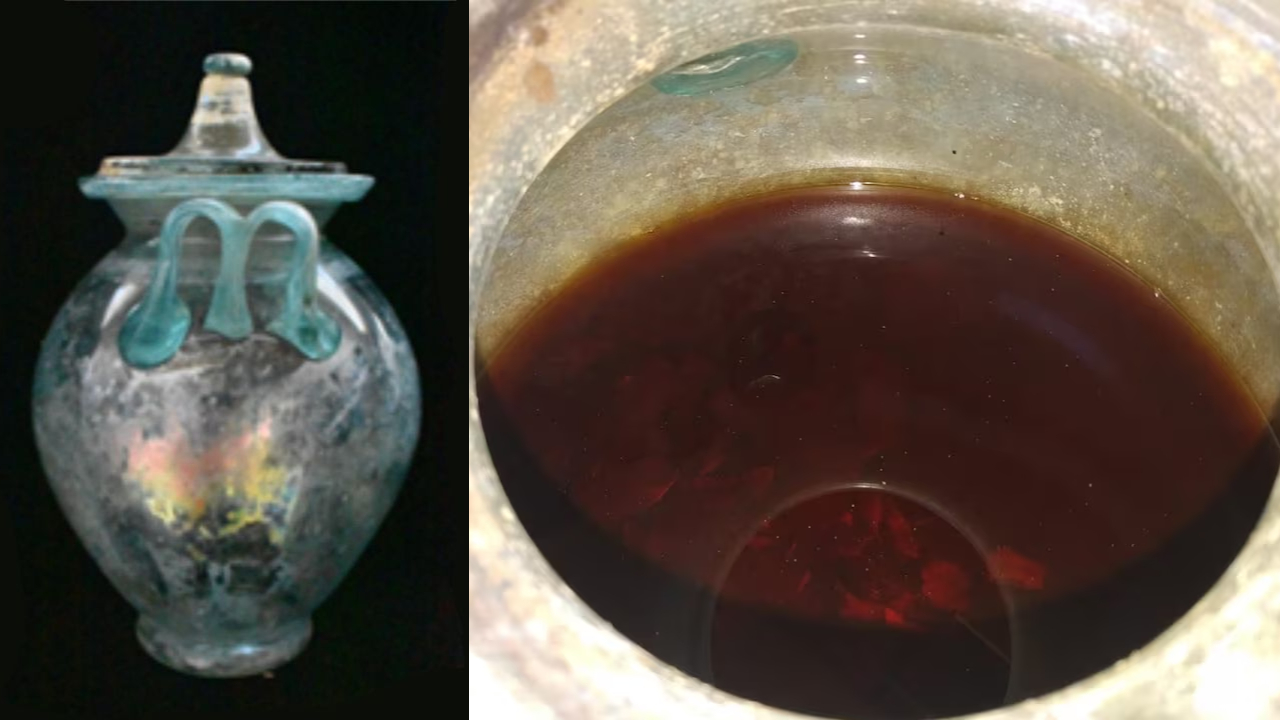

Archeologists found in Spain the oldest liquid wine in the world in a Roman funeral urn with cremated remains and almost 5 liters preserved.
A reddish-brown liquid found inside a Roman funeral urn in Carmona, Andalusia, was identified by researchers as the oldest confirmed liquid wine in the world. The material was mixed with cremated human remains and remained preserved for about 2,000 years, in a tomb likely built in the first half of the 1st century AD, surpassing the record previously attributed to the so-called Speyer Bottle from Germany.
The discovery came to light after construction work in a city house in 2019, when archeologists identified a subterranean Roman mausoleum that had remained sealed, hidden, and unsacked for centuries. This exceptional state of preservation was crucial for the liquid to survive in its original state for so long.
How the Roman tomb of Carmona preserved the oldest liquid wine ever found by archeology
The tomb of Carmona did not attract attention due to a visible monument on the surface, but quite the opposite. The mausoleum was carved into the rock, below ground, which helped protect it against looting, infiltration, and severe alterations over the centuries.
-
Mother from Brazil’s Maranhão Creates Lactose-Free Cookie for Daughter with Cerebral Palsy, Now Producing 10 Tons Annually and Exporting to Mexico

-
Brazilian Student Turns Electric Shower Repair into Thriving Industry with 3,600 Jobs and Over $1 Billion in Revenue, Aiming to Become the “Next WEG”

-
German Ship Concludes 40-Year Maritime Career with Final Mission in Brazil, Departing Recife with Floating Labs to Study Atlantic Currents
-
Artisanal Well Transforms 4 Hectares in Brazil’s Semi-Arid Region into Productive Farmland with Drip Irrigation


The archeochemical study shows that the funerary chamber had eight niches, of which six contained urns with cremated remains and funerary objects. Researchers also suggest that the ensemble likely belonged to a high-status family from ancient Carmo, the Roman name for Carmona.
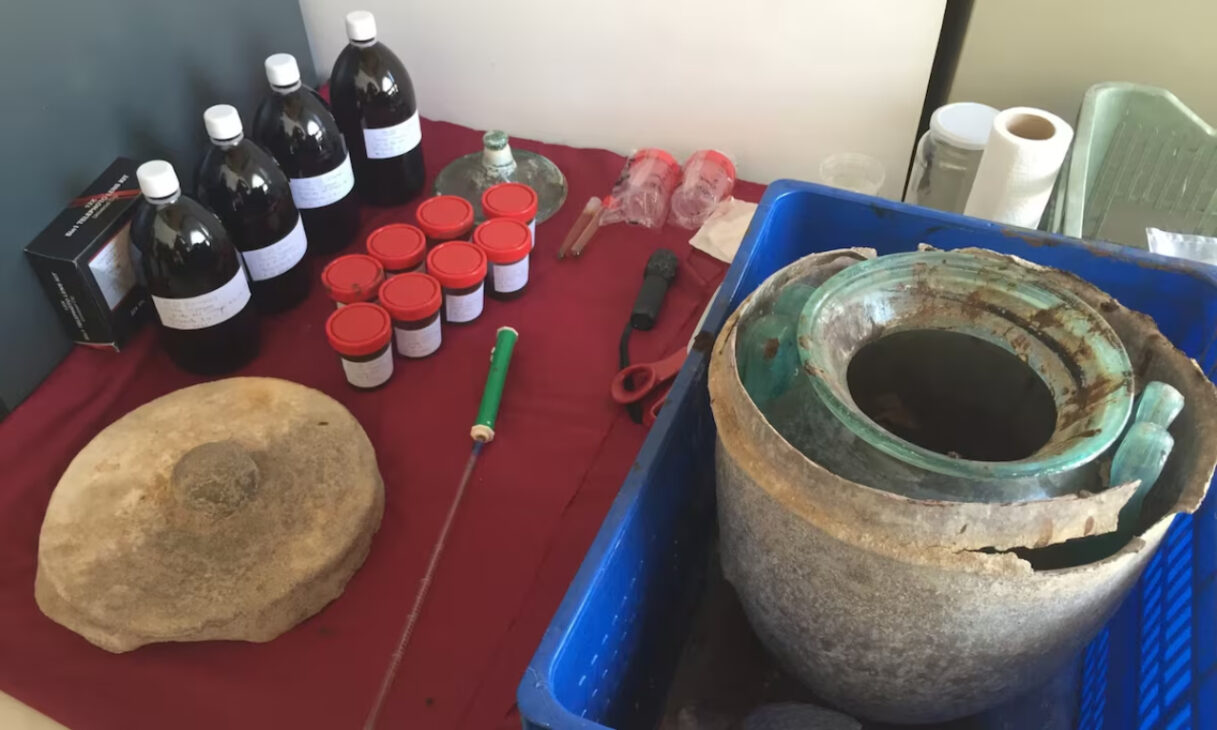
It was this combination of underground burial, efficient sealing, and absence of violation that allowed for rare preservation. In an archeological scenario where liquids almost always disappear or degrade completely, the case of Carmona became extraordinary precisely because the urn remained intact for about 2,000 years.
What was inside the Roman funerary urn and why the liquid was identified as white wine
The decisive urn for the discovery was in niche 8. It was made of glass, was inside a lead casing, and contained about 5 liters of a reddish liquid, as well as cremated bones of a man and a gold ring engraved with the image of Janus Bifrons, a Roman deity with two faces.
Laboratory analysis indicated that the liquid had a pH of 7.5, a sign of intense degradation compared to current wines. Even so, the team managed to detect chemical compounds characteristic of wine, especially polyphenols, using techniques such as chromatography and mass spectrometry.
Although the current color is dark, the authors concluded that it was originally white wine. The key to this identification was the absence of syringic acid, a compound associated with the decomposition of red wines, as well as the mineral and chemical compatibility with wines historically produced in ancient Roman Baetica.
Why the find in Carmona became the oldest liquid wine in the world confirmed by chemical analysis
Before the Spanish discovery, the most well-known record was the Speyer Bottle, found in 1867 in Germany and dated to the 4th century AD. The difference with Carmona, however, lies in the fact that the content underwent direct chemical analysis, which provided a scientific basis to classify it as the oldest liquid wine ever confirmed.
The article in the Journal of Archaeological emphasizes that, until then, studies on ancient Roman wines were mainly based on residues adsorbed in containers or degraded remains, not on a preserved liquid sample. This makes the Carmona urn a unique case for both archaeology and chemistry applied to historical heritage.


The result also reinforces the importance of the archaeological context. It was not just the liquid that survived, but the entire funerary environment that remained coherent, allowing for the cross-referencing of chemical data, the structure of the tomb, and objects found inside the chamber.
What the Roman tomb reveals about funerary rituals, cremated remains, and elite trousseau in Roman Spain
The burial chamber housed the remains of six individuals, with male and female urns distributed in different niches. In two of them, inscriptions preserved the names Hispanae and Senicio, a rare detail for a find of this type and important for reconstructing the family context of the mausoleum.
The objects found also help reveal the social status of the buried individuals. In another glass urn, archaeologists located Baltic amber, fabric fragments, and a container with solidified perfume residues, whose chemical composition had already been associated with patchouli in previous research on the same tomb.
In this scenario, the wine does not appear as an isolated detail, but as part of a ritual set. The study highlights that the use of wine in Roman funerary practices is known and documented, which makes it plausible that the urn was filled with wine as part of the burial ceremony or a libation linked to the passage to the afterlife.
Where this Roman wine might have come from and why the discovery does not turn the urn into a beverage
Researchers did not identify an exact commercial origin for the wine, but concluded that the mineral profile of the liquid is comparable to that of fine wines currently produced in the Jerez region, in southern Spain.
In other words, the find suggests a strong connection with the winemaking tradition of ancient Baetica, but does not allow for pinpointing a precise origin as if it were a modern label.

The discovery should also not be treated as a gastronomic curiosity. Although the analysis allowed for identifying the liquid as wine and the Smithsonian reports that the researcher mentioned the absence of microbiological toxicity, the sample remained for about 2,000 years in direct contact with cremated human remains, in addition to showing evident signs of deep chemical transformation.
Therefore, the value of the find lies in the historical information it preserves. More than an ancient wine, the urn from Carmona serves as a rare window into funerary rituals, material culture, and winemaking of Roman Spain, showing how an unlikely liquid managed to cross two millennia and reach contemporary science.


