Portuguese
  Spanish


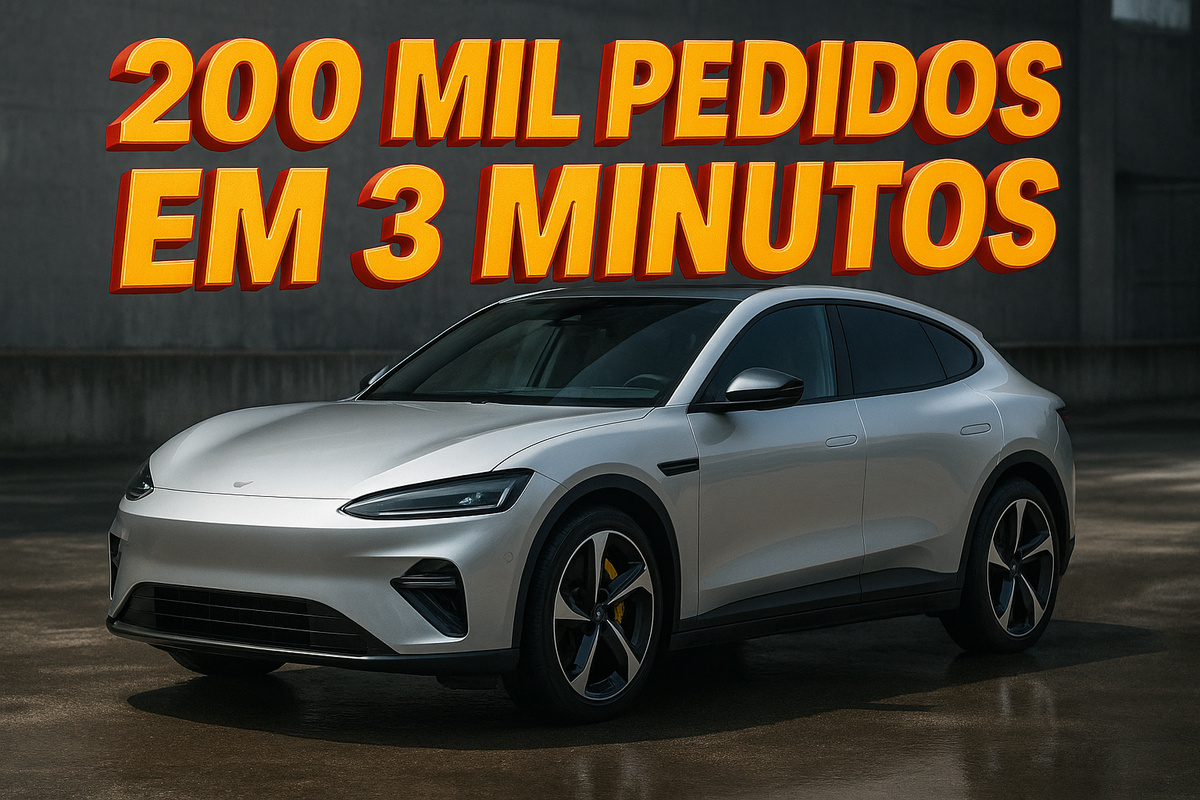

Xiaomi SUV Breaks Reservation Records in June 2025 and Reinforces Brand Ambition in the Electric Car Market
On June 26, 2025, Xiaomi surprised the automotive industry by launching the pre-sale of the YU7 electric SUV in China. As an immediate consequence, the model received 200,000 orders in just 3 minutes. This achievement demonstrates the brand’s strength in the electrified vehicle sector. Furthermore, it proves that consumers are betting on new proposals that offer performance combined with innovation.
According to data released by the company and the portal CnEVPost, the response was instant. This occurred because the YU7 delivers power, bold design, and cutting-edge technology. For this reason, the SUV already occupies a prominent space in the highlights of electric mobility in 2025.
High Power, Sports Car Acceleration, and Impressive Range
The YU7 impresses in every technical detail. Therefore, Xiaomi equipped the model with two motors — one front and one rear — that together offer more than 680 horsepower. This setup allows the SUV to accelerate from 0 to 100 km/h in less than 3 seconds.
-
End of the Affordable Car Era: Fiat Argo 1.0 2026 Offers 14.7 km/l Efficiency and Easy Maintenance, but $18,000 Price Raises Cost-Benefit Concerns

-
Honda XR 300L Tornado Special Edition 2026: Off-Road Focused Motorcycle with 293.5cc Engine, 24.3 HP, Priced at $6,200
-
Indian Government Offers Up to $1,000 Incentive for Drivers to Swap Old Cars for Electric Vehicles

-
Tesla Begins Testing Two-Seater Autonomous Robotaxi Without Steering Wheel or Pedals, Featuring Onboard Safety Monitor


In addition, the NCA (Nickel-Cobalt-Aluminum) battery system delivers a range of over 700 kilometers in the CLTC cycle. With this capacity, the driver can cover long distances with ease. Moreover, the fast charging allows for up to 80% of the energy to be recovered in just 30 minutes.
With these features, the YU7 combines sports performance with practical solutions for urban and highway use.
Xiaomi Accelerates Toward the Top of the Automotive Market
After the success of the SU7, Xiaomi decided to expand its presence in the sector with the YU7. CEO Lei Jun states that the goal is to make the brand a global reference also in electric vehicles.
For this reason, the company is strategically investing in infrastructure and innovation. State-of-the-art factories are being built in Beijing and Wuhan. These units are projected to produce up to 300,000 vehicles per year by 2027, according to the latest projections.
Additionally, Xiaomi is forming partnerships with companies in the electric power sector. This allows the company to expand charging points and facilitate access to consumer support infrastructure.
Bold Strategy, Targeted Marketing, and Immediate Acceptance
Xiaomi presented the YU7 during the Shanghai Sustainable Mobility Conference on June 24, 2025. Since then, the model has gained prominence in specialized vehicles and social networks. This elevated the interest of the target audience and accelerated the adoption of the pre-sale.
The visual proposal and sophisticated finish captured the public’s attention. As a result, the YU7 attracted consumers looking for performance combined with refined aesthetics.
In just 3 minutes, the pre-sale generated approximately R$ 15 billion, based on the average price of the model. This number reinforces the impact of Xiaomi’s campaign, which united innovative product and efficient communication.
What’s Next for the YU7?
Although the company has not yet confirmed an exact date, internal sources estimate that the first deliveries will occur in the last quarter of 2025. The expectation is to meet part of the demand this year.
Meanwhile, industry analysts are evaluating the next phase of Xiaomi’s strategy. The possibility of international expansion in 2026 emerges as a likely scenario, provided there is alignment with local regulations and availability of infrastructure.
With high performance, embedded technology, and competitive pricing, the YU7 has the potential to become a global model. Therefore, experts see room for Xiaomi to compete directly with established brands in the premium segment.
Do you believe that Xiaomi will dominate the electric SUV market, or is there still room for traditional giants?
Leave your comment and share it with those who follow the future of mobility!