Portuguese
  Spanish


Incentive for electric cars in New Delhi includes a bonus of US$ 1,000, tax exemption, and 32,000 charging points in the Indian capital.
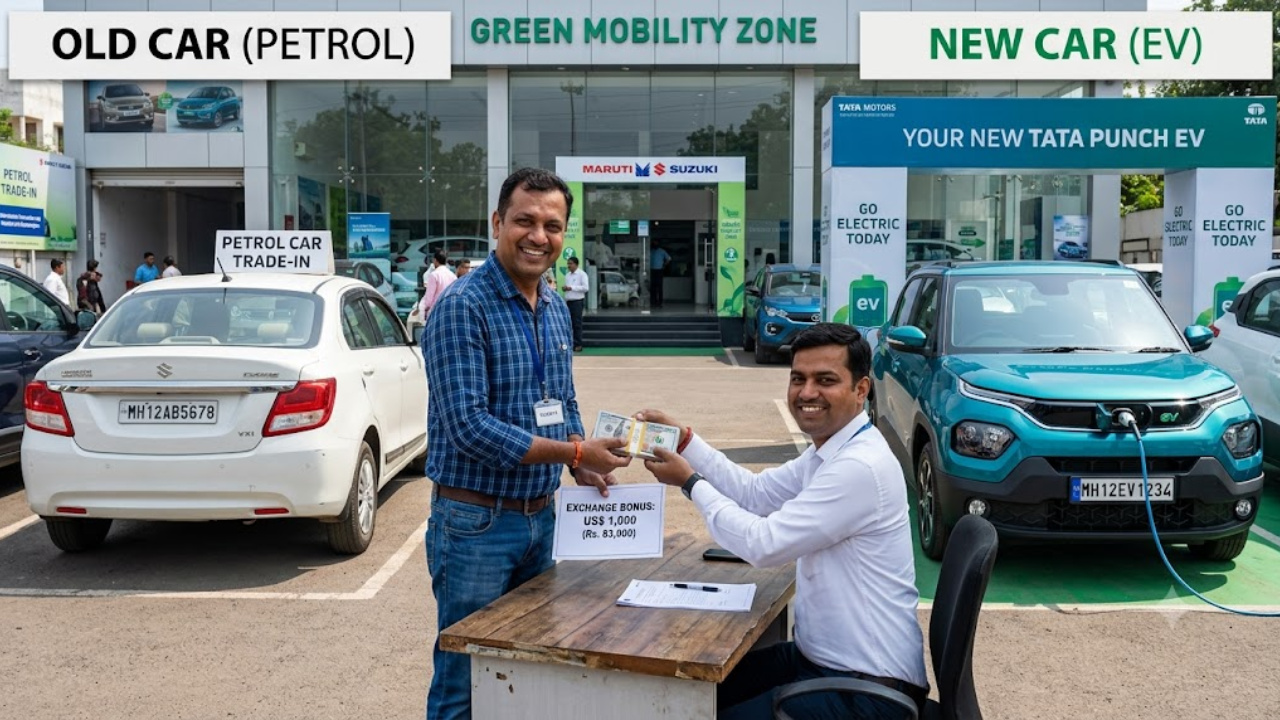
The New Delhi government launched on July 1st a program offering up to US$ 1,000, about R$ 5,169.50, for owners to replace old vehicles with electric models. The incentive for electric cars in New Delhi is part of a four-year policy created to tackle the high levels of air pollution in India’s capital.
Announced on Monday, June 29, the plan foresees a total investment of 150 billion rupees, equivalent to US$ 1.59 billion or approximately R$ 8.2 billion.
The initiative includes electric two-wheelers, cars, and light trucks. Besides the exchange bonus, the government promises to expand the charging infrastructure and eliminate certain costs for some buyers.
-
Tesla Begins Testing Two-Seater Autonomous Robotaxi Without Steering Wheel or Pedals, Featuring Onboard Safety Monitor

-
Renault Sandero: Affordable Used Models Feature 1.6 Engine, 106 HP, 14.7 km/l Fuel Efficiency, and Cruise Control Options.

-
Volkswagen Jetta Highline Remains Popular Years After Discontinuation: Features 2.0 TSI Engine, DSG Transmission, and Spacious Trunk, All for Less Than a New Fiat Argo

-
Brazilian Company from Caxias do Sul Among World’s Leading Brake Friction Material Manufacturers, Present in Over 125 Countries


Program will offer a bonus to replace old cars
The benefit of up to US$ 1,000 will be allocated to owners who decide to abandon old vehicles and acquire models powered exclusively by battery.
The proposal seeks to accelerate fleet renewal and reduce the circulation of cars using gasoline or other types of propulsion.
Hybrid vehicles were excluded from the program. Thus, financial and tax incentives will be directed only to fully electric models.
The policy is not limited to passenger cars. Scooters, motorcycles, and light trucks may also receive support, depending on the category and duration of the measure.
See the main incentives announced
The incentive for electric cars in New Delhi includes various benefits for consumers and for the expansion of infrastructure:
- up to US$ 1,000, or about R$ 5,169.50, for the exchange of old vehicles;
- 30,000 rupees, equivalent to R$ 1,640, for buyers of electric scooters and motorcycles in the first two years;
- 10,000 rupees, about R$ 546.67, for two-wheelers from the third year;
- road tax exemption;
- exemption from registration fees;
- installation of 32,000 charging points in the capital;
- investment of 150 billion rupees over four years.
Exemptions can reduce up to 10% of the vehicle cost
Buyers of battery electric models priced up to 3 million rupees will also be exempt from road tax and registration fees.
This limit is equivalent to approximately US$ 31.8 thousand or R$ 164 thousand.
Typically, these charges represent between 4% and 10% of the car’s value. The removal of these charges can significantly reduce the final acquisition cost.
In practice, the buyer can combine the tax exemption with other incentives provided, depending on the chosen vehicle and the applicable category rules.
Scooters and motorcycles will have their own benefit
The New Delhi government has created a specific range for electric two-wheelers.
In the first two years of the policy, buyers of battery-powered scooters and motorcycles will receive 30 thousand rupees, about US$ 318 or R$ 1,640.
From the third year, the amount will drop to 10 thousand rupees, equivalent to US$ 106 or approximately R$ 546.67.
The gradual reduction indicates that the government intends to offer a greater stimulus at the beginning of the program and decrease support as electric vehicles gain market share.
Capital will have 32 thousand new charging points
The policy also aims to address one of the main needs of electric vehicle users: access to chargers.
The government has committed to installing 32 thousand charging points in different areas of New Delhi.
The expansion is expected to accompany the growth of the electric fleet and offer more options for drivers of cars, motorcycles, scooters, and light trucks.
Without a wide network, the financial incentive alone could have a limited effect. Therefore, the program combines purchase discounts with infrastructure investment.
Only electric vehicles can be registered in 2028
The stricter measure is scheduled for April 2028.
From that date, New Delhi will only allow the registration of electric vehicles. The decision is expected to restrict the entry of new gasoline models and other forms of propulsion into the capital’s fleet.
Since hybrids were not included in the policy, they will also not have space within the announced rule.
The determination creates a deadline for consumers and manufacturers to adapt to the new scenario. Until then, the government will use incentives, exemptions, and charging points to accelerate the transition.
Local manufacturers may gain space
The expectation is that the incentive for electric cars in New Delhi will increase the demand for models produced by companies already operating in this market.
Among the mentioned manufacturers are Tata Motors, Mahindra & Mahindra, TVS Motors, Bajaj Auto, and Ather Energy.
The program could benefit companies offering everything from two-wheelers to automobiles and light commercial models.
With more consumers receiving discounts and paying fewer fees, the trend presented is an increase in sales during the four years of policy implementation.
Pollution control guides fleet change
The new strategy was created to reduce the air pollution faced by the Indian capital.
By offering money to remove old cars from circulation, the government is trying to accelerate a change that would otherwise depend solely on the individual decision of the owners.
Financial incentives make the replacement more attractive, while the prohibition of new registrations from 2028 sets a deadline for the transition.
With an investment equivalent to R$ 8.2 billion, 32,000 chargers, and benefits reaching US$ 1,000, New Delhi is betting on a combination of reward and restriction to transform its fleet in the coming years.
With information from g1