






 Portuguese
  Spanish
  4 min of reading
  7 comments


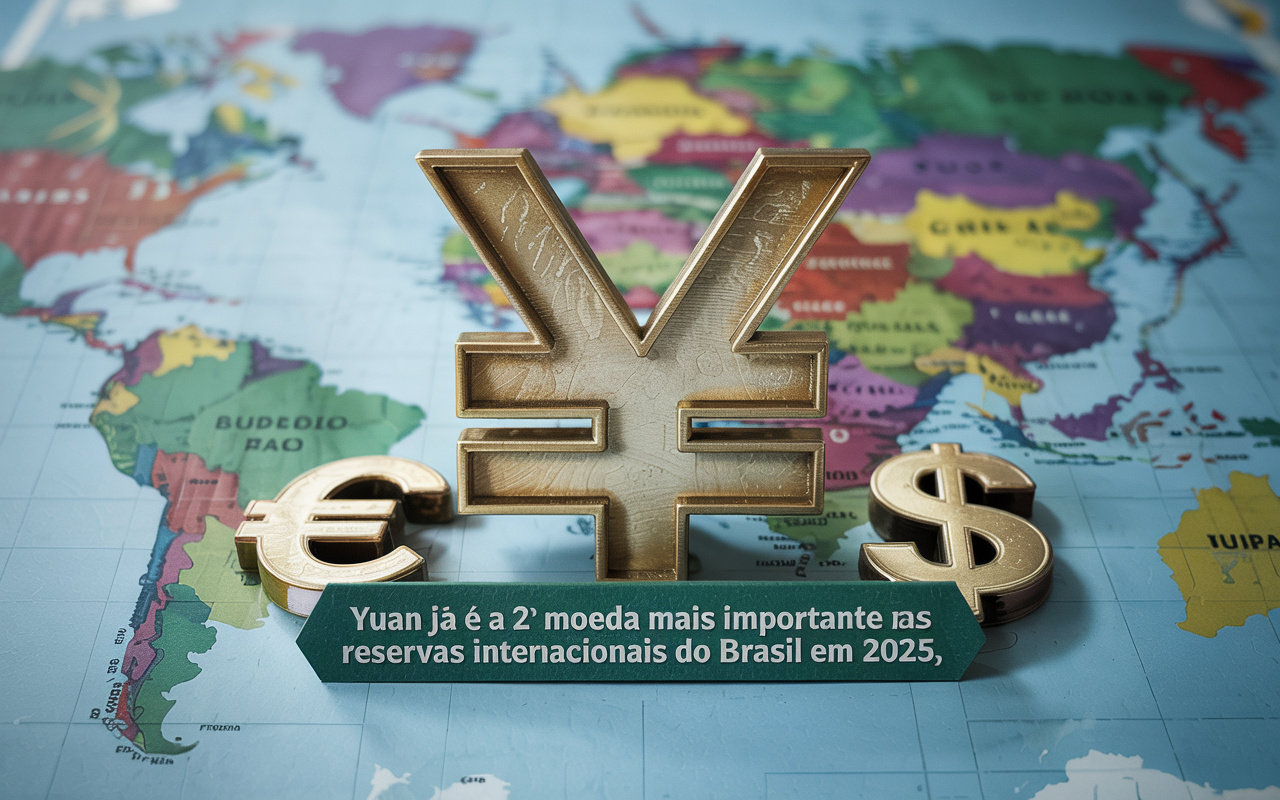


Yuan Is Already the 2nd Currency in Brazil’s Reserves in 2025, Surpassing the Euro and Expanding Geopolitical Competition Against the Dollar’s Hegemony.
While the public debate focuses on elections and fiscal crises, a piece of data from the Central Bank of Brazil has gone almost unnoticed — but carries the potential to change the global financial landscape. In 2025, the yuan has established itself as the 2nd most important currency in Brazil’s foreign reserves, surpassing the euro and trailing only the dollar.
It is a silent movement, built over the past few years, but with enormous symbolic weight: it means that Brazil, the largest economy in Latin America, has chosen the renminbi as the pillar of its currency protection, reinforcing ties with Beijing and amplifying the challenge to American hegemony.
How the Yuan Reached the Top
Until a few years ago, the presence of the yuan in Brazil’s reserves was almost irrelevant. In 2019, it accounted for just 1.2% of the total. By 2021, it represented 4.99%.
-
Brazilian Joins Homeownership Consortium, Faces Decade of Dual Payments Totaling $141,000, Surpassing Traditional Mortgage

-
Land Rover to Halt Production in July, Putting 371 Jobs at Risk, as Chinese Automaker Negotiates to Convert Factory to 100,000 Vehicles Annually by 2027

-
Mexican Pest Threatens U.S. Cattle Herds at Historic Lows, Potentially Boosting Brazilian Beef Exports as Burger Prices Soar

-
Brazilian Freight Bill Progresses in Congress with $5,000 Minimum Wage, 70% Advance Payment, and Fines Up to $1 Million, as Agriculture and Industry Warn of Rising Costs and Legal Uncertainty


In 2022, it made a historic leap: 5.37% of the total, surpassing the 4.74% held by the euro, according to the Reserve Report released by the BCB.


Since then, the trajectory has only grown. In 2025, even without updated official numbers, analysts confirm that the Chinese currency is already the second most important in Brazil’s treasury, surpassing the pound and consolidating itself as a symbol of gradual dedollarization.
This advance has been sustained by three factors:
- Currency swap of R$ 157 billion signed between Brazil and China in May 2025, ensuring liquidity in yuan.
- Expansion of bilateral trade: today, more than 40% of Brazil-China exchanges already occur in Chinese currency.
- Attraction for stability: in a world of high interest and currency risks, the yuan offers protection, especially when backed by real trade ties.
The Dollar Still Reigns, But…
It is clear that the dollar remains the pillar. More than 80% of global reserves and still about 80% of Brazilian reserves are dollarized. But the central point is different: for the first time, a major emerging country has chosen the yuan as its 2nd reserve anchor, leaving European currencies behind.

This generates discomfort in Washington and Brussels. For the USA, it means that Brazil — traditionally viewed as part of its sphere of financial influence — is migrating into China’s monetary camp.
For the European Union, it is a warning of irrelevance: if even the euro has lost ground in Brazil, its claim to rival the dollar is even more distant.
The Geopolitical Board
The rise of the yuan in Brazilian reserves is not just a technical decision by the BC. It is a direct reflection of geopolitics:

- China as the Main Trading Partner: in 2025, China purchases over US$ 100 billion per year in Brazilian commodities (soybeans, ore, oil, meat).
- BRICS as a Counterbalance: with India, Russia, and now Saudi Arabia, the bloc pushes for the creation of parallel payment systems.
- Financial Sanctions as a Weapon: after the war in Ukraine, Russia was cut off from Swift, accelerating the search for alternatives to the dollar.
In this scenario, Brazil positions itself at the center of a dispute: while it maintains its dollarized base, it expands its bet on the yuan as a hedge against future shocks.
The Impact on the Brazilian Market
In practice, the increase of the yuan in reserves brings direct effects:
- Protection for Agribusiness: exporters receiving in yuan see greater predictability, as the BC has more backing in the currency.
- Reduction of Currency Costs: companies can access yuan lines with less friction, without needing to triangular with the dollar.
- Greater Bargaining Power: Brazil gains greater bargaining power with Beijing, using the yuan as a project financing currency.
On the other hand, risks arise:
- Dependence on China: if the yuan becomes too much of a pillar, any political change in Beijing will directly impact Brazilian reserves.
- Low Convertibility: the yuan is still not fully free, and financial operations depend on approvals from the PBoC.
- Geopolitical Exposure: the USA may view the movement as a sign of excessive alignment with Beijing.
Washington on Alert
In Washington, the advance of the yuan is seen as yet another fissure in the dollar’s hegemony. If each emerging country adds a few percentage points of yuan to its reserves, the total may be sufficient for the gradual erosion of the American financial system.
Analysts linked to the Federal Reserve have already pointed out that the “risk is not that the dollar will lose its dominant position all at once, but rather a cumulative process of loss of relevance, initiated by swaps and alternative reserves.”
For Brazil, the presence of the yuan as the 2nd currency in reserves is both a victory and a trap. A victory because it strengthens the country in negotiations, reduces costs, and shows that Brasília knows how to leverage its strategic position between the USA and China.
In 2025, the data is clear: the yuan surpassed the euro and is already the second currency in Brazil’s treasury. The question is whether this choice marks the beginning of a new monetary autonomy or merely a swap of one guardian for another.





Jornalista Ptista é ****. Além de parcial, só trás desinformação…
Onde vcs acharam essa fonte o Yan tá valendo tanto quanto o real e o bolívar nada kkkkkk conta outra Maeda da Ásia não vale nada
A dívida externa brasileira, a qual subiu em julho passado, alem de cotada em dólar, não é também contratada em dólar? Fugir de sanções financeiras norte americanas, ao uso do yuan pode e vai trazer pressão maior ainda na rolagem de curto e longo prazo da dívida externa. NESSA HORA A CHINA VAI SOCORRER O BRASIL?
FICA DE AVISO E ALERTA
Diversificar ás reservas cambiais é uma estratégia inteligente ,desde que seja de moedas de países em que o Brasil tenha considerável fluxo de comércio exterior.