






 Portuguese
  Spanish
  5 min of reading
  0 comments


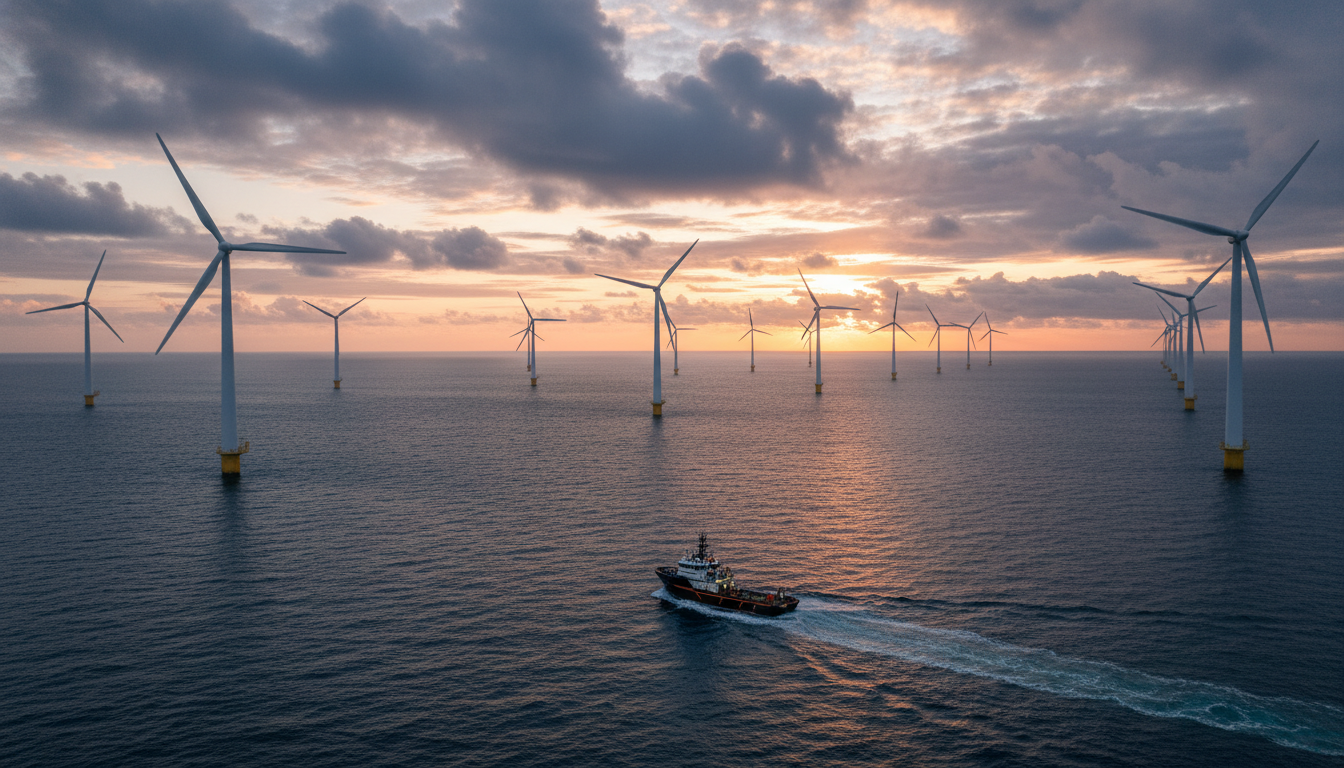
The world’s largest offshore wind farm is being built piece by piece in the middle of the North Sea — and when completed, 277 giant turbines will power more homes than the entire population of Portugal
More than 130 kilometers off the northeast coast of England, where the wind blows non-stop and waves reach five meters high, hundreds of workers face extreme conditions to assemble a structure that redefines what wind power is capable of.
According to an economic impact report by BVG Associates, published in November 2025, the Dogger Bank Wind Farm will have an installed capacity of 3.6 gigawatts — enough to power 6 million British homes per year.
To give an idea of the scale, 6 million homes are equivalent to more than the entire population of Portugal.
-
Bolivian Female Construction Workers Form Association to Combat Discrimination and 38% Pay Gap in the Industry

-
Near Amsterdam, residents buy land and discover they must also build streets, manage drainage, handle waste, and grow food on half their plot.
-
Brazil’s WEG to Open New Factory in China by 2027, Expanding Production of Large Rotating Electric Machines and Low to Medium Voltage Motors in Rugao

-
Chinese Shipyard Secures $1 Billion in Orders for Low-Carbon Container Ships Amid Global Fleet Renewal Efforts


Each of the 277 turbines measures 260 meters in height — more than double the Statue of Liberty. And all are planted on the ocean floor, tens of meters deep, facing tides, currents, and North Atlantic storms.
Three phases, three records: how the world’s largest offshore wind farm is being assembled
The project is divided into three phases — Dogger Bank A, B, and C — each with more than 1 gigawatt of capacity. The first two use 95 GE Haliade-X 13-megawatt turbines each. The third phase increases the power to 87 14-megawatt turbines.
These are the most powerful wind turbines ever installed on a commercial scale on the planet.
In March 2026, the first turbine of phase B was successfully erected. All foundations for phase C were already installed by December 2025.
When all phases are operational, expected by 2027, Dogger Bank will surpass the current record holder, Hornsea 2, which has 1.3 GW — almost three times smaller.

Who is behind the world’s largest offshore wind farm
The venture is a joint venture between three energy sector giants.
SSE Renewables, from the UK, holds a 40% stake and leads the operation. Norwegian Equinor, one of the world’s largest energy companies and listed on the Oslo Stock Exchange, owns another 40%.
The remaining 20% belong to Vårgrønn, a joint venture between Plenitude (the renewable energy arm of Italy’s Eni) and HitecVision.
Together, these companies are investing the equivalent of over £6.1 billion in the UK economy — about R$ 42 billion — creating jobs in construction, operation, and supply chain, with a special focus on the northeast of England.
A technology never before used in the UK
To transport the energy generated 130 kilometers offshore to the mainland, Dogger Bank is using HVDC — high voltage direct current technology for the first time in the UK.
Submarine cables run the entire route along the seabed, minimizing transmission losses that would be enormous with alternating current over this distance.
This system is considered a crucial test. If it works well at Dogger Bank, it will pave the way for even more distant offshore wind farms in the future.
Furthermore, standardizing HVDC technology across all three phases reduces costs and simplifies long-term maintenance.

R$ 42 billion in the economy and a transformed region
The BVG Associates report, commissioned by the offshore wind farm operators, details that the total economic impact on the British economy will be £6.1 billion.
The northeast of England, historically dependent on declining heavy industries, is the main beneficiary. Ports such as Teesside and Humber have been adapted to assemble and dispatch the giant turbines.
Thousands of direct and indirect jobs have already been created in construction, engineering, logistics, and maintenance. After completion, the park’s operation will require permanent teams for decades.
In 2025, the operators doubled the funds allocated to local communities, recognizing the impact of construction on the daily lives of coastal residents.
To understand the scale: each turbine is taller than two stacked football fields
Dogger Bank’s GE Haliade-X turbines are 260 meters in total height, from the base in the water to the tip of the highest blade.
This is equivalent to stacking two football fields vertically. Or almost two-thirds of the Eiffel Tower.
A single 14-megawatt turbine generates enough energy to power about 16,000 homes per year. The 277 turbines together produce 3.6 GW — more than many conventional nuclear power plants.
Each rotation of the blades sweeps an area larger than a full football field. And they spin 24 hours a day, 365 days a year, powered by winds in the North Sea that rarely stop.

The challenges of building in the middle of the North Sea
Working 130 kilometers from the nearest coast means that any part, tool, or worker needs to arrive by ship or helicopter.
Weather conditions are unpredictable. Five-meter waves, 100 km/h winds, and near-zero temperatures are routine in winter.
Installation windows last only a few hours. An entire turbine — with nacelle, tower, and blades — needs to be assembled in calm sea conditions, which limits work to a few days per month during the British winter.
Even so, the teams managed to complete all foundations for phase C by December 2025, on schedule.
The silent contribution to net zero
The UK has committed to achieving net-zero emissions by 2050. Dogger Bank, with its 3.6 GW, is a central piece of this strategy.
This park alone will avoid millions of tons of CO₂ per year, replacing energy that previously came from natural gas power plants.
At the same time, the experience gained in the construction and operation of Dogger Bank is generating technical knowledge that the UK intends to export.
Countries like Japan, South Korea, and the United States are already observing the British project as a model for their own deep-water offshore wind plans.
Not all winds are favorable
Despite the impressive numbers, the project faces challenges that cannot be ignored.
HVDC technology, though promising, has never been tested on this scale in the UK. Any failure in the submarine cables could leave millions of homes without power for weeks.
The impact on marine life also concerns environmentalists. The noise from foundation installation and the physical presence of the structures alter the habitat of fish and marine mammals.
Furthermore, the actual cost may exceed projections. Offshore projects historically face budget overruns, and Dogger Bank is not immune to this.
Will the North Sea wind justify every pound invested? The coming years will provide the answer — but, for now, the 277 turbines continue to rise, one by one, in the middle of the ocean.







Be the first to react!