






 Portuguese
  Spanish


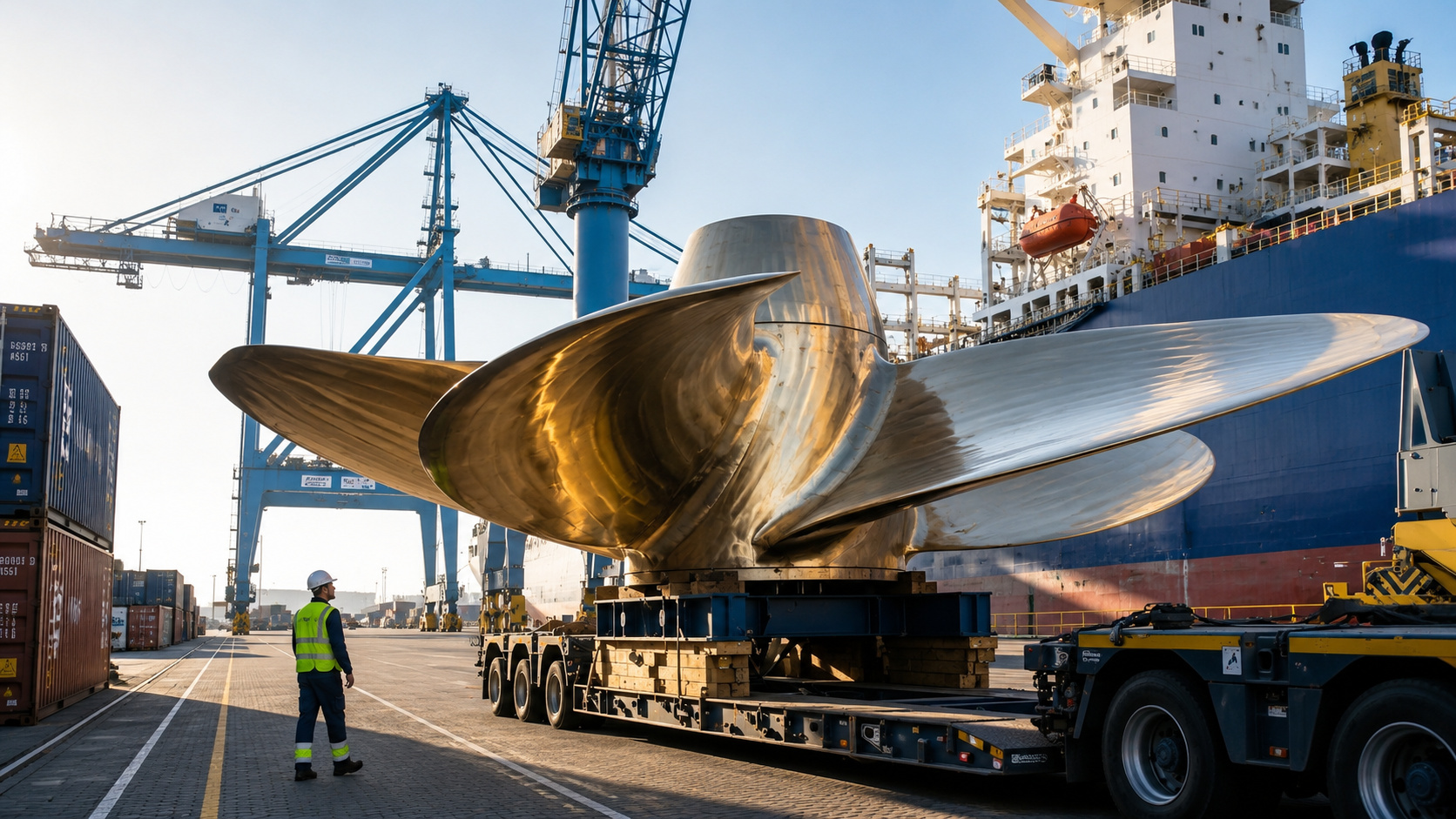

Giant propeller used in container ships like the MSC Irina reveals the little-seen engineering that helps sustain global trade
An almost invisible piece of engineering to the public plays an essential role in global maritime transport. The giant naval propeller of the largest container ships can weigh up to 131 tons, measure around 11 meters in diameter, and cost up to US$ 4 million per unit.
The manufacturing is also impressive. According to information from Mecklenburger Metallguss GmbH, MMG, a German company specialized in this type of part, a propeller of this size can take between three and four months to be ready.
This fact draws attention because this structure, although little known, is directly linked to the operation of the largest cargo ships on the planet. Without it, ships responsible for international trade routes simply cannot operate.
-
Brazil’s Maceió Port Joins Decarbonization Efforts with Study to Supply Clean Energy to Cruise Ships

-
Brazilian Port Expands Ship Capacity to 9.5 Meters, Boosting Cargo Transport and Reducing Logistics Costs
-
Three Chinese companies manufacture more than 96% of the world’s dry cargo containers and 100% of refrigerated ones, in a dominance built over 40 years that has made it almost impossible for the West to compete in this market.

-
The Panama Canal stores water in Gatún and Alhajuela lakes to maintain 38 daily crossings and prevent a drought linked to El Niño from once again stalling ships, raising freight rates, and putting pressure on global supply chains as occurred in 2023 and 2024.


World’s largest cargo ship uses naval engineering on an extreme scale
Since March 2023, the MSC Irina has been cited among the largest container ships in the world. The ship was built by the Chinese shipyard Hudong-Zhonghua for the Mediterranean Shipping Company, MSC.
The vessel is 399.9 meters long, 61.3 meters wide, and has a capacity for 24,346 TEUs. In practice, it is a true floating city dedicated to cargo transport.
Therefore, each component needs to withstand enormous efforts. The propeller, in this set, is one of the most decisive parts for transforming engine power into real movement in the ocean.


Giant naval propeller can weigh more than 100 tons
The largest propellers used in current container ships present rare numbers even within heavy engineering. In general, these parts can have 10 to 11.6 meters in diameter and weigh between 100 and 131 tons.
Additionally, they usually have four to six blades and are made with aluminum-nickel-bronze alloy, a material used for its resistance and durability in a marine environment.
The historical comparison shows the evolution of this sector. In 1912, the propeller of the RMS Titanic was about 7 meters in diameter and weighed 38 tons. A century later, the dimensions have practically changed in scale.
German company dominates the production of the largest naval propellers
The manufacturing of this type of propeller is dominated by a few companies worldwide. Among them, the German Mecklenburger Metallguss GmbH, based in Waren an der Müritz, stands out as one of the main global references.
According to the specialized publication Riviera Maritime Media, MMG has been associated with more than 60% of the global market for propellers weighing over 80 tons.
This dominance occurs because the production requires heavy casting, digital technology, high-precision machining, and manual finishing. Any error in the blade geometry can compromise the ship’s efficiency.
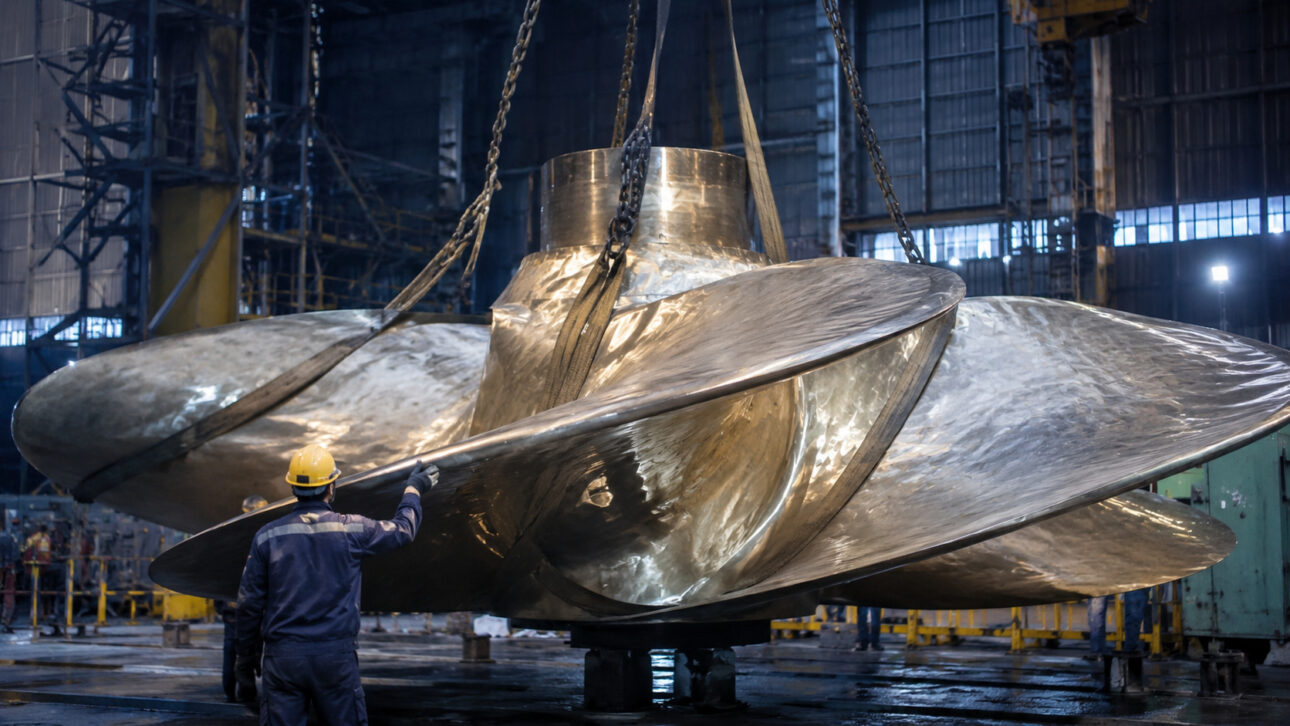
How a 131-ton propeller is manufactured
The process begins with 3D modeling and the creation of wooden patterns. These models serve as the basis for the molds used in casting the piece.
Then, the aluminum-nickel-bronze alloy is heated to over 1,200 °C. Next, the liquid metal is poured into large sand molds.
The cooling needs to be controlled for days. This step prevents internal stresses in the metal and reduces the risk of structural failures.
Subsequently, five-axis CNC machines adjust each blade with precision. Finally, polishing, balancing, and quality testing are performed.
The inspection can exceed 200 hours. Among the methods used are ultrasound examinations, capable of identifying invisible microcracks.
Why larger propellers help ships use less fuel
The logic of naval propulsion favors larger and slower propellers in cargo ships. This is because a large propeller displaces more water with each rotation.
Consequently, there is less turbulence and better utilization of engine power. On long trips, this difference can represent significant fuel savings.
In the largest container ships, the rotation usually stays between 80 and 100 RPM. Even so, these ships can sail near 23 knots, equivalent to approximately 43 km/h.
Giant engines complete the propulsion system
The propeller does not work alone. It receives power from large engines, manufactured by companies like MAN Energy Solutions and WinGD.
The largest models can have up to 14 cylinders and generate between 80,000 and 100,000 hp. This power moves vessels hundreds of meters long and thousands of containers.
Thus, engine and propeller form an essential set. One generates the power; the other transforms this energy into efficient movement at sea.

Little-seen piece supports an important part of global trade
According to the International Maritime Organization, maritime transport moves about 90% of world trade. In this scenario, a propeller failure can halt a vessel for weeks.
Therefore, the 131-ton naval propeller has a strategic role. It represents just a part of the ship but directly influences the operation, consumption, and safety of routes.
The piece sums up the engineering behind the world’s largest cargo ships. It involves months of manufacturing, metal heated to over 1,200 °C, millimetric precision, and finishing by specialists.
In the end, the giant propeller shows that a fundamental part of global trade depends on a structure hidden underwater, out of sight, but indispensable for keeping goods moving between continents.


