Portuguese
  Spanish


Developed by the Mexican studio MANUFACTURA, the material CORNCRETL mixes corn waste, recycled nejayote, and lime-based aggregates for 3D-printed houses, promising up to 70% less emissions, 90% less waste, and prototypes of robotic walls cured at room temperature in two to three days, according to MaterialDistrict and Wallpaper.
3D-printed houses have gained a new experimental material from Mexico: CORNCRETL, developed by the studio MANUFACTURA as a bio-based alternative to conventional concrete. The mixture uses corn waste, recycled nejayote, and lime-based aggregates to create construction components through robotic printing.
The project was featured in reports by MaterialDistrict on February 23, 2026, and Wallpaper on February 22, 2026. The proposal still appears as research and prototype, but it draws attention for transforming a traditional agricultural waste from Mexico into material for curved, modular, and low-carbon walls.
Corn waste became raw material for construction
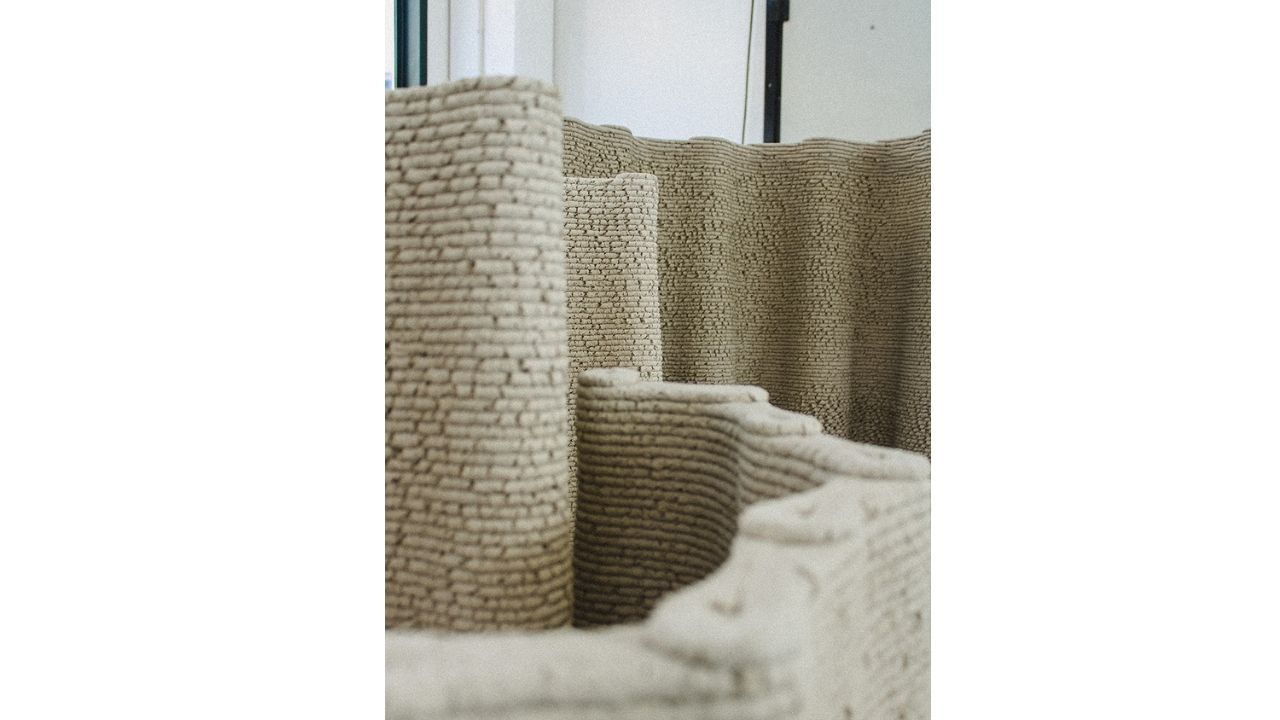
CORNCRETL is born from a direct connection between agriculture, Mexican culture, and sustainable construction. Corn has been present in the agricultural and cultural history of Mexico for over 7,000 years, but part of the production and processing generates waste that does not always find high-value use.
-
Traditional Mortar to Decline by 2026: ACIII-E Solution for Large Porcelain Tiles Offers Better Adhesion and Reduces Risk of Loose Pieces in Floors and Facades

-
72-Year-Old Man Spends Six Years Building a Rotating House for His Wife, Completing a Full Turn in 22 Seconds

-
Chinese Residential Building Surrounded by Circular Overpass After Residents Reject Compensation
-
After 79 Months and $145 Million Investment, Nepal Set to Open First 2.7 km Road Tunnel to Ease Traffic in Kathmandu Valley



Among these wastes is nejayote, a calcium-rich wastewater generated during nixtamalization, a traditional process used in corn preparation. Instead of discarding this byproduct, MANUFACTURA collects, dries, grinds, and pulverizes the material to achieve a consistency suitable for extrusion.
Recycled nejayote enters the mix with lime and mineral aggregates
The composition of CORNCRETL combines processed corn waste with limestone aggregates and Geocalce T, a mineral mixture made with natural hydraulic lime, geobinders, silica sand, dolomitic limestone, and marble powder. The result is a compound designed to work in digital manufacturing.
This choice also has historical ties. Lime-based construction systems have ancient roots in Mesoamerican architecture, where mixtures known as Sak-Kaab, or “white earth,” were valued for durability and environmental compatibility. In the new material, this tradition is reinterpreted with robots and 3D printing.
3D Printed Houses Can Reduce Forms and Waste
The most striking promise for 3D printed houses lies in reducing construction waste. According to MaterialDistrict, robotic printing removes the need for conventional forms and can reduce material waste by up to 90%.
This point is important because traditional construction usually generates leftover wood, concrete, packaging, and material scraps. By printing only where the wall needs to exist, the additive process changes the logic of construction, bringing construction closer to more precise and controlled manufacturing.
Emissions Can Drop by Up to 70% Compared to Conventional Concrete
The construction sector is identified as one of the major sources of CO₂ emissions, especially due to the use of Portland cement. CORNCRETL emerges as a lower-impact alternative, with the potential to reduce carbon emissions by up to 70% compared to conventional concrete, according to sources.
The reduction is associated with the use of agricultural waste and the chemistry of lime. Unlike Portland cement, lime hardens at room temperature and requires lower burning temperatures, which reduces energy consumption and emissions in the production process. The technology does not eliminate all construction impacts but attempts to cut a heavy part of the material’s footprint.
KUKA Robot and WASP System Tested Walls at Scale
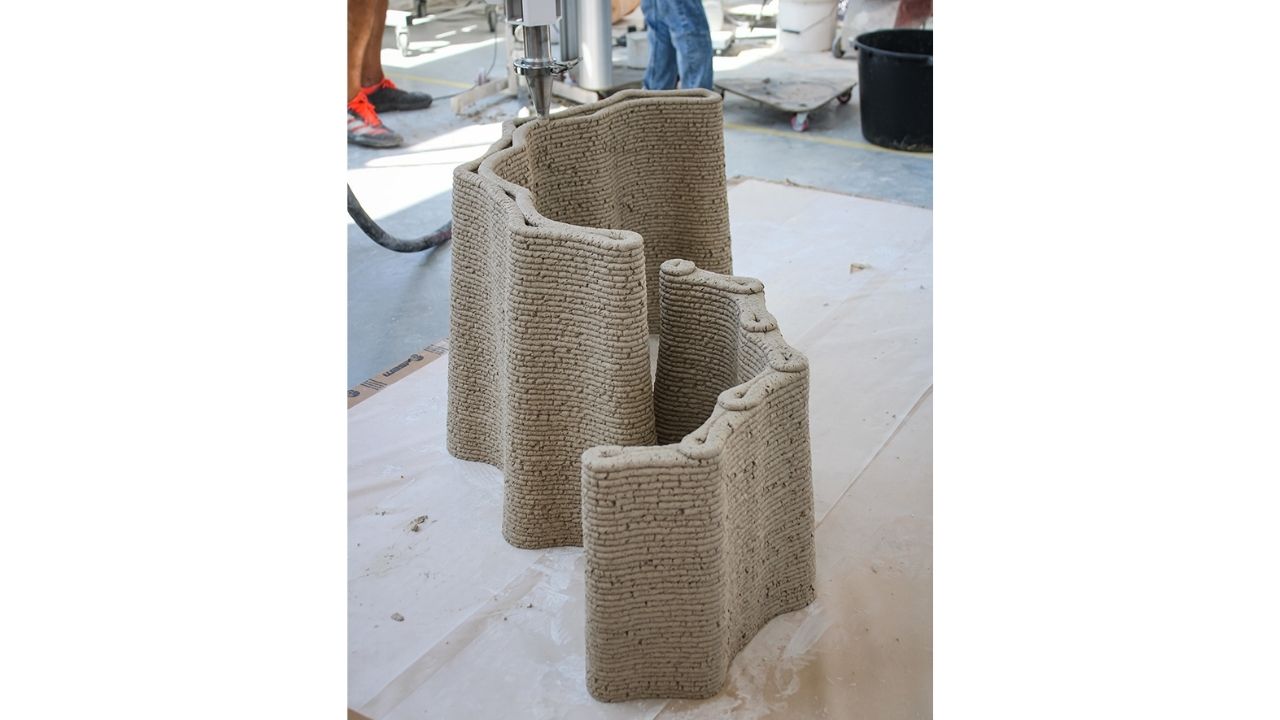
MANUFACTURA optimized CORNCRETL for additive manufacturing. In the tests mentioned by MaterialDistrict, the team used a WASP Concrete HD Continuous Feeding system combined with a KUKA robotic arm to print three wall prototypes at different scales.
The pieces were cured at room temperature in two to three days. This detail reinforces the difference compared to processes that rely on high temperatures or more complex moldings. The focus of the experiment is to prove that corn residues can become extrudable mass for walls printed by robots.
Curved walls show advantage over traditional forms
3D printing allows creating curved surfaces, textures, and geometries complex with more freedom than methods based on conventional forms. In the case of CORNCRETL, the prototypes show patterns reminiscent of terrazzo motifs and explore the aesthetic potential of the material.
This formal freedom interests architects and designers because it reduces the dependence on specific molds for each piece. In 3D printed houses, curved walls cease to be a luxury difficult to execute and become more dependent on digital design and extrusion control.
Modular panels aim at low-cost housing
The project also developed modular wall panels with heights of 40, 60, and 80 centimeters. These lightweight elements were designed for scalable construction systems and for applications related to low-cost housing.
The source does not report that complete houses have already been built with CORNCRETL on a commercial scale. Therefore, the safest data is to treat the technology as a prototype of material and construction component. The advancement lies in the possibility of bringing the compound to printed housing systems, not in claiming that it already replaces common concrete in constructions.
Material unites cultural memory and digital fabrication
The proposal by MANUFACTURA draws attention because it does not treat corn merely as an agricultural input. The project uses a byproduct linked to traditional Mexican practices and inserts it into a contemporary process of robotics, 3D printing, and circular construction.
This blend of cultural memory and digital fabrication is part of the appeal of CORNCRETL. The material tries to show that innovation in construction does not need to originate only from industrial laboratories distant from local culture, but also from residues and techniques present for centuries in producing communities.
What this corn concrete reveals about construction
The CORNCRETL still needs to be understood as research and prototype, but it points to an important direction for construction: reducing emissions, reusing waste, minimizing waste, and allowing geometries that would be more difficult with traditional molds.
The question is whether materials like this will be able to move out of the experimental field and reach real-scale projects. Do you believe that 3D printed houses made with agricultural waste can become a practical solution for housing, or are they still far from competing with traditional construction methods? Leave your opinion in the comments.