Portuguese
  Spanish


The concentration did not arise solely from cheap labor, but from the geography of steel, industrial scale, and even a 2017 environmental rule that eliminated smaller competitors. The absolute leadership was mapped by the British consultancy Drewry.
Three Chinese companies now concentrate the manufacturing of the most discreet and decisive piece of global trade, the maritime transport container. According to a survey by the British consultancy Drewry, released in 2021, factories located in China account for more than 96 percent of the dry cargo containers produced in the world and 100 percent of the refrigerated containers, a degree of dominance that has been consolidated over four decades and today makes Western competition practically unfeasible.
These Chinese companies go by the names CIMC, Dong Fang, and CXIC, and they operate as the backstage manufacturers of practically all maritime trade. While the large letters painted on the sides of the containers only identify the logistics operators, such as Evergreen or Maersk, it is the small metal identification plates that reveal who really built the box. And almost always the name displayed belongs to one of these three companies, all based in China.
The weight of steel explains the geography of the container
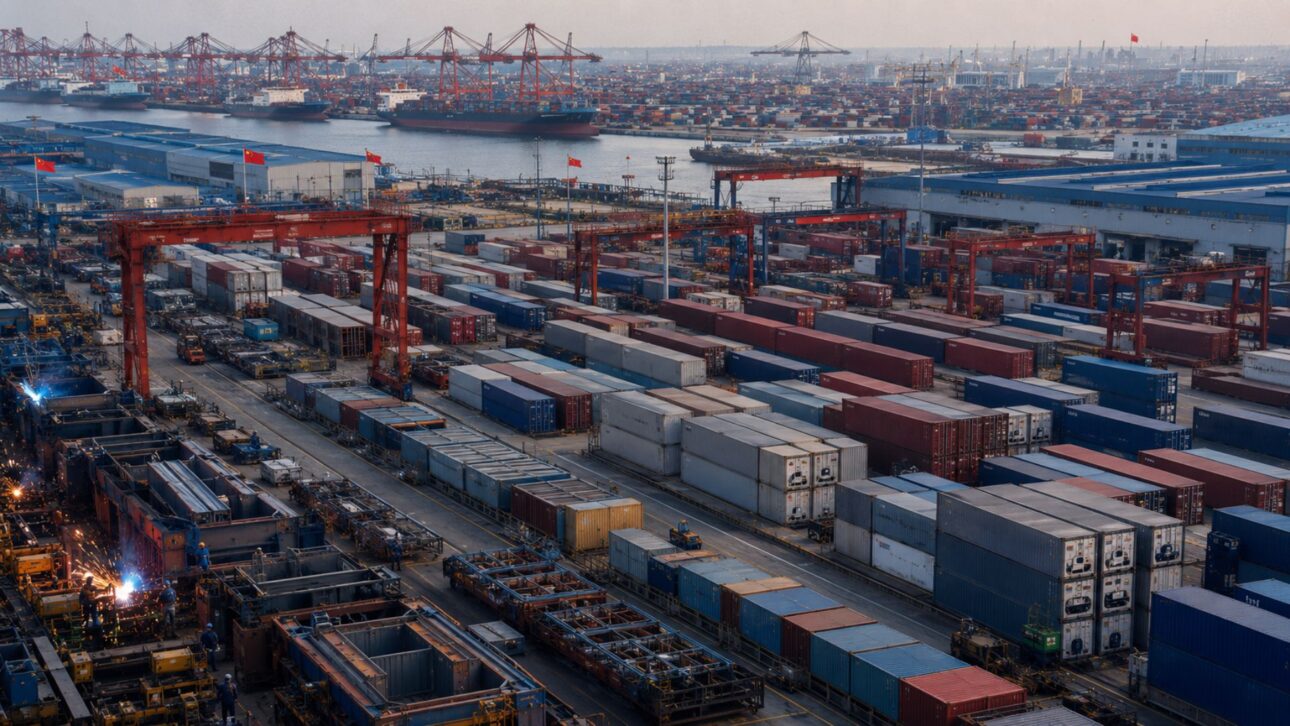
A standard 12-meter box contains about 4 tons of weather-resistant steel, an alloy that rusts on the surface to protect the internal structure.
-
Owner of Havan Visits Paraguay to Discuss Lower Taxes, Local Suppliers, and International Expansion with President

-
Brazilian Construction Retail Chain Closes After 60 Years, Begins Liquidation Sale Across Five Cities

-
Brazil Approves Landmark Bill Requiring Workplace Adaptations for Autism Inclusion

-
Brazil’s Micro-Entrepreneur Program May See Major Changes: Income Cap Could Increase to R$ 130,000, Annual Inflation Adjustments, and Allow Hiring of an Additional Employee



This steel represents approximately 60 percent of the total cost of a maritime container, which ties the production of the piece to the place where the metal is cheapest and most abundant.
And that place is China, which alone produces more steel than all other countries combined.
According to the World Steel Association, Chinese crude steel production reached about 1,005 million tons in 2024, more than ten times India’s mark, the second place, with approximately 149 million tons.
This share amounts to more than 53 percent of the entire world’s production. Building the container in Europe or the United States would require importing Chinese steel, paying tariffs, and still shipping the empty box back to Asia to fetch goods, a logistical cycle that falls apart at every step.
Who are the architects of the monopoly
The largest of the three is CIMC, short for China International Marine Containers, founded in 1980 in Shenzhen as a joint venture with a Danish company.
Its largest shareholder is the state-owned conglomerate China Merchants Group. Data from Drewry for 2020 shows that CIMC produced about 580 thousand twenty-foot equivalent units that year, which secured it approximately 42 percent of the global market.
Statistically, when seeing two containers side by side at a port, it is likely that CIMC built one of them.
Behind it are Dong Fang International Container, linked to the state-owned Cosco, and the private CXIC.
According to the same source, Dong Fang accounted for about 26 percent of the market, with 358 thousand units, while CXIC held approximately 14 percent, totaling 200 thousand units.
Together, the three Chinese companies held about 82 percent of the world’s production, totaling 3.1 million units manufactured in 2020.
The most modern factories operate with laser welding and quality control based on artificial intelligence, transforming container assembly into something akin to a high-precision automotive line.
State stability and the West’s frustrated attempt
The involvement of the Chinese state offers these companies something that Western private competitors hardly have, namely, the ability to weather crises without shutting down.
Supported by state banks, these manufacturers keep the lines running even when demand plummets, so that when trade recovers, the installed capacity remains available.
During the covid-19 pandemic, container prices worldwide tripled, and part of the market raised suspicions of price coordination among manufacturers.
The world’s second-largest shipping company, the Danish Maersk, even tried to enter this game, but the move was blocked.
Maersk maintained its own manufacturing division, Maersk Container Industry, specializing in high-quality refrigerated containers.
In September 2021, the group signed an agreement to sell this division to CIMC for about 987 million dollars, equivalent to approximately 5.3 billion reais at the exchange rate at the time.
In August 2022, however, the Antitrust Division of the United States Department of Justice blocked the operation, arguing that it would concentrate more than 90 percent of the global production of refrigerated containers in the hands of state-owned or state-controlled Chinese entities.
The parties terminated the deal.
The environmental rule that eliminated the competitors

The perhaps most surprising factor consolidating the dominance of the three giants was not strategic or corporate, but an internal environmental regulation of China.
In 2017, the Chinese government mandated the replacement of traditional oil-based paints with water-based paints, in an effort to reduce air pollution and emissions of volatile organic compounds.
The measure was an environmental victory, but it represented a sentence for the smaller manufacturers in the country itself.
The transition to water-based paints required heavy investments in entirely new drying and humidity control systems.
Small private Chinese manufacturers could not bear this initial cost and ended up closing down.
The three big ones, with easier access to state loans, modernized their facilities and absorbed the market share left behind.
In this case, the rule not only cleaned the air but also paved the way for even greater concentration in the sector.
Why scale prevents the migration of production
Thinking of CIMC merely as a box manufacturer underestimates its reach, as the group acts as an infrastructure powerhouse.
Its subsidiary CIMC Tianda is one of the world’s largest suppliers of passenger boarding bridges, those used in airports from Paris to San Francisco.
The group was also a pioneer in modular construction, delivered thousands of rooms for quarantine centers in Hong Kong during the pandemic, owns the German fire truck manufacturer Ziegler, and operates in the construction of offshore oil platforms.
As global industrial production begins to migrate to countries like Vietnam and India, it seems logical to assume that container manufacturing will follow the same path, but there is a difficult obstacle to overcome, scale.
A modern factory in Vietnam could produce something like 100,000 twenty-foot equivalent units per year, a number that impresses until compared to that of the leader.
Alone, CIMC manufactures close to 2 million units annually. The history of the three companies is a demonstration of industrial dominance built not through aggressive acquisition, but through four decades of patience, integration, and state policy.
The container is the physical form of globalization, and its manufacturing reveals how the industrial power of the 21st century has concentrated in a few hands.
The dominance of Chinese companies over this seemingly mundane piece was not by chance, but the result of the combination of abundant raw materials, monumental scale, state support, and even environmental regulations that reorganized the sector from within.
Reversing this situation would require much more than political will in other countries.
And you, did you imagine that only three Chinese companies were behind almost all the containers that cross the oceans? Comment on what you think about this concentration in the manufacturing of such a strategic piece for world trade, if you believe that other countries will be able to compete in the future, and how this could affect Brazil, which relies on maritime transport for a large part of its exports. The debate is open and we respect different opinions.