






 Portuguese
  Spanish
  3 min of reading
  0 comments


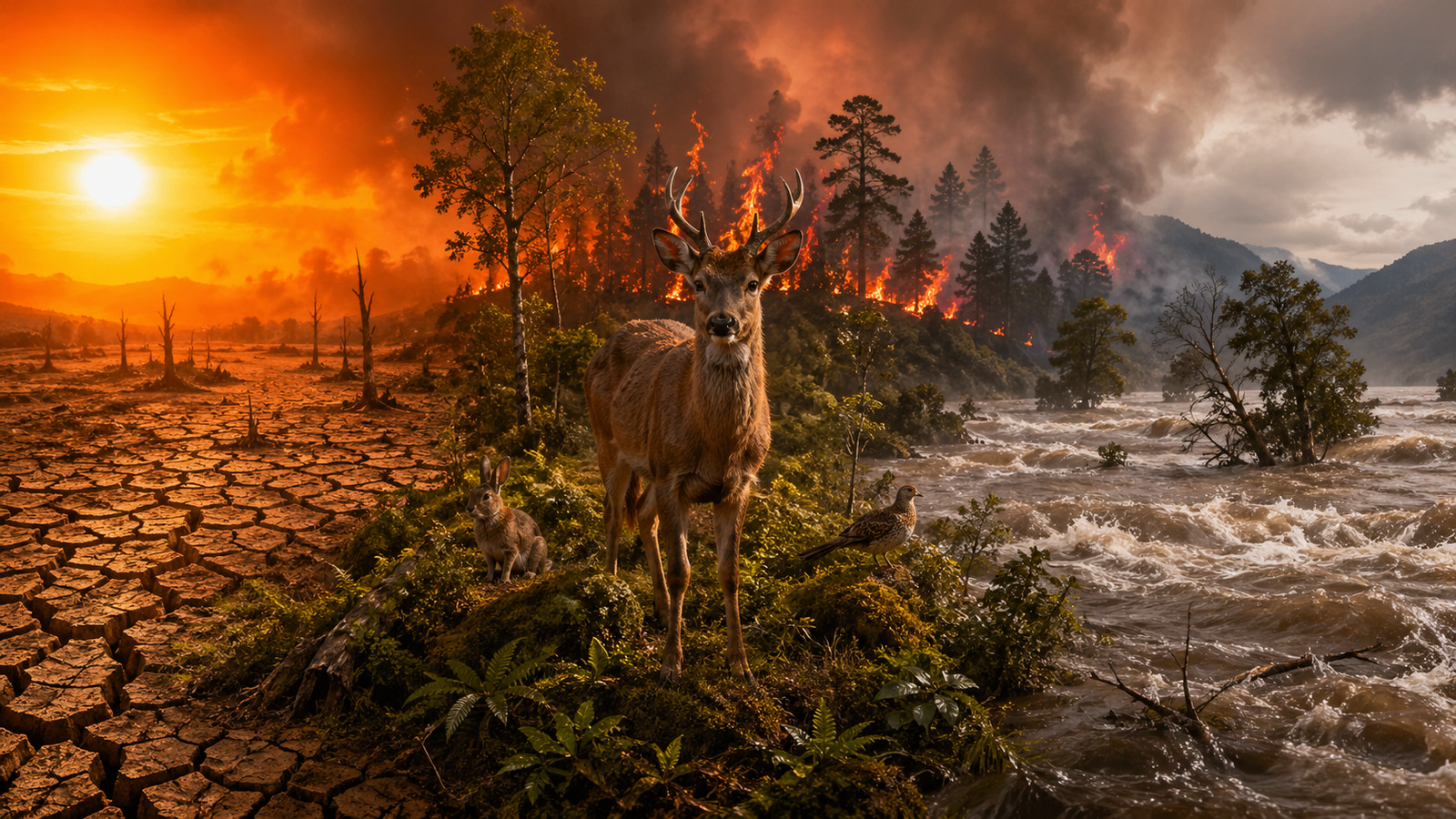
PIK-led study projects 36% of terrestrial habitats could face heat, fires, and floods by 2085, but rapid emissions cuts would reduce multiple exposure to 9% in future climate reversal scenario
By 2085, 36% of species’ terrestrial habitats could be exposed to multiple extreme events, such as heatwaves, fires, or floods, if warming continues to advance in the second half of the century.


Study brings together 18 scientists
The conclusion is in a study recently published in the journal Nature Ecology & Evolution. The work brings together 18 international scientists, led by the Potsdam Institute for Climate Impact Research, PIK.
Lead author Stefanie Heinicke, a researcher at PIK, stated that climate change and extremes are still largely underestimated in conservation planning. For her, the risk will not just be a gradual rise in temperature.
-
Brazilian mechanic invented a lamp made from a PET bottle during the 2001 blackout, the idea turned into an NGO present in 30 countries and has already illuminated 40,000 people in 200 communities without electricity in Brazil.

-
The first trillionaire in history, Elon Musk, opens his wallet and pays the equivalent of R$ 306 billion, or US$ 60 billion, for the artificial intelligence programming startup Cursor, in yet another AI investment made through SpaceX, his rocket company.
-
The future of computers may change sooner than expected: Amazon bets on commercial quantum computing within seven years, while qubits, the Ocelot chip, AI, and scientific simulations take center stage in the new race among big techs.

-
What does a Covid-19 vaccine have to do with heart attack and stroke? A study with over 1 million veterans reveals an unexpected link between immunization, the heart, and seniors over 75 years old.




Impact can come in sequence
A single heatwave, flood, or fire can already devastate animal populations. When different extreme events happen in sequence, the effects on species and habitats become greater, impacting survival areas in a combined way.
Previous studies recorded this worsening after the 2019-2020 fires in Australia. In areas that had also suffered drought just before, plant and animal species saw a 27 to 40% greater decline.
This data shows how the overlap of impacts weighs on biodiversity. The destruction caused by fire, drought, heat, or excessive water can be more severe when these factors do not appear in isolation.
Emissions can reduce risk
The same study points out that a rapid reduction of emissions to net-zero could still avoid a large part of these impacts. In this scenario, warming would begin to reverse in the second half of the century.
With this change, only 9% of terrestrial animal habitat would be exposed to multiple types of extreme events by 2085.
The difference shows the gap between prolonged warming and a path of reversal.
Heinicke stated that it is still possible to make a big difference by reducing emissions as quickly as possible. The projection places climate action as a central point for limiting future losses.
Modeling expands the analysis
The research analyzes the impacts of climate change on terrestrial biodiversity. Instead of observing average temperature, it works with climate impact models and more complex data.
These models allow projecting flooded areas, wildfires, and other effects associated with climate change.
Thus, the study compares different threats to current terrestrial species habitats, within scenarios for the end of the century.
In the scenario where global warming continues in the second half of the century, 74% of current terrestrial animal habitats will be exposed to heatwaves. Another 16% will face wildfires, 8% droughts, and 3% river floods.
These areas include important regions of great biodiversity in the Amazon basin, Africa, and Southeast Asia.
The advance of simultaneous threats over these spaces increases concern for species that depend on these habitats.
Fires appear strongly
Co-author Katja Frieler highlighted the weight of wildfire projections. She leads the Inter-Sectoral Impact Model Intercomparison Project, ISIMIP, and heads a research department at PIK.
Frieler stated that it is remarkable to see such significant projections for fires. The scientist also pointed out that there was an important gap regarding animal exposure to fire in studies of this type.
For her, the result is striking because fires appear as a greater threat than drought. This point broadens the focus of the debate on extreme events and their direct effects on terrestrial habitats.
The study’s central warning is that the future of habitats depends on the warming trajectory in the coming decades.
With rapidly reduced emissions, the scope of multiple impacts could significantly decrease by 2085.
With information from Potsdam.




-

1 person reacted to this.