






 Portuguese
  Spanish


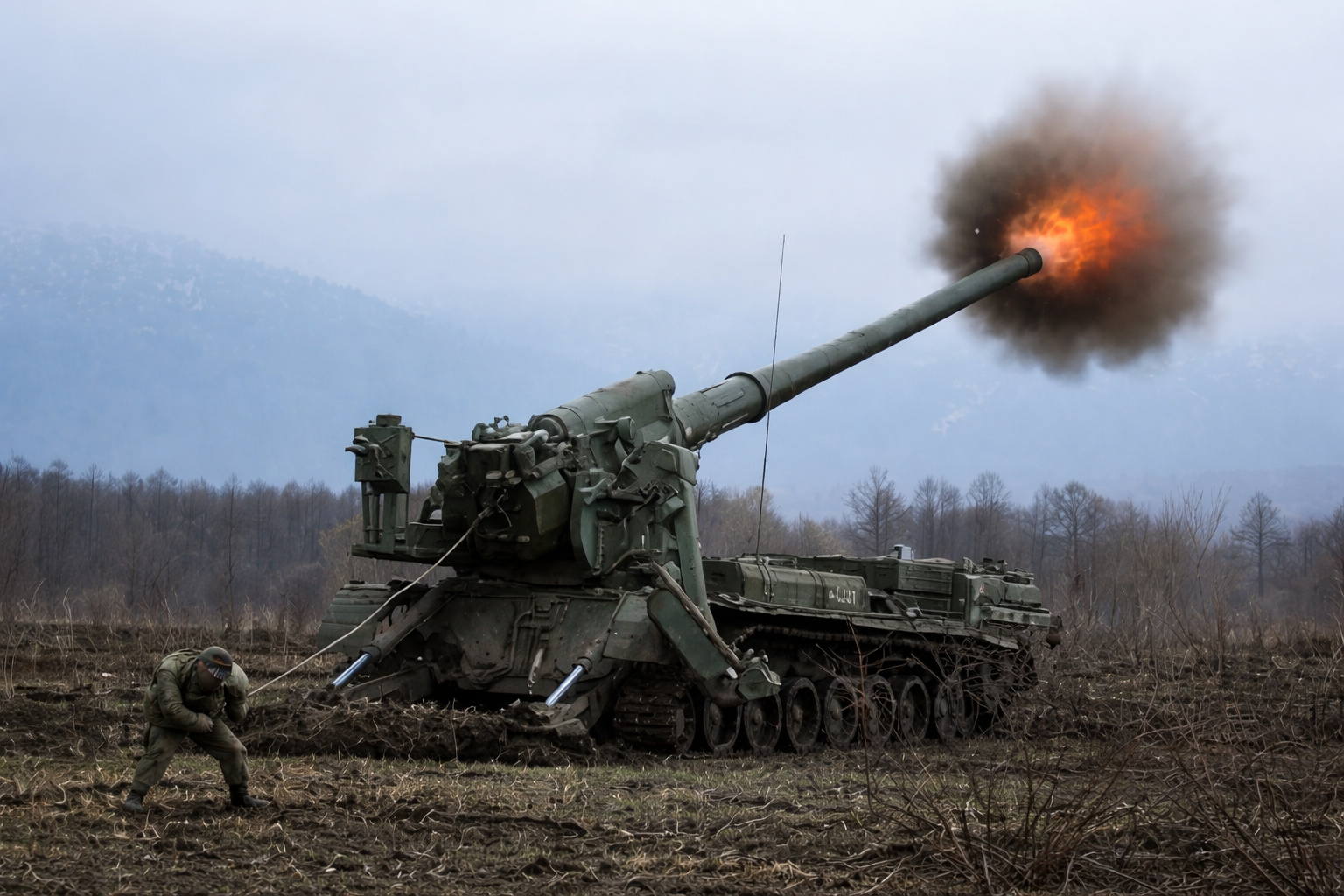


With a 203 mm Gun and a Range of Up to 47.5 km, the 2S7 Pion/Malka Was the Most Devastating Artillery of the Cold War, Created to Destroy Bunkers and Strategic Bases.
When the Soviet Union decided to develop the 2S7 Pion in the late 1960s, the goal was not just to create another piece of heavy artillery. The ambition was different: to produce a system capable of breaking through deep fortifications, destroying command centers, neutralizing tactical nuclear facilities, and operating in a total war scenario, including with special munitions.
The project officially emerged in the most tense context of the Cold War, when direct confrontation between NATO and the Warsaw Pact was considered plausible. The Soviet doctrine understood that, before any advance of armored vehicles or infantry, it would be necessary to annihilate defenses tens of kilometers from the frontline, something that conventional artillery of 122 mm or 152 mm could not do efficiently. The result of this logic was one of the most extreme systems ever deployed.
A 203 mm Gun Designed to Destroy What “Should Not Fall”
The heart of the 2S7 is a 203 mm gun, a rare caliber even among the largest artillery in the world. For comparison, most modern heavy pieces operate between 155 mm (NATO standard) and 152 mm (Soviet/Russian standard).
-
U.S. Military Intervention Risk in Brazil Raises Alarm, Highlights National Sovereignty Amid Tensions Over Washington’s Terrorist Designation of PCC and Comando Vermelho

-
Brazilian Air Force’s Sole KC-30 Aircraft Completes Strategic Mission to Spain for 105mm Anti-Tank Ammunition for Leopard 1A5 Tanks

-
Brazilian Air Force Seeks to Acquire More Gripen Fighter Jets
-
U.S. Air Force Launches Air-to-Air Missile Project with Range of Up to 1,850 km for Indo-Pacific Operations




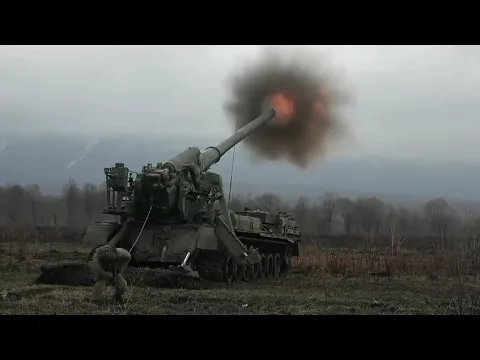

This leap in caliber allowed for something crucial: projectiles weighing over 110 kg, capable of delivering devastating energy upon impact. It is not just about explosion, but about real penetration capability and structural collapse, especially against reinforced bunkers, runways, underground depots, and hardened military installations.
Depending on the type of ammunition, the range varied between about 37 km (standard ammunition) and up to 47.5 km with rocket-assisted projectiles, something impressive even by today’s standards.
The Weight of Destruction: 46.5 Tons on Tracks
To support a gun of this magnitude, the vehicle had to be colossal. The 2S7 weighs about 46.5 tons, distributed over a specially reinforced tracked chassis.
But, unlike traditional self-propelled howitzers, the Pion was not designed for “shoot and move quickly.” Its philosophy is different: arrive at the position, prepare to fire, execute devastating fire, and only then reposition.
The recoil generated by a 203 mm shot is so extreme that the design needed to incorporate a huge hydraulic spade at the rear, which anchors to the ground before firing. Without this, the vehicle would simply be pushed back, compromising stability and accuracy. This detail alone shows how outside the curve this system is.
Numerous Crew and Brutal Logistics
Another aspect that differentiates the 2S7 from practically any other artillery system is its operation. The direct crew of the vehicle is relatively small, but the complete system relies on an expanded team, including support vehicles responsible for transporting ammunition, propellant loads, and auxiliary equipment.
Each projectile weighs over 110 kg, and the loading is not automatic. The process involves hydraulic cranes and a carefully coordinated sequence of operations. This limits the rate of fire but reinforces the purpose of the system: each shot must count for many. It is not a weapon of constant saturation, but a tool for strategic impact.
The Most Sensitive Role: Special Ammunition
One of the most delicate aspects—and often avoided in superficial analyses—is that the 2S7 was designed to operate special ammunition, including low-yield tactical nuclear projectiles, something common in Soviet doctrine at the time.
This ammunition did not turn the system into a “nuclear missile,” but allowed for short-range nuclear strikes against troop concentrations, air bases, logistics centers, or strategic chokepoints. The mere existence of this capability made the Pion an extremely powerful deterrent.
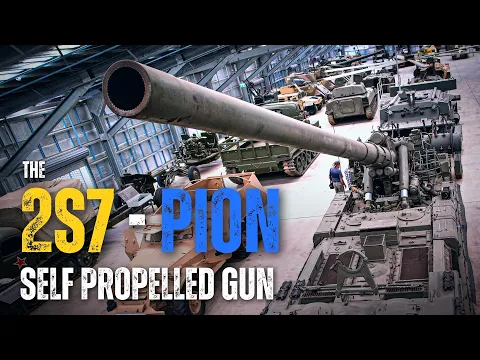
Even when loaded only with conventional ammunition, the fact that it is compatible with this type of armament placed the 2S7 in a completely different category from common artillery.
Precision, Brutality and Use Doctrine
Contrary to what many imagine, the 2S7 was not made to fire “blindly.” The doctrine foresaw the combined use of forward observers, aerial reconnaissance, and later, drones, for fire correction and precise targeting of high-value targets.
Its ideal employment was not against shallow trenches or dispersed infantry, but rather against strategic targets that justified the logistical cost and preparation time, such as:
- Fortified Headquarters
- Ammunition and Fuel Depots
- Air Defense Systems
- Critical Infrastructures
- Deeply Buried Bunkers
In other words, it was not a tactical support weapon but a strategic coercion tool on the battlefield.
From Pion to Malka: The Silent Modernization
With the end of the Soviet Union, many believed that systems like the 2S7 would be retired. The opposite happened. Russia chose to modernize it, giving rise to the 2S7M Malka.
The improvements did not focus on the gun—which was already devastating enough—but on mobility, electronics, communications, and integration with modern command and control systems. The result was a system capable of operating in contemporary battle networks, receiving real-time coordinates and adjusting fire much more quickly.
This update extended the lifespan of the Pion/Malka far beyond what was imagined in the 1990s.
Real Use and Contemporary Relevance
Unlike many extreme projects of the Cold War that never went beyond prototypes, the 2S7 was produced in series, integrated into the armed forces, and maintained operational for decades.
Its reappearance in recent conflicts drew attention exactly because it revealed something uncomfortable for modern military thinking: heavy artillery of large caliber still has a relevant role, especially in wars of attrition and systematic destruction of infrastructure.
While many countries have bet exclusively on guided munitions and air strikes, the Pion reminds us that nothing completely replaces the ability to launch over 100 kg of explosives nearly 50 km away, repeatedly, without depending on airspace control.
Why No Direct Equivalent Has Emerged in the West?
One of the most curious points is that there is no direct equivalent to the 2S7 in the modern Western arsenal. NATO focused efforts on high-precision 155 mm artillery, combined with guided munitions and air power.
This does not mean the Soviet concept was wrong, but rather that the doctrines diverged deeply. While the West prioritized flexibility and surgical precision, the Soviet Union—and later Russia—maintained the logic of mass destruction of strategic targets in depth. The Pion is the extreme embodiment of this philosophy.
A Symbol of Military Engineering Without Compromise
In the end, the 2S7 Pion/Malka is not just a weapon. It is a symbol of an era when military engineering did not seek elegance, but brute supremacy. Every aspect of the design—from the absurd caliber to the colossal weight, from heavy logistics to compatibility with special munitions—reveals a clear mindset: if something needs to be destroyed, it will be, regardless of the cost.
Few systems encapsulate the logic of the Cold War as well as this tracked gun. And the fact that it still exists, modernized and operational, shows that some ideas deemed “exaggerated” continue to make sense when the goal is absolute deterrence.







A Rússia é uma potência os **** não aceitam.
Alguns desses foram usados recentemente na guerra da Ucrânia com munição teleguiada. Precisão e poder de destruição absurdos combinados. O problema é que o governo libera pouquíssimas munições teleguiadas para os operadores e eles precisam economizar ao máximo.
Só não mostrou onde caiu, e o valor real de destruição.