Portuguese
  Spanish


Pickups equipped with tracks gained attention by transforming well-known models into off-road vehicles, with expensive adaptation, rural application, and restrictions for driving on public roads in Brazil.
Two pickups adapted with tracks instead of wheels gained attention on social media after appearing in Goiânia (GO).
The modification was made on a Mitsubishi L200 and a Ford Ranger Raptor, which started circulating in images and videos with a mechanical setup similar to that used in heavy-duty vehicles, such as agricultural machinery and equipment prepared for difficult terrain.
The comparison to a “war tank” arose due to the appearance of the vehicles after the wheel swap.
-
1983 Chevrolet Runs Over 100,000 km Without Gasoline, Powered by Wood Chips, Reaches 125 km/h in Airport Test

-
Workshop Converts Giant Tractor Tire Tricycle into a Three-Wheel Drive Hybrid with 36,000-Watt Electric Motor Capable of Climbing Hills

-
Sales of Brazil’s Cheapest Electric Car Halted Before First Deliveries: E-Motors Suspends Emova Easy Due to Import Tax Increase and Rising Freight Costs

-
Nissan Discontinues Qashqai SUV Amid Cost-Cutting, Chinese Competition, and Product Line Review

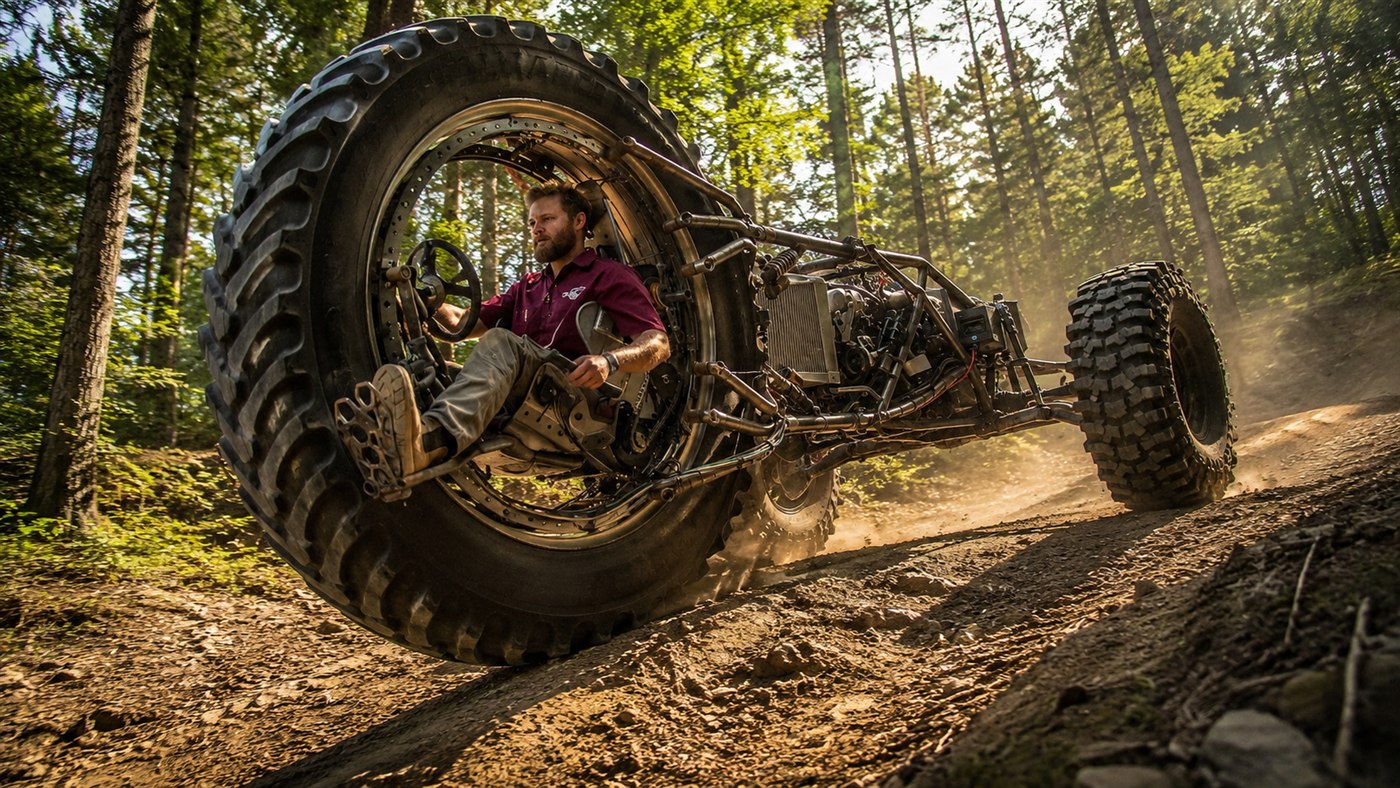


Instead of conventional tires, the trucks received track modules, a system that increases the contact area with the ground and is used in situations where regular traction might be insufficient.
This type of equipment appears more frequently in off-road operations, rural areas, muddy sections, soft soil, sand, snow, or uneven terrain.
In the case of the pickups shown on social media, the adaptation draws attention by combining well-known models with a feature normally associated with service vehicles.
The body remains recognizable, but the ground clearance increases, and the setup changes the appearance and dynamic behavior of the truck.
How tracks work on pickups
The replacement of wheels with tracks does not necessarily require a complete reconstruction of the vehicle.
In systems of this type, the tire is removed, and the track module is installed at the point where the original wheel would be attached.
The fitting occurs at the vehicle’s hub, with components and supports compatible with the chosen application.
The mechanical logic is similar to that of a wheel, but with an important difference: the contact with the ground no longer occurs only through the tire tread and is distributed over a larger surface.
This distribution helps reduce the risk of getting stuck in low-traction terrains, provided the setup is correctly sized for the vehicle’s weight and use.
Although the installation can be described as relatively simple, the change affects various aspects of the pickup.
The ground clearance increases, the steering may become heavier, the suspension starts to work differently, and the mechanical setup experiences different stresses than those intended for the original use with tires.
There is also an impact on driving dynamics.
With tracks, the vehicle tends to behave differently in curves, braking, acceleration, and maneuvers.
Therefore, vehicle modification specialists treat this type of adaptation as a significant alteration, even when the kit can be removed later.
Use of tracks on farms and difficult terrains
Tracks are known in vehicles and machines that need to operate on unstable surfaces.
Tractors, harvesters, excavators, rescue vehicles, and mining equipment use this type of system precisely to maintain mobility in places where common wheels may lose efficiency.
In Brazil, the application usually makes sense in rural areas, farms, muddy regions, and operations on unpaved terrains.
In other countries, similar sets are also used in vehicles prepared for snow, services in remote locations, and off-road travel.
The difference, in this case, lies in the adaptation made to pickup trucks known to the public.
The Mitsubishi L200 and the Ford Ranger Raptor are models associated with the pickup truck segment but received a set closer to severe professional applications.
This combination helps explain the impact of the images, without implying that the modification is common in the Brazilian market.
The use of tracks on a pickup truck can meet specific needs for travel on private property.
Even so, the purpose of the vehicle changes when the set is installed.
The pickup truck no longer has the original factory configuration and requires care compatible with preparation for difficult terrain.
Price to transform a pickup truck with tracks
The cost is one of the factors that limit this type of adaptation to more specific uses.
According to the original report, sets sold abroad for pickups and SUVs can range from US$ 25,000 to US$ 35,000.
For heavy pickups and SUVs, the mentioned range goes from US$ 35,000 to US$ 50,000.
In an approximate direct conversion, without considering freight, taxes, nationalization, installation, and possible mechanical adjustments, these values would be between about R$ 125,000 and R$ 255,000.
The final price in Brazil can be higher, depending on the imported model, the type of application, and the expenses involved in the process.
Rafael Cascão, owner of the Mitsubishi L200 shown in the publications, stated in one of the posts that importing the tracks would not cost less than R$ 120,000, even in a condition he considered cheap.
The statement helps to size the investment, but it does not allow for determining the final price paid for the two displayed pickups.
Foreign manufacturers operating in this segment usually sell different sets according to the weight, size, and purpose of the vehicle.
Therefore, a light truck, a heavy pickup, an SUV, and a truck require systems with different capacities.
The technical specification directly affects the cost, installation, and recommended use.
Can a pickup with tracks circulate on public roads?
Circulation on public roads is the point that requires the most legal attention.
Marco Fabrício Vieira, counselor of Cetran-SP, stated that it is not allowed to drive on public roads with this kit in cars.
According to him, the track system represents a profound structural alteration, as it affects the vehicle’s dynamics, suspension, and the effort required from the engine.
In the specialist’s assessment, even if the adaptation is reversible, the vehicle remains altered while equipped with the set.
To circulate legally, it would be necessary to go through homologation and regularization with the competent traffic authorities.
Brazilian legislation provides rules for vehicle modifications.
The Contran Resolution No. 916, of March 28, 2022, deals with the granting of brand, model, and version codes, as well as procedures related to prior authorization, the Vehicle Safety Certificate, and the Certificate of Compliance with Traffic Legislation, when applicable.
The National Traffic Secretariat, Senatran, is the highest executive traffic authority of the Union.
In the case of significant alterations, regularization must follow the rules provided by the National Traffic System.
Without this process, the use of vehicles with this type of modification tends to be restricted to private areas or controlled environments, according to the purpose of the preparation.
Pickup adaptation resonates on social media
The resonance on social media occurred mainly due to the visual transformation of the pickups.
By replacing the tires with tracks, the vehicles retain the original body but assume a configuration rarely seen on Brazilian streets and roads.
Off-road projects with elevated suspension, larger tires, and trail accessories are known among pickup owners.
However, track sets appear less frequently, mainly due to cost, specific purpose, and restrictions for use on public roads.
In rural properties, the equipment can have practical applications when movement occurs on terrain with mud, holes, unstable soil, or sections where conventional vehicles lose traction.
Outside of this context, the adaptation requires technical evaluation, regularization, and compatibility with the intended use.
The modified L200 and Ranger Raptor in Goiânia show a preparation aimed at specific off-road mobility situations.