Portuguese
  Spanish


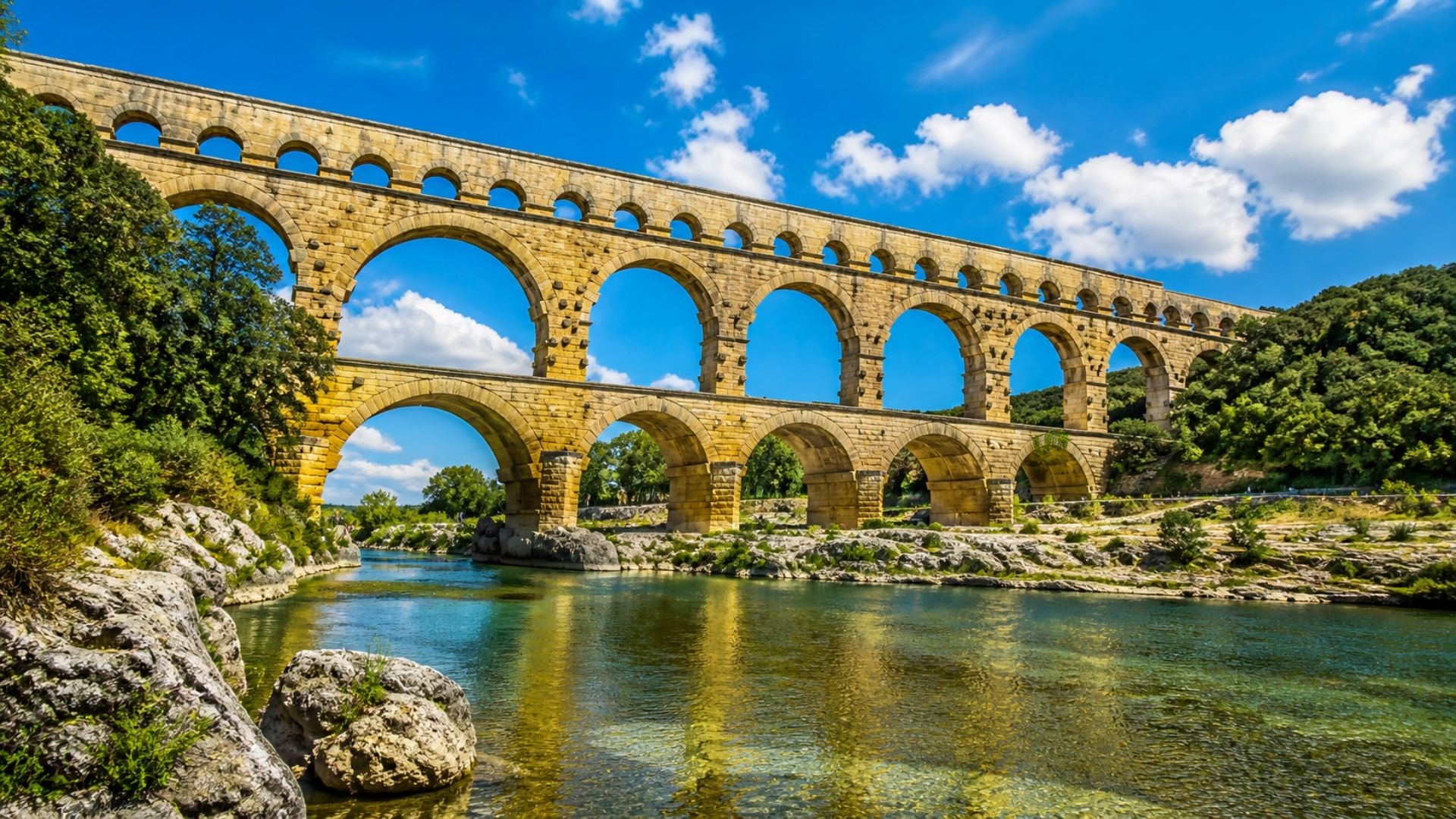


Stone, precise calculation, water flowing by gravity, and a minimal slope transformed the Pont du Gard, in the south of France, into an aqueduct considered one of the most impressive works of Roman engineering.
Stone was the central element of a solution that seemed almost impossible for its time. Built by the Romans in the 1st century, the Pont du Gard was erected to allow the Nîmes aqueduct to cross the Gardon River in the south of France, maintaining an average drop of only about 25 centimeters per kilometer along approximately 50 km. The result was a three-level structure that reaches almost 49 meters in height and 275 meters in length.
According to the Axómetro portal, what transforms the monument into something greater than an ancient bridge is precisely the magnitude of the challenge overcome. The Romans not only needed to cross a deep valley but also to make the water flow by gravity with extreme precision to Nîmes. And they achieved this in a work that UNESCO describes as a technical and artistic masterpiece, while the official Pont du Gard website itself presents it as the highest bridge-aqueduct in the Roman world.
The strongest detail lies in the almost invisible precision that sustains the entire work
The most impressive number of the project might not even be its height, but the subtlety of its slope. According to the monument’s official website, the aqueduct was designed with an average incline of only 25 centimeters per kilometer, one of the smallest ever recorded for this type of work, which required extremely rigorous calculations for the water to flow by gravity without stopping or gaining too much speed.
-
Giant 3,600-ton Crane Breaks Two World Records by Installing World’s Largest Single-Piece Forged and Welded Hydrogenation Reactor, Weighing 3,037 Tons, in Chinese Petrochemical Plant in Just Six Days

-
$80 Million Bridge in Brazil Cuts Travel Time from 30 Minutes to 1 Minute, but Audit Reveals Major Flaws
-
Man Builds Stone Bed with Granite Rocks and Hand-Sawn Cedar Beams, Home Extension Garners Over 437,000 Views on Bonus Bolts Channel

-
Brazilian Researcher Develops Color-Changing Roof Tile to Reduce Air Conditioning Use by Up to 15%



This precision helps explain why the Pont du Gard remains so fascinating. The aqueduct bridge was not an isolated construction, but the most spectacular part of a hydraulic system of about 50 km created to supply Nîmes, ancient Nemausus, with large volumes of water. In other words, the monumental structure that has survived to this day was, in practice, a functional link in a much larger urban infrastructure.
The curious twist is that the Romans built everything almost without mortar

One of the points that most impress historians and visitors is how the structure was assembled. Encyclopaedia Britannica highlights that the Pont du Gard was built without mortar between the blocks, relying on the precision of the cut and the weight of the pieces to keep everything stable. This transforms the work into a kind of monumental stone puzzle, where fitting and mass were an essential part of the engineering.
This choice helps to gauge the degree of technical control involved. The monument was erected in three levels of arches, with the largest one crossing the river and reaching about 24 meters in span, an extraordinary feat for Roman engineering. The official website itself states that the structure originally had 47 arches on the upper level, plus 11 on the intermediate level and 6 at the base, reinforcing the rare nature of the composition for its time.
The context of the work shows that it was born to sustain luxury, power, and urban life
The aqueduct was built around 50 AD, during the reigns of Claudius or Nero, when Nîmes was growing as a Roman city and needed more water for its urban functioning. The monument’s official website states that this infrastructure supplied the city for about five centuries, serving uses related to the public and private life of an expanding Roman colony.
This context changes the interpretation of the monument. The Pont du Gard was not just a demonstration of architectural strength, but a strategic piece of a city that wanted to live according to the Roman standard, with stable water supply for fountains, baths, and residences. That is why UNESCO does not treat it merely as a bridge or a ruin, but as the main element of a hydraulic system that helped shape regional urban life.
Why this work still changes the way we look at ancient engineering


The Pont du Gard debunks the idea that great ancient works impress solely by their size. Here, what continues to amaze is the combination of scale and precision. The structure rises almost 49 meters, crosses the Gardon with three levels, and maintains a hydraulic channel at the top, all within minimal margins of error for a work built about two thousand years ago.
That’s why the monument is still treated as a symbol of Roman engineering. It shows that the Romans not only mastered the construction of large volumes in stone but also hydrology, slope calculation, structural resistance, and adaptation to the terrain. It’s no coincidence that UNESCO included it on its World Heritage list in 1985, recognizing its outstanding universal value.
What still intrigues historians about the work

Even with centuries of study, some points remain in debate. Britannica records that the aqueduct was once attributed to Agrippa, at the end of the 1st century BC, but more recent excavations suggest construction between 40 and 60 AD. The official website, however, works with a dating around 50 AD, under Claudius or Nero. This shows that the exact chronology and the final political attribution of the work are not yet considered a completely closed matter.
Another reason for the continuous fascination is that the structure survived not only time but also centuries of changes in use and conservation. The aqueduct ceased to function long after classical antiquity, but the monument remained standing and passed through different historical periods until it became one of France’s great heritage symbols. What is still debated, ultimately, is not whether it was a prodigy, but how such a precise combination of calculation, stone, and scale managed to endure for so long.
In the end, what is most impressive about the Pont du Gard is that its grandeur is not just in what is seen. The monumental stone, the 49 meters of height, and the 275 meters of extension catch the eye, but the true astonishment lies in what flowed within it: an engineering solution fine enough to carry water for 50 km with a minimal incline and solid enough to continue challenging the present two thousand years later.