Portuguese
  Spanish


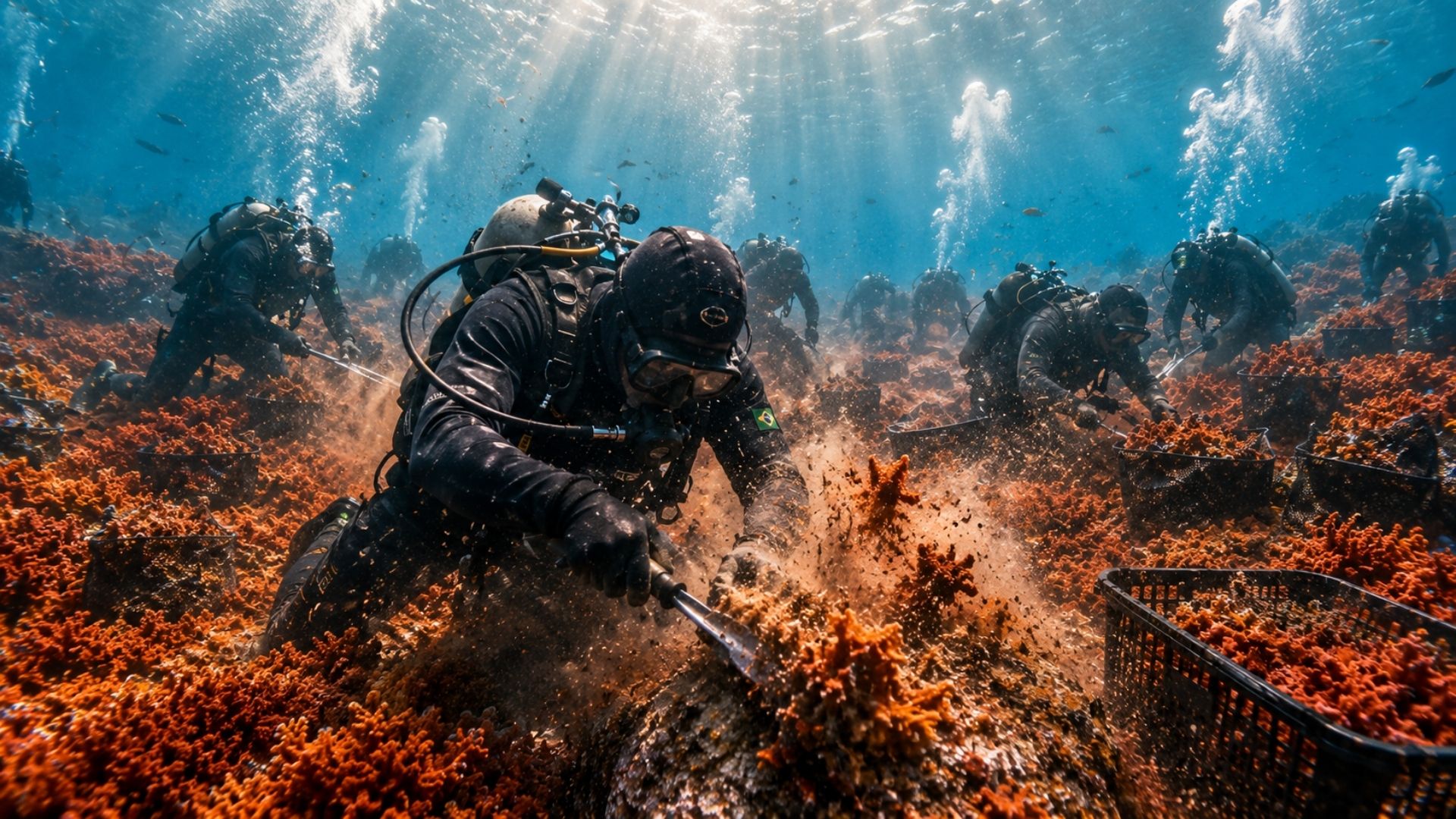

A task force of the Brazilian Navy removed 5,549.57 kilos, about 5.5 tons, of invasive coral from the Bay of All Saints, on Itaparica Island (BA). It was the first large-scale operation to eradicate the species in Brazil, and brought together military personnel, divers, universities, state and federal agencies, and volunteers from the region itself.
According to the Navy News Agency, the action brought together the corporation and a group of researchers to contain the advance of the bioinvasive octocoral Chromonephthea braziliensis, known as sun coral, the species that was threatening the native biodiversity of the Bay of All Saints. According to Correio 24h, 5,549.57 kilos of this invasive coral were removed, the largest volume ever collected of the octocoral in a single work front on the Brazilian coast, in an effort that became a national reference in combating bioinvasion.
The story behind this number begins underwater, in a stretch of sea that seems calm on the surface, but was silently being taken over by an invasive coral without natural predators. What the divers found at the bottom was a living carpet spreading over rocks, hulls, and submerged structures, suffocating local marine life and raising the alarm throughout the region.
The day the Navy went into the water
The operation had the atmosphere of a military mission, because that was exactly it. In May 2025, teams from the corporation descended into the waters of Itaparica Island with a clear objective: to remove as much invasive coral as possible before the bioinvasion advanced to new points in the Bay of All Saints. Trained divers, cylinders on their backs, took turns searching the seabed almost inch by inch.
-
Researchers want to change the way of producing rare earth magnets, reducing purification steps and making better use of the elements found in Swedish deposits.

-
A Brazilian project dumped 5,500 concrete blocks and 2 barges into the ocean to block trawling in Paraná, and 25 years later what seemed like a risky intervention turned into an underwater nursery, a diving spot, and a refuge for endangered species.
-
Micron invested $9.3 billion in a factory in Hiroshima to produce the memory that powers the brain of global artificial intelligence.
-
Few people know, but China photographed for the first time Earth’s “quasi-moon,” a small asteroid that accompanies our planet around the Sun and may be a fragment torn from the Moon millions of years ago.




It was not a dive for contemplation. Each coral colony needed to be located, evaluated, and removed with almost surgical care, to avoid spreading fragments capable of generating new colonies. The species carries a treacherous characteristic: when manipulated carelessly, it reproduces from its own loose pieces, and what was a cleanup can turn into a new wave of contamination.
Therefore, the Navy did not undertake this endeavor alone. Alongside them were researchers, environmental technicians, and residents who know every corner of that sea. The declared goal was never just to collect the coral in a single day, but to test, in practice, a method that could be repeated on a scale, serving as a model for other coastal states facing the same invader.
Who is the invisible enemy of the Bay of All Saints
The villain of this story has a difficult scientific name: Chromonephthea braziliensis. It is a soft and flexible skeleton octocoral, in shades ranging from reddish to white, nicknamed sun coral. Beautiful from afar, devastating up close. This species does not belong to Brazilian waters, and its arrival is a classic case of silent bioinvasion, the kind that no one notices until it’s too late.
The problem with the invasive coral was never its appearance, but its hunger for space. Without natural predators in the bay, the octocoral multiplies at an accelerated pace, covering rocks, native corals, and practically any firm surface it encounters. Where the invasive coral settles, the original fauna and flora lose ground, and the delicate local food chain begins to crumble.
The fishermen in the region were the first to feel the effects of the invasion firsthand. Fish that used to appear in abundance began to disappear because the invasive coral transforms the habitat that served as a nursery and shelter for dozens of organisms. An invasion like this is not an abstract environmental problem: it affects the food, income, and future of those who live off the sea in the region.
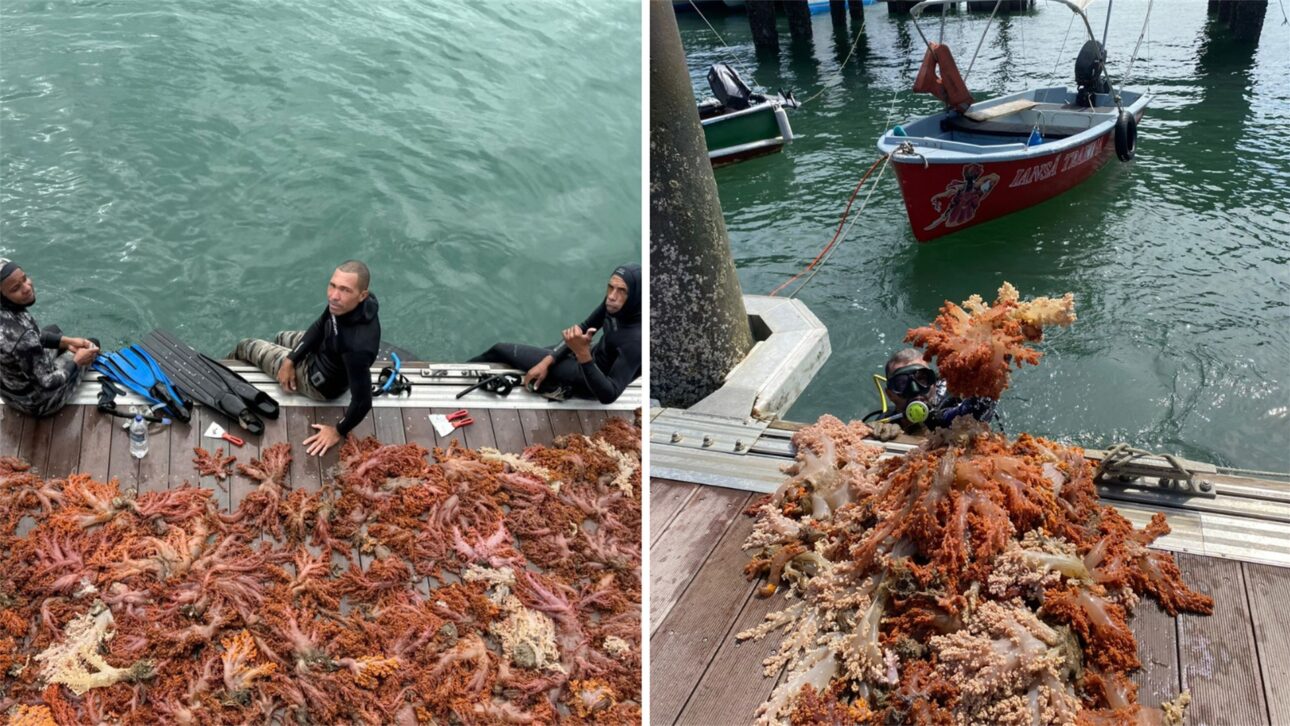
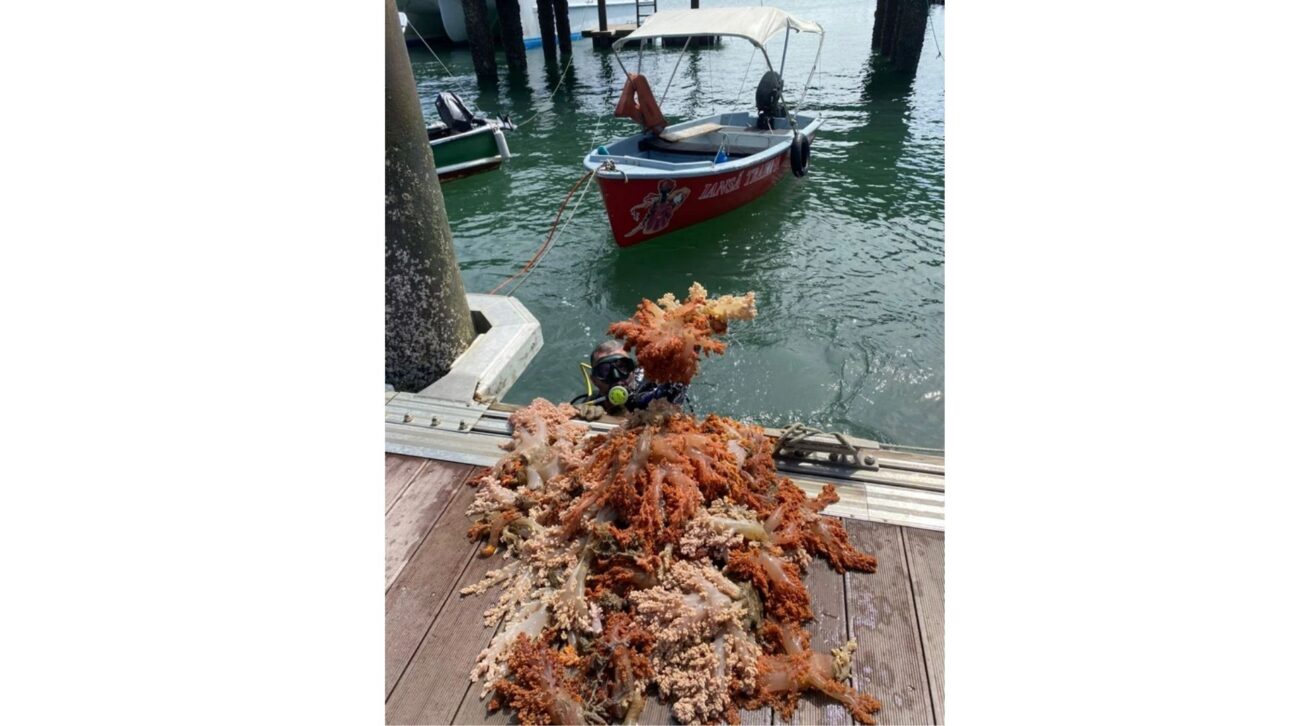
Colonies of the invasive coral Chromonephthea braziliensis collected from the bottom of the Bay of All Saints during the operation. (Photo: Reproduction/Correio 24h)
A task force that brought together uniforms, science, and fishermen
What impresses in this story is not just the weight collected, but the collaboration among very different people. The Brazilian Navy coordinated the logistics and diving part, but the fight against the invasive coral was only possible because universities, state and federal environmental agencies, and local volunteers joined together in the same endeavor.
Researchers from federal universities provided the technical foundation, helping to identify the species, map the most affected areas, and define the best way to remove it without spreading the bioinvasion. Environmental agencies contributed with supervision, licenses, and planning, while the military ensured the heavy structure to operate safely within the bay.
And there were the volunteers, many of them fishermen and residents of Itaparica Island, who know that sea better than any map. They were the ones who, over the months, helped point out where the coral was most concentrated. This mix of uniforms, science, and popular knowledge became the backbone of the operation and explains why it managed to collect so much material in such a short time.
Steel brush, firm hands, and acidic salt: how the coral was removed
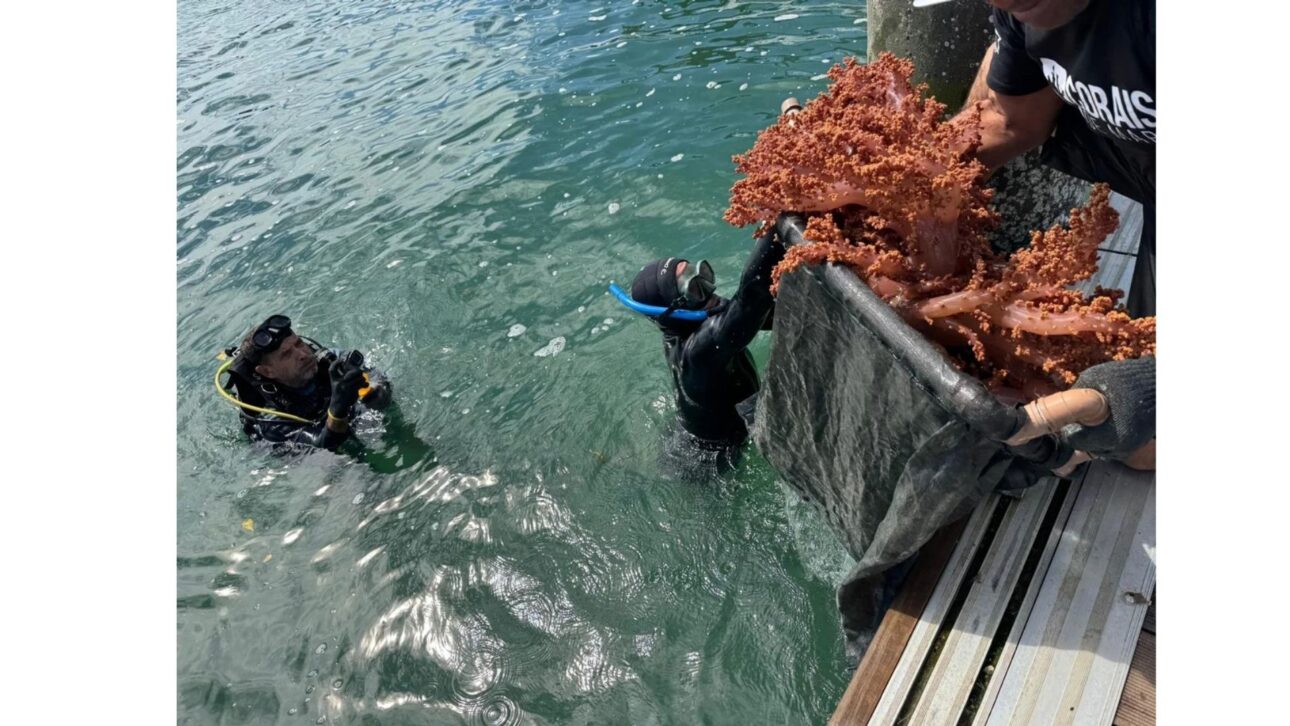
Combating the invasive coral is not a task of just pulling and throwing away. The method used in the Baía de Todos-os-Santos was designed precisely not to stimulate the reproduction of the octocoral during removal. In most areas, the removal was manual: divers detached the colonies one by one and cleaned the substrate, that is, the surface where the coral was attached.
To ensure nothing was left behind, the steel brush came into play. After removing the colonies, the teams scrubbed the rocks and structures to remove any trace of the organism, preventing tiny fragments from regrowing and restarting the infestation from scratch. It is a manual, repetitive, and demanding job, done underwater and against the clock.
In deeper areas, where manual removal is risky, the task force resorted to an acidic salt solution applied directly to the invasive coral colonies. The technique attacks the octocoral without requiring divers to stay too long at great depths. The combination of firm hands, steel brush, and acidic salt was what allowed the fight against the invader in different scenarios within the same operation.
5,549.57 kilos: the account of a cleanup done in stages
The number that named the operation did not come in one go. The 5,549.57 kilos of invasive coral were collected in stages, as the teams advanced through different points of Ilha de Itaparica. In the first phase, 2,939.42 kilos of the invader were removed. In the second, another 2,610.15 kilos, totaling the 5.5 tons that made history.
Collecting this volume required surgical planning. Each kilo of coral removed had to be taken out of the water, weighed, and safely discarded, so the octocoral would not return to the sea by accident. The precision of the number, with decimal places, shows the level of technical control of the operation: here, every gram of the invader counted mattered.
Put into perspective, 5.5 tons is equivalent to the weight of several popular cars stacked. However, instead of metal, it was live coral, removed colony by colony from the bottom of the Bay of All Saints. It is this size that makes the action the largest eradication operation of the species ever carried out in Brazil, a milestone in the fight against marine bioinvasion in the country.
Why bioinvasion scares scientists so much
For those on the beach, a coral may seem harmless. But the bioinvasion caused by the invasive coral Chromonephthea braziliensis is, for scientists, one of the most serious threats to the Bay of All Saints. The logic is simple and frightening: a species without natural predators, that reproduces quickly and occupies any space, tends to transform the entire ecosystem in its image.
When the invasive coral dominates a rocky shore, it expels native organisms, reduces life diversity, and impoverishes the entire chain. Fish lose shelter, native algae lose space, and the balance built over centuries is undone in a few years. The invasion does not kill at once: it suffocates gradually, and when the effects become visible, reversing it is much more costly.
There is also the risk of the species jumping from the bay to other parts of the coast, carried by ship hulls and sea currents. It is this potential for spreading that keeps researchers awake at night. Containing the invasive coral at a single point is not enough if the bioinvasion can restart a few kilometers away, in a chain reaction difficult to stop once it gains momentum.
From Itaparica to the rest of the Brazilian coast
More than cleaning a piece of the sea, the task force operation in the Bay of All Saints was born to become a model. It was the first time the country faced the invasive coral on a large scale, and each step was documented to serve as a manual for other coastal states that already deal, or will soon deal, with the same type of invader.
The reasoning of those involved is that the invasion does not respect state borders. If it worked in that bay, the same protocol of early detection, manual removal, steel brush, and acidic salt solution can be adapted for Espírito Santo, Rio de Janeiro, or any coast where the invasive coral appears. Turning the experience into a replicable script is perhaps the most valuable legacy of the task force.
Quick detection and immediate action became the motto. The sooner a new colony of the invader is located, the cheaper and more effective the response. Waiting for the octocoral to settle means, in practice, condemning oneself to gigantic operations like this, of tons and tons. The model from Itaparica advocates the opposite: act while the advance still fits in the palm of your hand.
What still threatens the Bay of All Saints
Collecting 5.5 tons of invasive coral was a victory, but no one involved in the operation considers the war won. The species is persistent, and just one forgotten fragment is enough for the bioinvasion to restart. Therefore, continuous monitoring of the region has become an inseparable part of the fight, with periodic dives to check if the invasive coral has regrown.
The control of vessels arriving at the location has also come under scrutiny. Since the species hitchhikes on boat hulls, tightening inspections and educating the maritime community about the risks of bioinvasion is as important as removing colonies from the seabed. Preventing the arrival of new outbreaks costs much less than remedying an infestation already spread across the bay.
There is also the educational front. Teaching fishermen, divers, sailors, and bathers to recognize the invasive coral and to alert authorities turns every resident into a bay watchman. This is how the bioinvasion began to be mapped, and it is how it can be contained in the future. The largest eradication operation of the species ever conducted in Brazil showed that it is possible to react, but left a question hanging: how many other bays across Brazil are already being taken over, right now, by an invasion that no one can see from the shore?