Portuguese
  Spanish


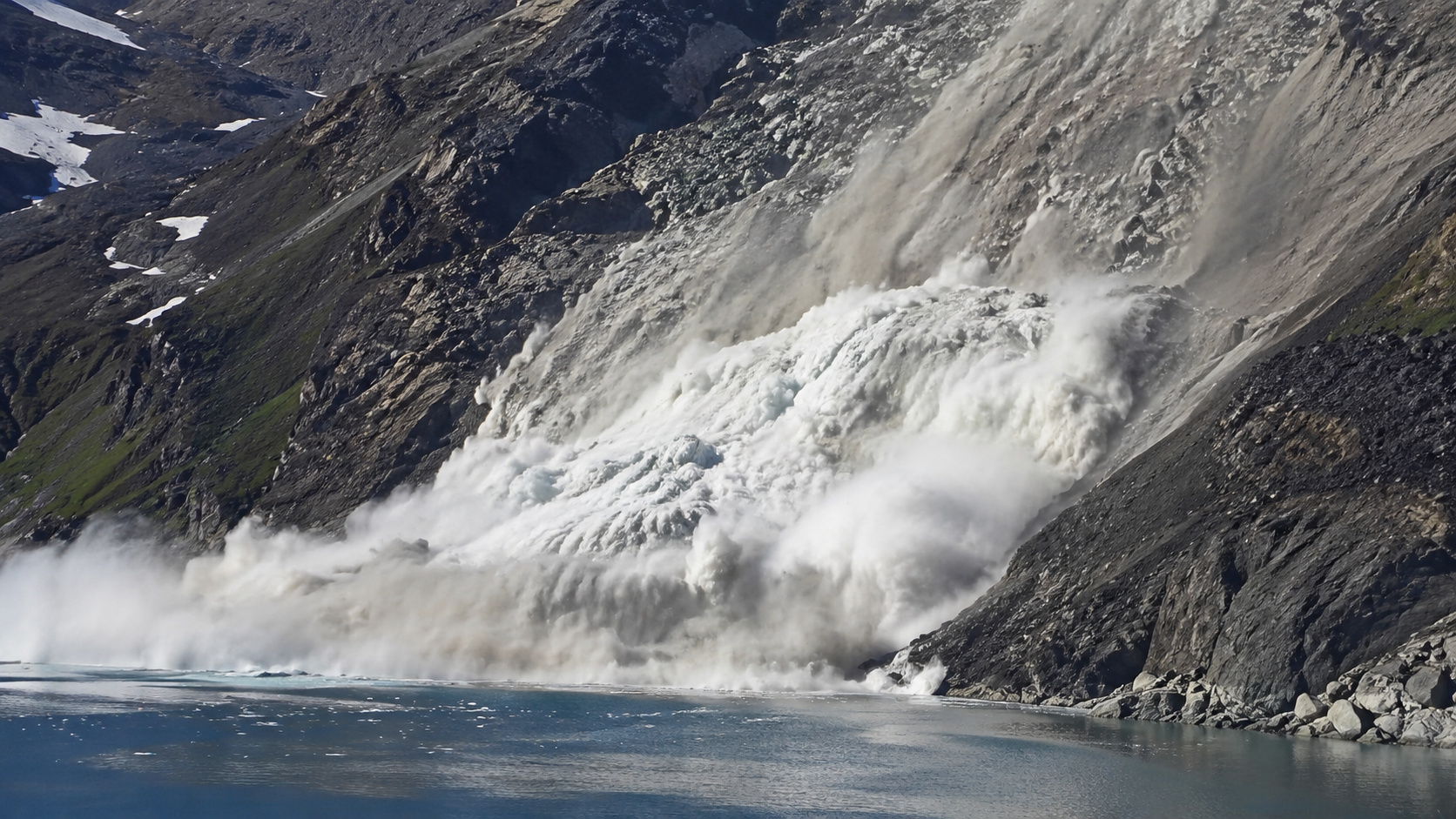

200-meter megatsunami in Greenland made the Earth vibrate for 9 days after 25 million m³ of rock and ice fell into a fjord.
A strange, global, and persistent seismic signal appeared on Earth’s sensors in September 2023. It did not behave like an earthquake, lacked the chaotic signature of a tectonic rupture, and repeated an almost monotonous vibration, as if the planet had been turned into a bell ringing every 90 seconds. The answer came from an international effort with 68 researchers from 40 institutions in 15 countries. The study showed that 25 million m³ of rock and ice plunged into the Dickson Fjord, in eastern Greenland, generated a 200-meter megatsunami and kept the water trapped in the fjord oscillating for nine days.
Megatsunami in Greenland began with the collapse of a 1.2 km mountain over the Dickson Fjord
The event began on September 16, 2023, in a remote region of northeastern Greenland. A slope that once rested on glacial ice lost stability and collapsed towards the fjord.
According to the researchers, the collapse involved more than 25 million m³ of rock and ice, enough volume to fill about 10,000 Olympic swimming pools. The mass fell onto the Dickson Fjord and displaced a colossal amount of water.
-
She spent 73 years breathing inside an iron lung, survived the aftereffects of polio, and became the last woman in the United States dependent on the equipment before dying at 78 years old.

-
Brazilian students created a $1 filter using pine bark, cotton, and 3D-printed parts to clean cassava wastewater, reduce the toxicity of a hazardous waste, and transform contaminated water into biofertilizer.

-
Astronaut from Artemis II steps down after mission to the Moon and decision surprises after a record of 406,771 km, a historic 10-day journey, and an unprecedented achievement for Canada.

-
A fossil kept for years in a small museum in Montreal concealed 450-million-year-old soft tissue, a discovery that has only happened once before in history.


The result was an initial wave estimated at 200 meters high, one of the largest recorded in recent times. Instead of dissipating quickly, the energy remained trapped in the narrow and winding geometry of the fjord.
Earth vibrated for nine days with a seismic signal that confused scientists from the Arctic to Antarctica
The signal was detected by seismometers spread across the planet, from the Arctic to Antarctica. The strangest thing is that it did not seem like a common earthquake.
Earthquakes produce records rich in different frequencies. The Greenland event, on the contrary, had a unique, persistent, and repetitive vibration, with a period of approximately 92 seconds.
The scientists even called the phenomenon a USO, an acronym in English for “unidentified seismic object”. Only after the combination of seismic data, satellite images, local measurements, and numerical simulations was the puzzle solved.
Fjord acted like a giant bathtub and kept the water sloshing from side to side
The central phenomenon was a seiche, an oscillation of water trapped within a basin, lake, or fjord. It’s like when the water in a bathtub sways from side to side after an impact.
In Dickson Fjord, the narrow, deep, and curved shape prevented the energy from escaping quickly. The initial wave lost height, but the mass of water continued to move at a regular pace.
Simulations showed that this movement went back and forth every 90 seconds, practically the same interval recorded in global seismic signals. It was this oscillation that made the Earth’s crust vibrate for nine days.
4-meter wave still damaged research base 70 km from the landslide
Even far from the initial point, the tsunami remained strong. About 70 km from the landslide, waves approximately 4 meters high damaged a research base in Ella Ø.
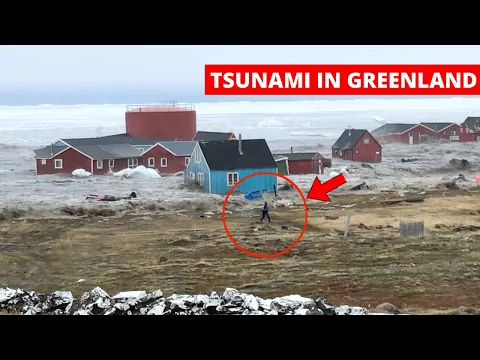
The event also destroyed cultural and archaeological sites in the fjord system. There were no fatalities because no tourist vessels were nearby at the time of the collapse.
This detail is critical: the region is part of routes used by Arctic cruises. If a ship had been in the fjord at the time of the megatsunami, the outcome could have been much more severe.
Climate change entered the disaster chain by weakening the ice that supported the slope
The study did not treat the event as a simple isolated geological accident. The authors linked the collapse to glacial thinning at the mountain’s base, a process connected to climate warming.
With less ice supporting the slope, the rocky wall lost support. This type of instability tends to grow in polar regions, where glaciers, permafrost, and steep slopes respond quickly to rising temperatures.
Greenland had already recorded tsunamis generated by landslides in other regions. The 2023 case, however, was the first of its kind observed in eastern Greenland and drew attention due to the rare combination of collapse, tsunami, and global seismic signal.
Catastrophe showed that regions once considered stable can generate extreme risks
The most concerning point of the research is that the event occurred in a remote area, poorly monitored and considered unlikely for a chain of impacts of this scale. The mountain fell, the fjord amplified the wave, and the entire Earth recorded the effect.

This changes the way scientists look at polar regions. Areas once seen as stable can become sources of giant landslides, local tsunamis, and risks for communities, scientific bases, and polar tourism.
The study advocates for more intense monitoring in zones of accelerated melting. In a warmer Arctic, the danger is not only in the disappearing ice but in the mountains that may lose support when this ice retreats.
200-meter megatsunami revealed a new face of extreme climate disasters
The case of Greenland shows a rare sequence of connected effects: warmer atmosphere, thinner ice, unstable slope, giant landslide, tsunami, seiche, and global crust vibration.
The strength of the discovery lies precisely in this. It was not just a high wave in a remote place. It was a cascading catastrophe, capable of uniting climate, ice, ocean, rock, and seismology in a single planetary event.
The Earth vibrated for nine days because a mountain fell into a fjord, and this may be the most brutal warning that polar warming is already creating disasters that science was just beginning to imagine.