Portuguese
  Spanish


Charcoal fragments preserved for 780,000 years in Gesher Benot Ya’aqov, Israel, show that ancient hominids used driftwood accumulated on the shores of a lake to maintain fire, cook fish, and repeatedly occupy a resource-rich landscape
Charcoal fragments from 780,000 years ago found at the Acheulian site of Gesher Benot Ya’aqov, Israel, reveal that hominids occupying the shores of the ancient Hula Lake used available driftwood in the landscape to maintain fireplaces and organize daily life.
The research, led by archaeologists from the Institut Català de Paleoecologia Humana i Evolució Social and Bar-Ilan University, analyzed remains preserved in an occupation layer dated to approximately 780,000 years ago. The material shows that survival depended less on the search for ideal wood and more on environmental knowledge.
Gesher Benot Ya’aqov preserves a sequence of human occupations on the shores of the paleo-lake Hula. More than 20 archaeological horizons document generations of Acheulian hunter-gatherers returning to the same location, where water, plants, animals, raw materials for tools, and fuel were available.
-
New Discovery Suggests Prehistoric “Hobbits” May Have Survived on Komodo Dragon Remains

-
Tiny 10-centimeter fish in Brazilian reservoirs may play a surprising role in reducing methane emissions, scientists find.
-
ChatGPT Creator Bets Big on Fusion Energy Machine Promising Unlimited Power for Microsoft by 2028, But Physicists Skeptical

-
Time Travel Proven Possible by Science, Yet a Mystery Still Challenges Einstein, Quantum Physics, and Top Scientists
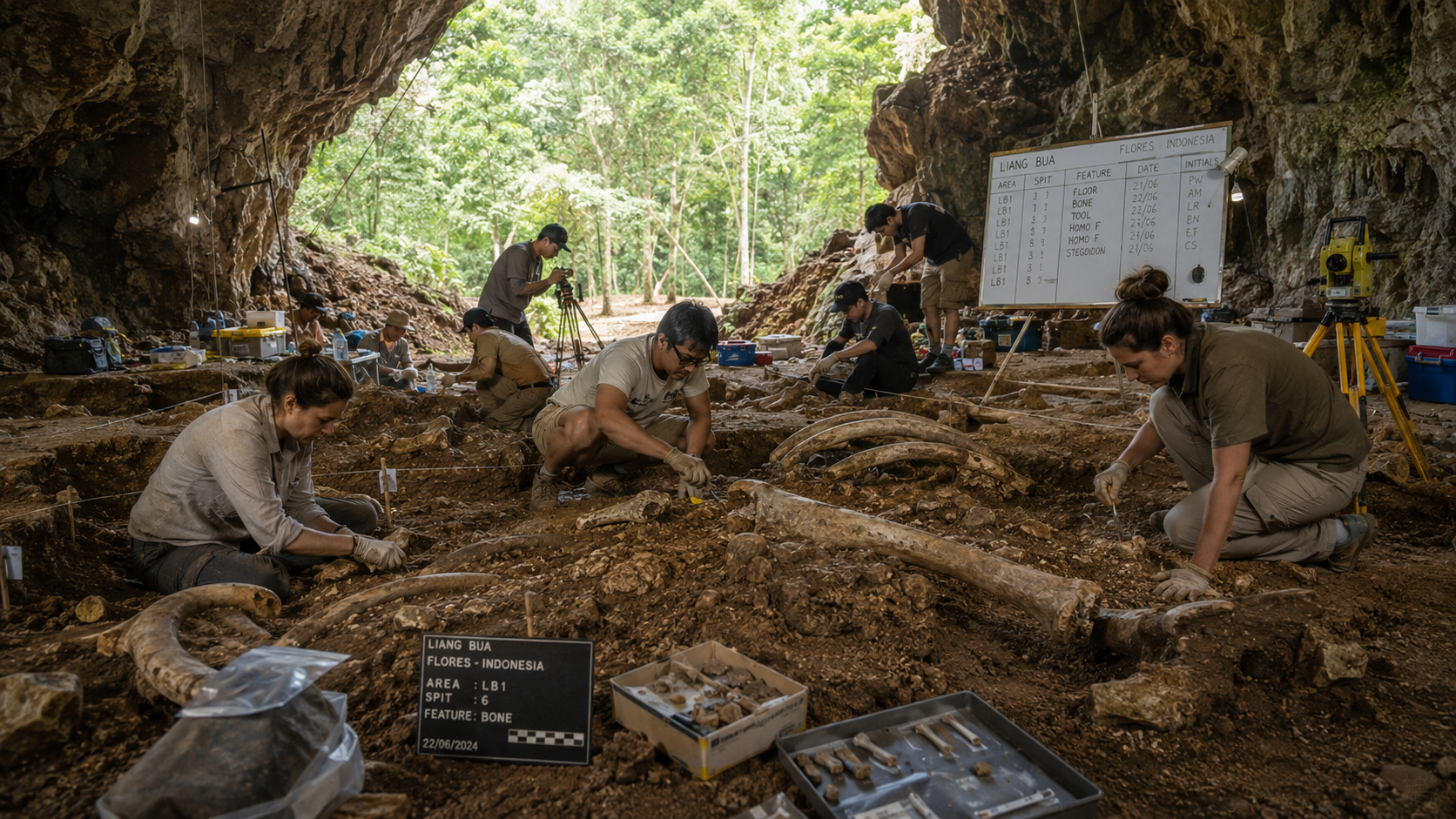



Preserved charcoal opens a rare window into the use of fire
Charcoal rarely survives in prehistoric sites so ancient, making the set found in Gesher Benot Ya’aqov an unusual source for understanding the daily practices of the first fire users. The site offers a detailed record of the repeated use of flames.
In the ancient camp, researchers identified an intense landscape of activities. There were stone tools produced with flint, limestone, and basalt, remains of hunted animals, and various plant foods, such as fruits, nuts, and seeds collected on the lake shore.
A specific layer preserved a moment of great archaeological impact. Alongside stone tools and plant remains, the skull and bones of a straight-tusked elephant were found, associated with evidence of large-scale hunting and butchering.
The spatial arrangement of these remains indicates that the animal was processed on-site. In this scenario, fire appears as a central element of the camp, linked to daily life, resource utilization, and the repeated permanence of human groups in the lacustrine landscape.
Microscopic analysis identified 266 fragments
In the current investigation, scientists focused the analysis on a single occupation layer. They examined 266 charcoal fragments with microscopic techniques, observing the internal structure of the wood to determine the botanical origin of the burned materials.
The results revealed a surprising diversity of plant species. Among them were ash, willow, vine, oleander, olive, oak, pistachio, and pomegranate, considered the first known evidence of this fruit tree in the Levant.
The charcoal set showed greater plant diversity than other botanical remains from the site, such as seeds, fruits, and unburned wood. This indicates that firewood collection recorded a broader sample of the environment than other forms of plant use.
These species form the portrait of a landscape composed of wet vegetation by the lakeside and open Mediterranean forests. The material also shows how early humans related to this space, taking advantage of available resources.
Floating wood sustained the fireplaces
Instead of selecting specific types of wood, the hominids of Gesher Benot Ya’aqov seem to have primarily used floating wood naturally accumulated on the lake’s edge. Fallen branches and trunks, carried by water, formed an accessible fuel stock.
The composition of the charcoal closely follows the wood available in that environment. This suggests an efficient strategy based on using what the landscape itself provided. Firewood, therefore, may have influenced the choice of occupation site.
The lakeside gathered fresh water, plant foods, animals, raw materials for tools, and a constant fuel supply. For groups that depended on fire, this combination made the place especially useful for living, hunting, processing food, and returning to the same location.
Spatial analysis showed that dense concentrations of charcoal overlapped with fish remains, mainly characteristic teeth of large carps. This association reinforces the evidence that fish were cooked on site almost 800,000 years ago, with controlled fire.
The findings indicate advanced cognitive abilities. The hominids controlled fire, organized the surrounding space, and integrated flames into complex subsistence strategies, although firewood collection seems to have been more routine and based on availability.
Together, these behaviors reveal a community adapted to the environment, capable of exploiting local resources and returning to a point that offered essential conditions. The study, published in the journal Quaternary Science Reviews, refines models on fire and subsistence in the Middle Pleistocene.