






 Portuguese
  Spanish


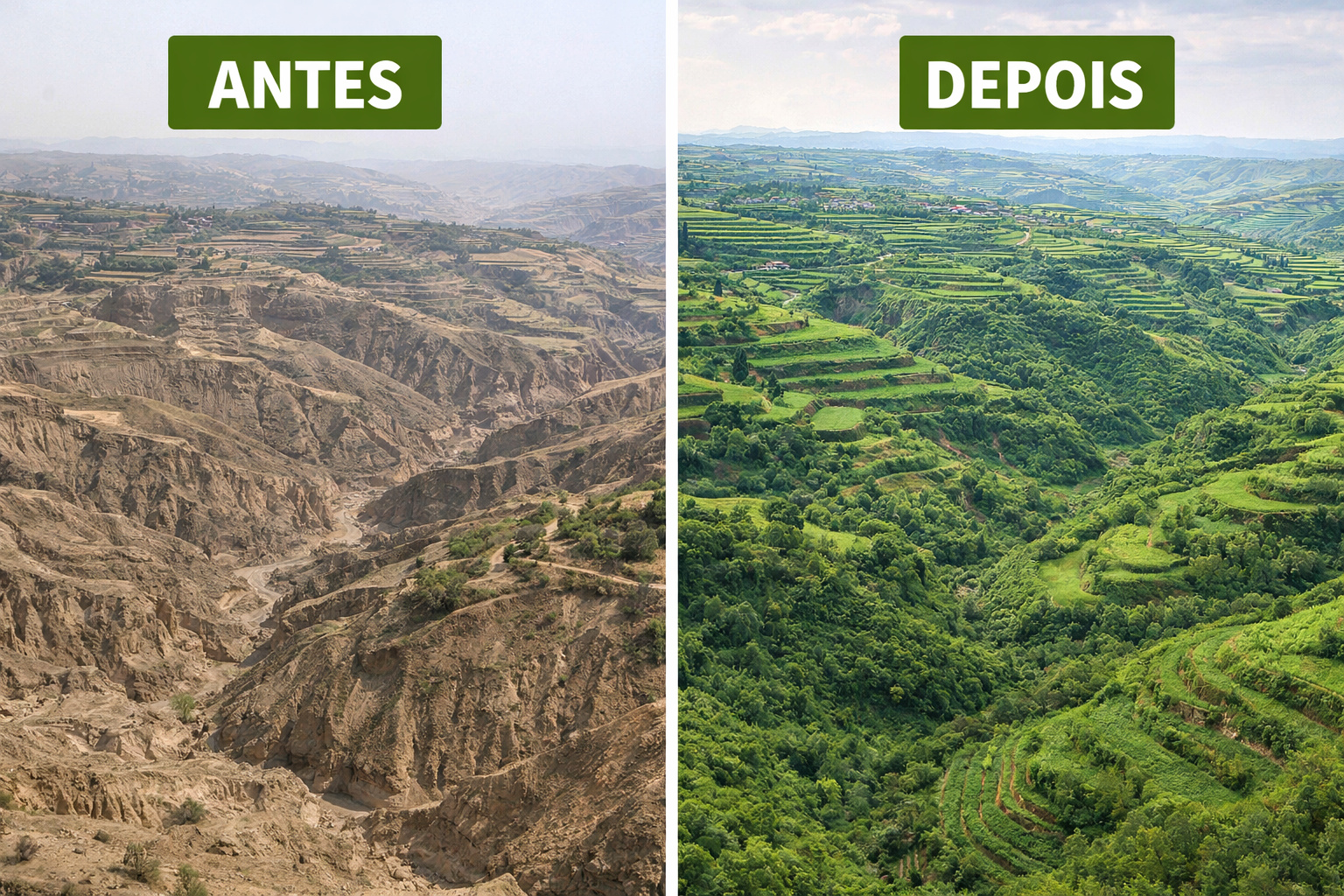


Loess Plateau: How The Most Degraded Region of China, Marked By Extreme Erosion and Annual Loss of Millions of Tons of Soil, Became a Global Symbol of Environmental Restoration.
For much of the 20th century, the Loess Plateau in northern China was often described as one of the most degraded landscapes on the planet. Located mainly in the provinces of Shaanxi, Shanxi, and Gansu, the plateau is made up of loess soils, extremely fine and fertile sediments, but highly susceptible to erosion when unprotected by vegetation.
Decades of deforestation, intensive farming on steep slopes, and overgrazing turned hills into deep ravines. With each rainy season, millions of tons of soil were washed into the Yellow River, contributing to siltation and recurring floods. In some areas, erosion removed several centimeters of fertile soil each year.
By the 1990s, the region was home to about 100 million people living in extreme poverty, with declining agricultural productivity and increasing food insecurity.
-
Son of Poor Farmers Fled Home Four Times Seeking Work, Founded Hyundai, and Transformed It into a Global Industrial Giant in Over 190 Countries

-
13-Year-Old Raises Funds to Build Well, Transforming Lives in Cambodian Community Lacking Clean Water

-
Man with Metal Detector Finds Medieval Silver Seal in England, Uncovers 2,000-Year-Old Roman Gem with ‘Richard’s Secret’

-
Thailand Converts 8 Tons of PET Bottles into 3,500 School Backpacks, Showcasing Circular Economy with Over 40 Factories Involved




It was in this context that one of the largest environmental restoration projects ever undertaken at a regional scale emerged.
The Rehabilitation Project Supported By The World Bank
In 1994, the Chinese government, with funding and technical support from the World Bank, launched the Loess Plateau Watershed Rehabilitation Project. The goal was to curb erosion, restore vegetation cover, and recover agricultural productivity.

The project operated over an area of more than 35,000 square kilometers, equivalent to several combined Brazilian states. The strategy was based on simple principles of ecological engineering and soil management.
Key actions included the construction of agricultural terraces on slopes, the prohibition of grazing in critical areas, reforestation of degraded hills, and the recovery of native vegetation areas.
Terraces were excavated manually and with light machinery to reduce the speed of surface water runoff. By decreasing the energy of rain on the soil, erosion was dramatically reduced.
In steeper areas, farmers were incentivized to abandon cultivation and allow for natural regrowth of vegetation.
Hydrological Transformation and Soil Recovery
The impact was visible within a few years. Vegetation cover significantly increased. Studies indicate that the erosion rate was reduced by tens of millions of tons of sediment per year that were previously carried to the Yellow River.
With stabilized soil, water infiltration improved. Water retention in the land increased, elevating soil moisture and favoring sustainable agricultural growth.

The landscape changed. Previously bare slopes began to exhibit permanent vegetation. Deep ravines were partially stabilized.
The change was not just aesthetic. Agricultural productivity significantly increased in terraced areas. In some communities, agricultural income doubled within a few years.
Economic and Social Impact
The project was not limited to environmental engineering. There was productive reorganization. Farmers began to cultivate higher-value crops in the flat and terraced areas, while steep regions were designated for ecological restoration.
Income diversification included fruit farming, controlled livestock, and sustainable forest production. World Bank reports indicated that millions of people directly benefited, with increased income and improved living conditions.

The region, previously associated with dust storms reaching as far as Beijing, began to be cited as an example of large-scale ecological restoration.
Documentaries and academic studies analyzed the Loess Plateau as an emblematic case of recovering a degraded landscape through integrated policies.
Critics, Limits, and Environmental Challenges
Despite the positive results, the project was not without criticism. Some researchers questioned the choice of tree species in certain areas, warning of potential impacts on groundwater consumption.
There was also debate about the balance between ecological restoration and food security, as agricultural areas were converted to permanent vegetation.
Another point is that the success depended on strong government coordination and land use restrictions, something difficult to replicate in different political contexts.
Nonetheless, independent evaluations confirmed that erosion was significantly reduced and that there were real improvements in socioeconomic conditions.
From Collapsed Landscape to Global Reference
The Loess Plateau became a symbol that processes of environmental degradation can be reversed when there is technical planning, consistent investment, and local involvement.
What was once portrayed as land doomed to desertification is now included in studies on global ecological restoration.
The recovery of 35,000 km² did not eliminate all the region’s challenges but profoundly altered its environmental trajectory. Hills that used to collapse with each rain now support stable vegetation.
Rivers that received massive volumes of sediment reduced their erosion load. Communities facing chronic poverty expanded their productive opportunities.
This case demonstrates that structured interventions, based on principles of soil conservation and water management, can transform landscapes considered unrecoverable.
More than just reforesting, the project reorganized the relationship between soil, water, and human activity. The Loess Plateau ceased to be an example of environmental collapse to become an international reference for restoration on a continental scale.







O humano é um **** que tem a enorme capacidade de destruir, mas, também tem a capacidade de reconstruir o que destruiu. Aí está um forte exemplo.