Portuguese
  Spanish


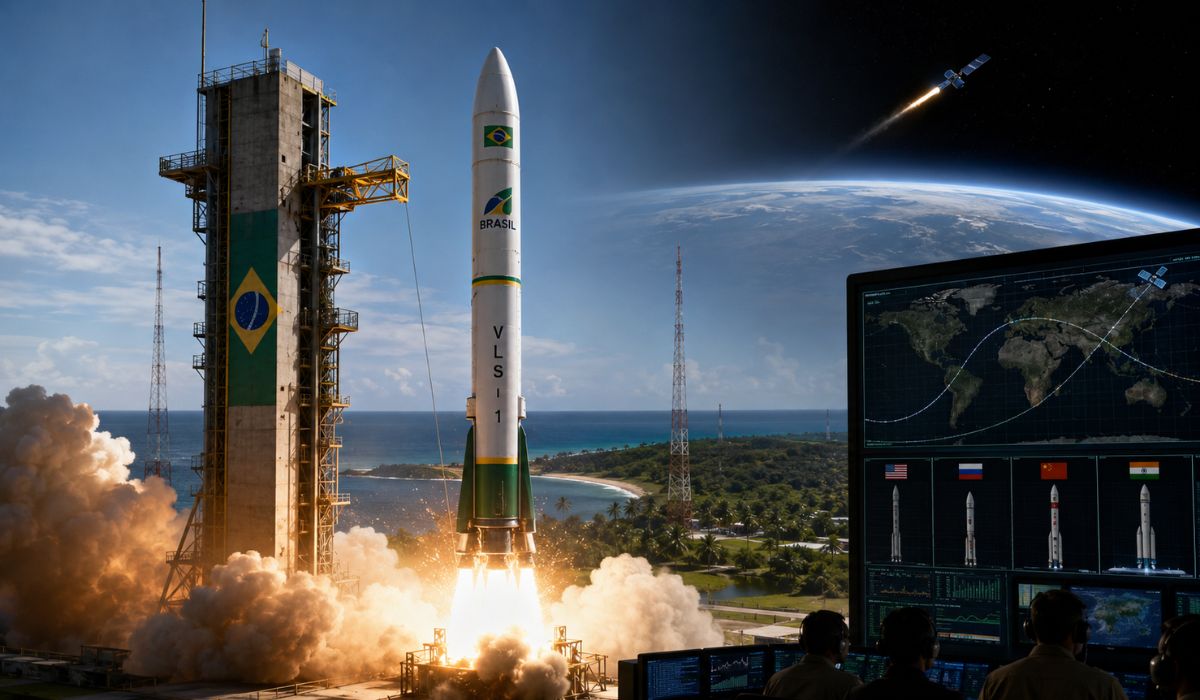


Brazilian Microlauncher Project brings together national companies, public investment, and space technology to expand the country’s capacity for launching small satellites from Alcântara.
In a sector dominated by a few powers, launching a satellite into space does not only depend on technology.
It also involves funding, a launch base, industrial mastery, specialized teams, and the ability to put a rocket into orbit without resorting to foreign structures.
Brazil is developing the Brazilian Microlauncher, known as MLBR, a small-sized rocket designed to transport small satellites to Earth orbit and reduce the country’s external dependence on space launches.
-
How Much Does Starlink Satellite Internet Cost for Cars, Trucks, and RVs? Prices for Antenna, Accessories, and Plans

-
Scientists Convert Food Waste into Aviation Fuel, Successfully Test 50% Blend with Conventional Kerosene to Cut Emissions and Promote Sustainable Flights
-
OnePlus N6 Smartphone to Launch in India with 8,000mAh Battery and 45W SuperVOOC Charging, Lasting Up to Three Days
-
Scientists Plan to Release Air Bubbles Underwater to Protect Antarctica’s “Doomsday Glacier” from Melting




According to information from G1, the project involves companies from São José dos Campos and Jacareí, in the interior of São Paulo, with support from the Brazilian Space Agency, Finep, and the Ministry of Science, Technology, and Innovation.
Revista Pesquisa Fapesp also reported that the program received R$ 189 million from Finep/MCTI for the construction of the first prototype.

Brazilian rocket seeks to expand access to space
The MLBR will be approximately 12 meters tall, close to the height of a four-story building.
The proposal disclosed in reports about the project is that it will carry payloads of up to 40 kilograms, especially small satellites used in scientific, commercial, environmental, and strategic missions.
In a more recent publication, the Brazilian Space Agency reported a capacity of up to 30 kilograms of payload in low orbit, which indicates a divergence between data released by public sources regarding the vehicle’s projected limit.
This type of rocket meets a growing demand in the space market, marked by the use of smaller satellites by companies, universities, and governments.
These devices can collect data, test technologies, observe the planet, and expand communication services.
If the project progresses as planned, Brazil will be able to launch these satellites with technology developed in the country and from national territory.
Today, countries that do not master the entire launch chain depend on foreign companies and bases to put satellites into orbit.
This dependence can involve costs, schedule restrictions, and technological limitations in an area treated by sector bodies as strategic.
Ten Brazilian companies participate in the project
According to G1, ten Brazilian companies are participating in the rocket’s development.
Some of them are concentrated in the Paraíba Valley, a region known for the presence of aerospace industries, research centers, and companies linked to advanced engineering.
Cenic Engenharia, from São José dos Campos, is among the companies leading the project.


The company itself reports that the development is conducted by a national productive arrangement with companies such as Cenic, ETSYS, Concert Space, Delsis, and PlasmaHub.
Strategic partners such as Bizu Space, Fibraforte, Almeida’s, and Horuseye Tech are also mentioned.
These companies operate in different areas of the microlauncher, with activities related to aerodynamics, propulsion, launch systems, structures, navigation, control, and integration of space technologies.
In practice, the project is not limited to manufacturing a rocket.
The initiative also seeks to organize a national chain capable of designing, testing, and operating complex space systems, according to information released by the involved institutions.
Satellites can serve agriculture, defense, and the environment
Satellites launched by a microlauncher can have different applications, depending on the purpose of each mission.
According to engineer Ralph Correa, interviewed by Rede Vanguarda in the material cited by G1, these equipments can support navigation systems, Earth observation, remote sensing, and weather forecasting.
“From proprietary navigation systems similar to GPS, to Earth observation systems, sensing, weather forecasts—that is, there is a large number of possible applications,” he stated.
This type of technology can also be used by sectors such as agriculture, telecommunications, environmental monitoring, defense, urban planning, and disaster management.
In agriculture, satellites help monitor crops, identify areas of water stress, and track productivity.
In the environmental area, these equipments allow observing wildfires, deforestation, river advancement, irregular occupation, and changes in land use.
In the defense sector, satellites can enhance communication, surveillance, mapping, and monitoring capabilities for sensitive areas.
Therefore, the mastery of space launches is treated by sector bodies as a capability with impact in areas beyond scientific research.
Alcântara is planned for the MLBR launch
The expectation cited in the original material is that the first launch will occur from 2027, after the system testing and qualification stages.
The operation is expected to use the Alcântara Launch Center, in Maranhão.
The choice is related to the geographical location of the base, situated close to the Equator.
An Ipea study on the launch center points out that its position, about 2°18’ south of the Equator, offers advantages for placing satellites in equatorial orbits, with greater operational ease and potential cost reduction.
This proximity allows for better utilization of Earth’s rotation in certain mission profiles.
In technical terms, rockets launched near the Equator can gain efficiency in certain types of launches, reducing the need for fuel compared to bases located at higher latitudes.
This characteristic helps explain why Alcântara has been cited for decades as a relevant facility for the Brazilian space program.
Space autonomy depends on a complete technological chain
One of the central points of the MLBR is what is called independent access to space.
The expression refers to a country’s ability to produce satellites, master launch vehicles, operate a launch base, and place payloads into orbit without relying on third parties.
Few countries possess this combination.
According to the Brazilian Space Agency, the United States, Russia, China, and India are among the examples of nations with their own orbital launch capability.
For Brazil, reaching this level would represent a change in the country’s degree of participation in the space chain.
The country already operates in space research, satellite development, sounding rockets, technology centers, and international cooperation.
However, it still seeks to consolidate the ability to autonomously launch its own orbital satellites.
Should the MLBR achieve this goal, Brazil will be able to advance towards a more complete space chain, less dependent on foreign structures.
Investment funds prototype and rocket tests
The investment of R$ 189 million, cited by Revista Pesquisa Fapesp, funds the construction of the first prototype of the launcher.
This amount is concentrated in a development stage considered technical and decisive by the involved institutions.
Before any orbital flight, a rocket must undergo design reviews, engine tests, structural validations, material analysis, system integration, and safety trials.
Each component needs to function under extreme conditions.
During a launch, the vehicle faces intense vibration, thermal variation, acceleration, aerodynamic pressure, and rigorous control requirements.
A failure in any subsystem can compromise the mission.
Therefore, the schedule until 2027 depends on a sequence of tests and validations.
The technical challenge of the MLBR is to transform specialized knowledge, public funding, and industrial capacity into a rocket capable of executing orbital missions.
Microlauncher serves smaller satellite range
The MLBR will not have the size of the large rockets used to carry heavy payloads into space.
The project’s proposal is to operate in a smaller range, aimed at small satellites.
Even so, the development of microlaunchers has gained space in the international market by serving more flexible missions, with smaller payloads and specific schedules.
Instead of waiting for a slot on large shared rockets, small satellite operators can contract dedicated launches, when available.
This model interests universities, startups, sensing companies, governments, and sectors that need to test technologies in shorter timeframes.
For Brazil, participation in this segment can expand industrial opportunities, specialized workforce training, and the performance of the national aerospace sector, according to recurring assessments by sector bodies and companies.
Project still depends on technical qualification
The development of the Brazilian Microlauncher is still ongoing and depends on complex technical stages.
Therefore, the first launch scheduled from 2027 should be treated as a goal, not a guaranteed outcome.
The project brings together national companies, public funding, and planned use of Alcântara, three components linked to the pursuit of space autonomy.
If the launch is successful, the country will be able to test a necessary step to reduce dependence on foreign structures in orbital missions.
Engineer Toshiaki Yoshino, program director interviewed by Rede Vanguarda, compared this autonomy to a key to space access.
“It is a very complex technical engineering activity. And everyone likes to say challenge, right? So, here people work with that motivation. For Brazil to achieve autonomy in launching these rockets is like acquiring a key that opens the doors to space. In the world, very few countries possess this key,” he stated.
In a scenario of increased satellite use by governments, companies, and research institutions, mastery of orbital access has become directly related to communication, Earth observation, security, environmental monitoring, and the digital economy.