






 Portuguese
  Spanish


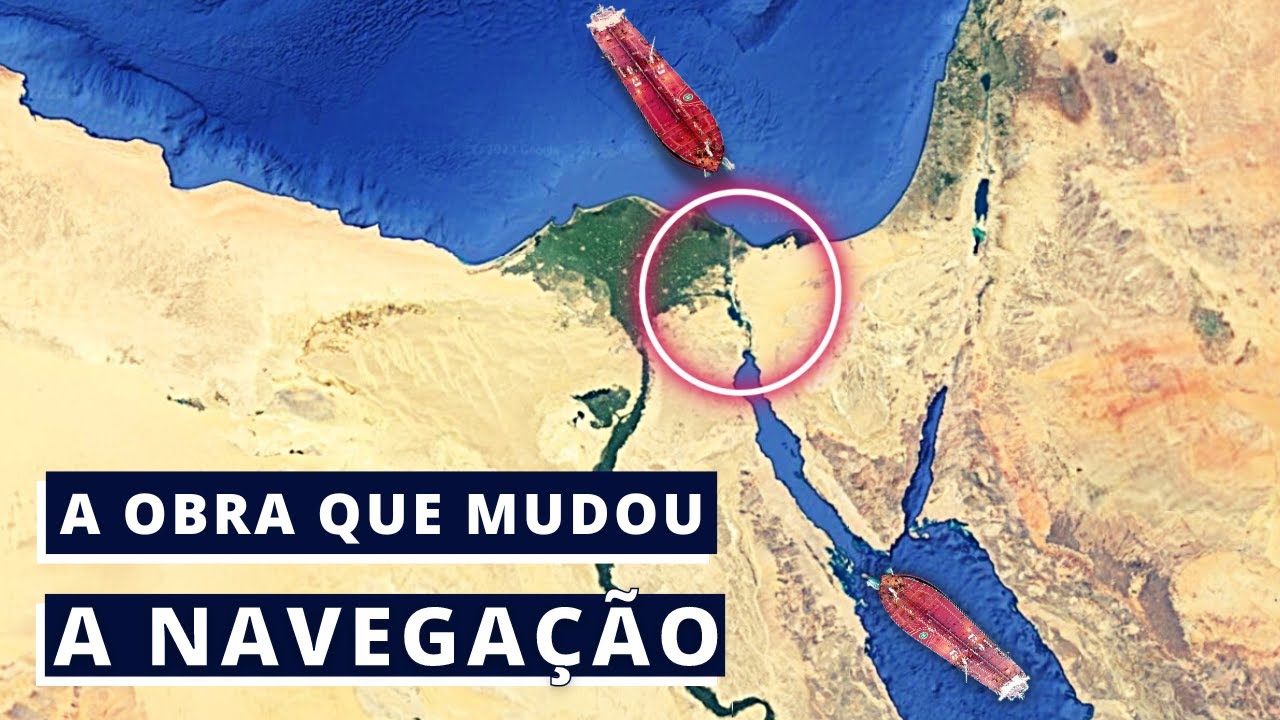


With 258 Million Cubic Meters of Sediments Removed in 12 Months, the New Suez Canal Redefined the Egyptian Desert and Became an Absolute Milestone in Global Maritime Engineering.
Few modern works have managed to alter the dynamics of international trade as profoundly and quickly as the New Suez Canal, inaugurated in 2015. In just 12 months of intensive operation, engineering teams from Egypt and international consortia removed 258 million cubic meters of sediments, according to official data from the Suez Canal Authority (SCA) — one of the largest dredging operations ever carried out in human history.
The project was not limited to enlarging the existing canal. It transformed a stretch of 35 kilometers into a two-way navigation system, allowing vessels to travel simultaneously in opposite directions, drastically reducing wait times. This gave Egypt a new strategic role in global maritime transportation.
This gigantic scale of dredging in such a short time is the structural heart of the project’s grandeur — and what places the New Suez Canal alongside the greatest maritime engineering works ever constructed.
-
Brazil’s $1.3 Billion, 870-Meter Immersed Tunnel to Be Latin America’s First of Its Kind, Featuring Special Public Facilities and Information Center

-
Brazilian Innovator Develops Concrete Blocks from Recycled Plastic, Eliminating Mortar and Reducing Construction Costs
-
Brazilian Woman Builds House with Recycled Plastic Bottles, Halving Construction Costs in the Process
-
Couple Sold Their Home to Live in a Trailer While Converting a Granite Tower into an Award-Winning 11-Meter Residence in Cornwall


258 Million Cubic Meters of Sediments Removed: An Achievement That Challenges Human Capacity to Move Earth and Water
Moving 258 million cubic meters of sand, mud, and rock in just one year means, in practical terms:
- digging a volume equivalent to over 100 thousand Olympic swimming pools,
- removing more material than was used in the construction of dozens of mega dam projects,
- surpassing the dredging rate of many countries in projects accumulated over decades.
This impressive volume placed Egypt among the world leaders in dredging engineering, requiring:
- dozens of large dredgers,
- continuous operation 24 hours a day,
- logistics coordinated by military and civil engineers,
- real-time monitoring of the seabed.
The pace was so accelerated that the SCA classified the operation as “the fastest large-scale dredging ever conducted globally”.

A Duplication That Accelerated Naval Traffic and Repositioned Egypt in Maritime Trade
The main objective was clear: to reduce congestion in Suez and increase daily traffic capacity. The expansion allowed:
- reducing crossing time from 18 hours to 11,
- increasing the number of daily ships from 49 to 97 (projected capacity),
- improving the energy and operational efficiency of the route,
- enhancing maneuvering safety and avoiding long waiting periods in the Red Sea.
The Suez connects Asia to Europe via the shortest existing route, and any delays directly impact the trade of oil, containers, grains, and industrial products.
With the New Suez Canal, Egypt not only expanded its strategic importance but also created a more stable and predictable alternative for international maritime logistics.
Heavy Engineering in a Challenging Environment: Unstable Ground, High Speeds, and Continuous Operation
Large-scale dredging required complex solutions:
- removing deep layers of sediments without compromising navigability,
- managing tides, winds, and internal currents,
- dredgers operating side by side with millimetric precision,
- continuous transport of sediments to planned disposal areas.
The surrounding desert also imposed logistical challenges: it was necessary to build temporary roads, set up support bases, and transport materials and workers to remote and arid regions.
Coordination among international teams — from Belgium, the Netherlands, the USA, and the United Arab Emirates — was essential to maintain the fast pace of work, transforming an operation typically planned for 3-5 years into execution completed in just 12 months.

Economic and Geopolitical Impacts: Egypt as a Protagonist of an Essential Route
The Suez is responsible for about 12% of global maritime trade and a significant part of the oil and gas that supplies Europe. With the expansion:
- annual revenue from the canal increased,
- the risk of bottlenecks and accidents decreased,
- Egypt’s position as a logistical intermediary was strengthened,
- and capacity margins were created for future growth.
For an economy heavily dependent on geography, every dredged meter represents global competitiveness.
One of the Largest Maritime Engineering Operations of the Century
The New Suez Canal is, in essence, a monumental work based on a single number that defines its magnitude: 258 million cubic meters removed in 12 months. This figure alone places it among:
- the largest dredging volumes ever recorded,
- the fastest canal expansions in history,
- and the most ambitious projects ever undertaken by a country in such a short time frame.
The result is infrastructure capable of sustaining global maritime trade for decades, with enhanced efficiency and operational resilience far superior to the original canal from 1869.





Gostaria de ver tema tão complexo ser debatido por diversos ângulos. O que esperar de consequências geotécnicas a médio prazo. São impactos muito grandes com foco na solução de problemas econômicos num gargalo da navegação alterando dinâmicas geohidrológicas continentais e oceânicas.
Enquanto isso, a Prefeitura de Belo Horizonte não consegue limpar a Lagoa da Pampulha, assoreda, lotada de sujeira e sedimentos. Deveria ser o cartão postal e orgulhar os belorizontinos! Vários programas foram implantados, muita verba gasta e nada!! Triste ver como a cidade é abandonada!!!
Sem diagnostico e sem atuar nas causas, o que tem ocorrido na Pampulha, para obter frutos eleitorais e lucros indevidos de caráter ****, nada vai mudar. Poluição rima com corrupção em obras na Pampulha.
Típico de políticos brasileiros!!! Corrupção tá entranhada na administração pública em geral.