Portuguese
  Spanish


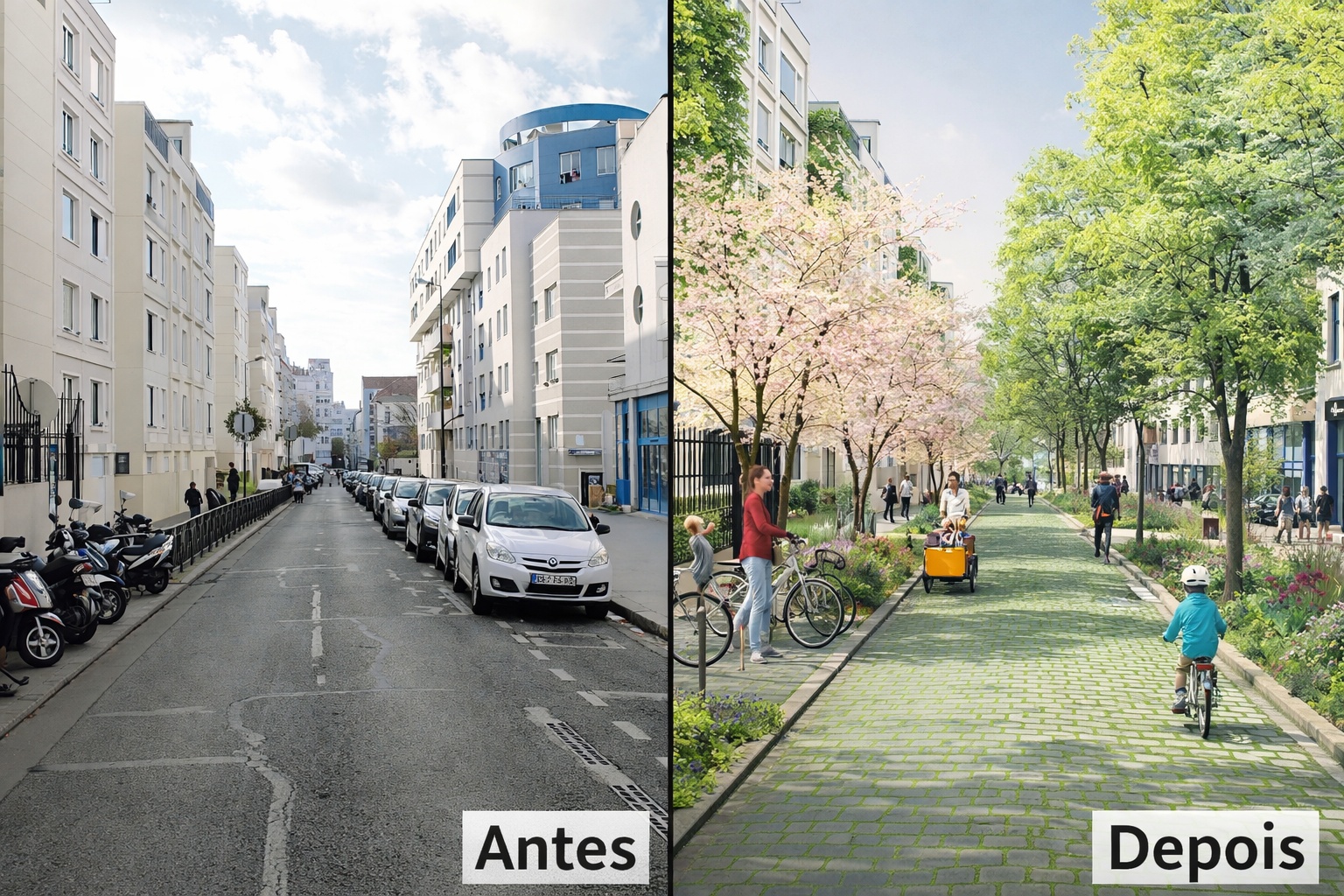


Paris Reconstructs Mobility: Removes Cars, Plants 170,000 Trees, and Creates Safe School Streets to Reduce Pollution and Protect Children.
What is happening in Paris since the end of the 2010s is not a cosmetic operation or a “beautification” plan. It is a deep environmental reconfiguration with lasting effects on mobility, health, and urban climate. Under the management of Mayor Anne Hidalgo, Paris launched a series of measures that integrate traffic reduction, massive tree planting, removal of cars from historic roads, and the creation of “school streets” – sections where cars are prohibited during drop-off and pick-up times, or even permanently, depending on the area.
Although controversial, especially at the beginning, the program has become a global reference and gained momentum over the years, mainly due to the combination of technical data and measurable results. The explicit goal was not only to reduce congestion, but to protect children, reduce toxic particles, and transform urban space into a breathable, cool, and safe environment.
Today, Paris is paving a way that other European metropolises are watching closely – London, Milan, Barcelona, and Amsterdam are already studying how to copy parts of the model.
-
Green Roofs on Homes Gain Popularity for Reducing Heat, Noise, and Rain Impact in Brazil

-
Brazilian promises his children to save a river, creates an eco-barrier in his backyard, has already removed more than 40 tons of trash from the water, and even inspires the idea in other states of the country.

-
How a Brazilian company created a system that transforms broken pallets of any brand into new assets, recycles 80 tons of plastic per month, and found a profitable solution to a problem that challenges industries across the country.
-
Invasive bullfrog capable of devouring other amphibians and laying up to 20,000 eggs is found in Florianópolis, raising an alert about the threat to native fauna.



A Capital That Historically Belonged to Cars
To understand the magnitude of the change, it is essential to remember that Paris was one of the European cities most impacted by car culture in the post-war period.
Its ring road (Boulevard Périphérique) became a symbol of intense traffic, and central avenues were congested even at random times. The idea of removing cars from important roads was treated as political heresy and economic risk.
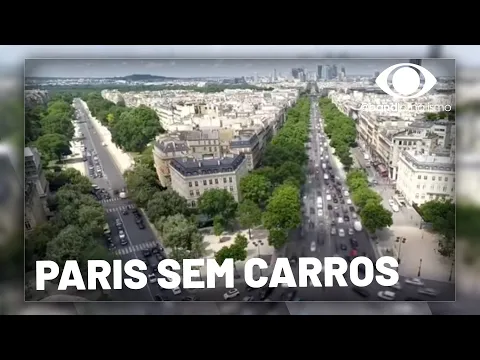

Nevertheless, starting in 2016, Paris began to progressively block areas traditionally dominated by cars, such as parts of the banks of the Seine, creating pedestrian zones and continuous bike lanes.
The catastrophic forecast was of permanent chaos and logistical collapse, but the data showed otherwise: a significant modal redistribution, with increased walking, cycling, and public transport trips.
170,000 Trees to Reduce Temperature and Capture Pollution
The most impressive aspect of the plan is the number of trees. By 2030, the goal is to plant at least 170,000 new trees, reorganizing linear parks, creating urban microforests, and transforming major roads into green corridors that act as “islands of coolness.”

This decision does not come from nowhere. Studies published in Nature and by the European Environment Agency show that the strategic planting of trees can reduce urban temperature by up to 5 °C during heatwaves.
In Paris, this became vital after the heatwave of 2019, when temperatures exceeded 42 °C and hospitals reported an increase in admissions due to hyperthermia.
In addition to cooling, large trees capture fine particles (PM2.5 and PM10), absorb CO₂, and increase soil permeability – a crucial detail for a city facing sudden flooding episodes linked to intense rainfall.
Fewer Cars, More Life: Historic Avenues Change Function
One of the most symbolic strategies of the Parisian plan is to remove cars from historic and sensitive roads. Entire sections along the Seine have been transformed into pedestrian boulevards, outdoor cafés, sports areas, and bike lanes. In practice, Paris is replacing car dominance with human permanence.
Moreover, other traditional streets have undergone “traffic calming” reconfigurations, reducing the speed limit to 30 km/h on about 80% of the city’s road network – a measure that decreased accidents, increased safety, and reduced urban noise.
Although the policy has been the target of protests from drivers and industry associations, recent surveys show growing acceptance among the population, especially among families and the elderly.
The “School Streets”: A Direct Response to the Impact of Pollution on Children
The city also decided to tackle a widely ignored problem: children’s exposure to pollution. In many major European capitals, children breathe air loaded with particles and nitrogen oxides right at school doors, precisely at times when engines are revving and vehicles are queued.
To break this logic, Paris created over 300 traffic-free school streets, some completely blocked, others with restricted access during critical hours. In several of these streets, nitrogen dioxide (NO₂) levels decreased by between 20% and 40%, according to measurements released by the city hall.
The motivation is strongly scientifically based. The World Health Organization estimates that 7 million people die each year due to air pollution and that children exposed to fine particles have a higher incidence of respiratory diseases, chronic inflammation, and decreased school performance.
In a few words: Paris is designing traffic based on children’s physiology, not road engineering.
The Silent Impact on Mobility
When Paris announced the closure of entire sections to cars, many experts projected traffic collapse.
However, what was observed was a phenomenon already seen in London, Pontevedra, and Barcelona: the “evaporation” of traffic, where a significant portion of car trips simply ceases to exist when there are safe and comfortable alternatives.
In recent years, Paris has expanded protected bike lanes, improved public transport, and encouraged micromobility. The pandemic accelerated temporary bike lanes that later became permanent. Today, Paris is among the cities with the highest growth in bicycle commuting in the West.
Paris as a “Urban Climate Laboratory”
The Parisian transformation has become an international reference for a simple reason: it combines environmental policies, public health, mobility, and urban planning into one coherent package. It is a living laboratory for what major cities will have to face in the coming decades: heatwaves, toxic pollution, climate risk, and demographic pressure.
With the changes already implemented, Paris shows that urban-scale policies can reduce emissions, decrease accidents, improve quality of life, and prioritize children over engines.
What seemed like utopia to many is now being replicated. Barcelona is developing superblocks, London is implementing zero-emission zones, Milan is expanding pedestrian areas, and New York is studying “school street” models.
It is no coincidence.
In the end, the question is simple
If large cities have been able to reorganize in recent decades to accommodate millions of cars, why wouldn’t they be able to reorganize to accommodate millions of people?
Paris decided to answer this question in practice. And much of the planet is watching.