Portuguese
  Spanish


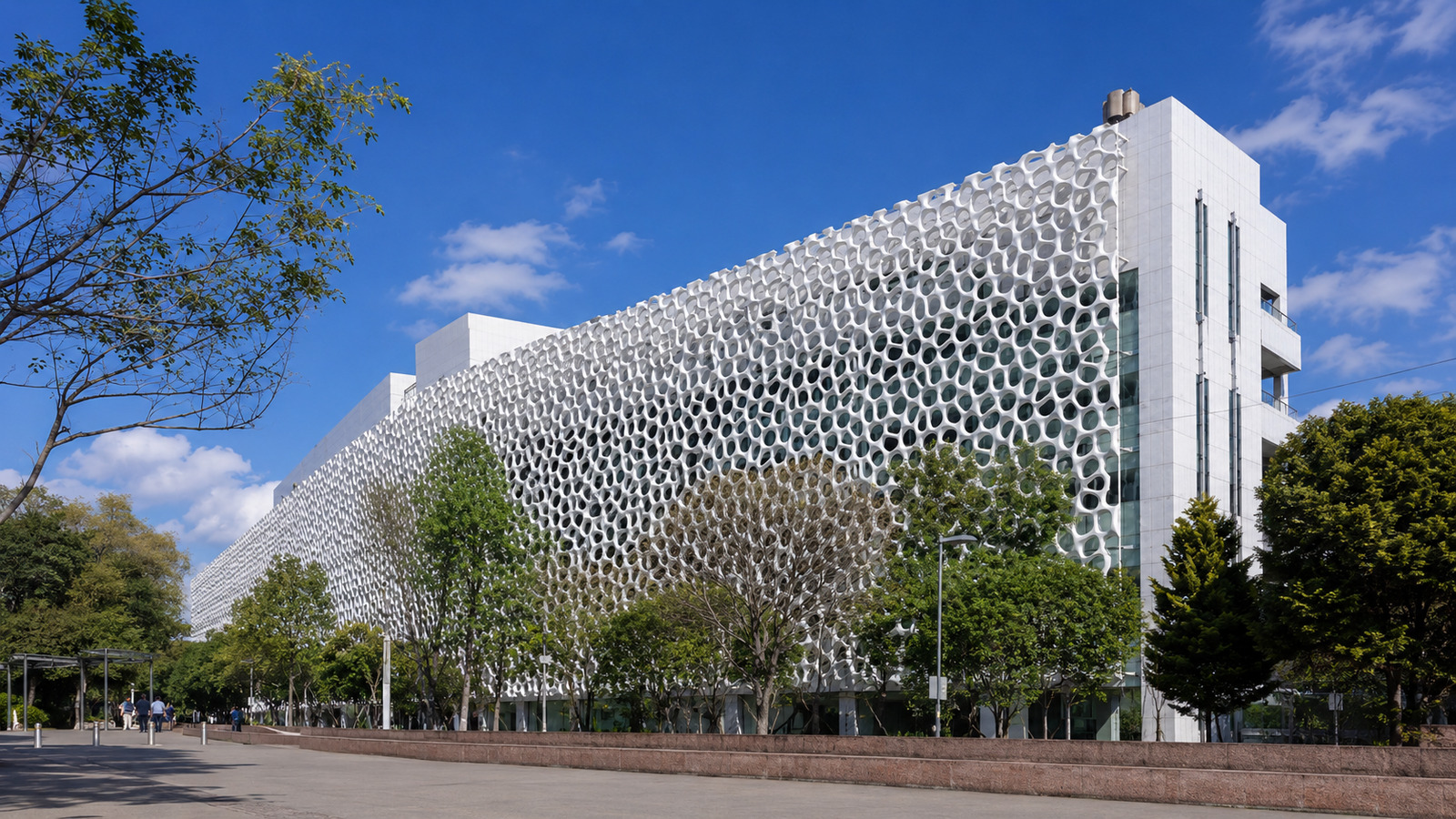

Hospital in Mexico City uses facade with photocatalytic concrete to transform pollutants generated by vehicles into harmless residues, with the action of sunlight and without relying on mechanical filters or electrical systems
A hospital in Mexico City neutralizes pollution equivalent to 8,750 cars with photocatalytic concrete on the facade, using sunlight to transform nitrogen oxides into harmless residues, without filters or electrical system.


Facade transforms sunlight into reaction against smog
The technology is in the Specialty Tower of the Manuel Gea González hospital, where a 2,500 m² facade is coated with Prosolve370e. The building has been in operation since 2013 and uses sun exposure.
The photocatalytic concrete is a cement mixture enriched with titanium dioxide nanoparticles, TiO2. This compound acts as a photocatalyst with external ultraviolet radiation.
-
Green Roofs on Homes Gain Popularity for Reducing Heat, Noise, and Rain Impact in Brazil

-
Brazilian promises his children to save a river, creates an eco-barrier in his backyard, has already removed more than 40 tons of trash from the water, and even inspires the idea in other states of the country.

-
How a Brazilian company created a system that transforms broken pallets of any brand into new assets, recycles 80 tons of plastic per month, and found a profitable solution to a problem that challenges industries across the country.
-
Invasive bullfrog capable of devouring other amphibians and laying up to 20,000 eggs is found in Florianópolis, raising an alert about the threat to native fauna.



From this activation, the material triggers oxidation reactions. They reach nitrogen oxides, known as NOx, components of urban smog generated by vehicles.
The result is the conversion of these pollutants into harmless nitrate ions. Then, the rain washes the residues away, cleaning the surface and keeping the facade clean without mechanical maintenance.
How photocatalytic concrete cleans the air
The process begins when ultraviolet photons hit the coating and activate the TiO2. Then, the catalyst generates oxidizing radicals capable of breaking pollutants into less reactive fragments.
The final product includes calcium nitrate, a salt used as fertilizer, as well as water and small amounts of carbon dioxide. Thus, pollution is transformed on the building’s surface.
Since TiO2 acts as a catalyst, not as a reagent, it is not consumed. The facade maintains its photocatalytic capacity while exposed to light and humidity.

Geometry increases the active area of the facade
At the Specialty Tower, the Berlin-based office Elegant Embellishments created three-dimensional modules in the shape of a quasicrystal, called Prosolve370e. The wavy shape is not just for visual purposes.
This geometry increases the active area, creates turbulence in the airflow, and distributes pollutants more evenly. As a result, more particles come into contact with the photocatalytic surface.
The estimate associated with the hospital indicates neutralization equivalent to thousands of cars per day for 5 to 10 years of the tiles’ lifespan. The case is among the documented practical applications.
Mexico and Italy concentrate documented examples
Besides the Mexican hospital, another cited project is the Palazzo Italia in Milan. The Expo 2015 pavilion received 9,000 m² of facade with Tiocem, a white photocatalytic concrete developed by Italcementi.
The material used in Palazzo Italia was developed after 12,500 hours of research. The architectural project is by the office Nemesi & Partners and shows the technology in a different context, linked to a prestigious pavilion.
The two cases concentrate most of the available practical evidence. Together, they show application in public health and in high-visibility architecture, with large facades as the central point of efficiency.
Urban scale defines the limit of the technology
The Smithsonian Magazine documents that simple chemical reactions, activated by the sun, can generate active air cleaning on an urban scale. The main point is less about complexity and more about the area covered by the material.
The larger the photocatalytic surface, the greater the impact on local air quality. Economic viability depends on the longevity of the coating and the replacement cost, close to that of conventional paint.
Architects and researchers emphasize that a building does not solve a city’s pollution. The photocatalytic concrete functions as a complement, not as a substitute for mobility policies and emission control.
The potential lies in the scale. Facades, sidewalks, and viaducts with photocatalytic surfaces could form an active area comparable to an urban forest, operating passively and continuously.
With information from Monitor do Mercado.