Portuguese
  Spanish


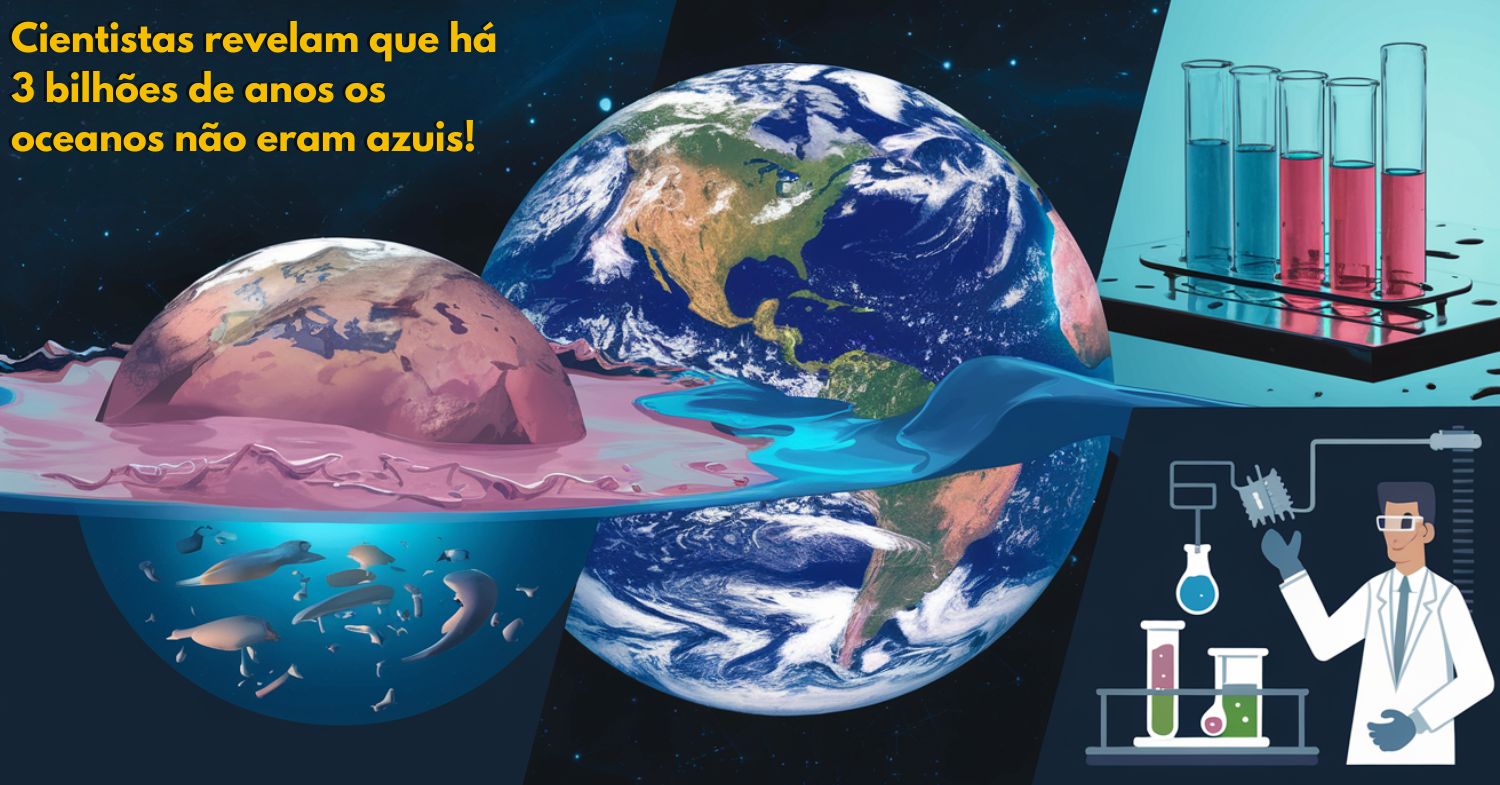


Researchers Identified That, Due to the Chemical Composition of the Time, Primitive Oceans Had a Different Coloration Than the Current Blue. The Study Analyzes How High Levels of Dissolved Iron Influenced This Hue.
If someone were to describe Earth, they would probably mention its characteristic blue hue. However, billions of years ago, blue oceans did not have this appearance. Scientists and recent research have revealed that, in primitive Earth, seas exhibited a deep green coloration, a look that lasted for over 2 billion years. This discovery, published in the journal Nature Ecology & Evolution, brings new perspectives on the planet’s evolution and even on the search for life on other worlds.
The explanation for this change in color is linked to the chemical composition of ancient oceans and the microorganisms that inhabited them. Understanding this phenomenon helps reconstruct Earth’s history and explore the conditions that may exist on other planets.
Understand Why Oceans Were Green and Not Blue
The researchers reached this conclusion through high-precision computational simulations, which indicated that, around 3 billion years ago, the chemical composition of Earth’s seas gave them an emerald hue. But what caused this color? Scientists point to three main factors that explain this phenomenon:
-
Engineers Develop Jacket That Converts Air Humidity Into Drinkable Water, Producing Up to 900 ml Daily for Hikers, Campers, Rescuers, Rural Workers, and Military in Remote Areas

-
NASA Plans to Repurpose Mars Rover for Lunar Mission, Sending a 1-Ton Nuclear-Powered Vehicle to Explore the Moon’s South Pole Without Solar Dependence
-
Early Humans Made Beds Nearly 200,000 Years Ago in African Caves, Study Reveals

-
Japanese Smart Bike Detects Cyclist’s Intent to Turn and Potential Falls


High Concentration of Dissolved Iron
Around 3 billion years ago, Earth’s atmosphere had little to no free oxygen (O₂). In an anoxic environment (without oxygen), iron predominantly existed in the form of ferrous ions (Fe²⁺), which are highly soluble in water. This meant that large amounts of dissolved iron were present in the oceans.
Interaction of Light with Iron
The presence of dissolved iron affected how light was absorbed and scattered in the water. Different substances in the water can alter its coloration by absorbing certain wavelengths of visible light and reflecting others. Ferrous iron tends to absorb light in the blue region of the spectrum and reflect wavelengths in the green region, giving the oceans a greenish hue.
Activity of Cyanobacteria
Cyanobacteria were essential microorganisms in the evolution of life on the planet. They performed photosynthesis, releasing oxygen into the atmosphere and contributing to the greenish coloration of the seas. This balance kept the oceans green for approximately 2.4 billion years, until a major transformation changed everything.
The Great Oxidation: How the Oceans Turned Blue
The change in the color of the oceans occurred due to an event known as the Great Oxidation, which took place between 2.4 and 2.1 billion years ago. During this period, the oxygen released by cyanobacteria began to accumulate in the atmosphere and interacted with the dissolved iron in the water.
This chemical reaction oxidized the iron, transforming it into insoluble oxides, which sank in the sea and were removed from the ocean solution. With the decrease in dissolved iron, the oceans lost their greenish hue.
The predominant blue hue of the oceans today is not only due to the reflection of the sky but mainly to how light interacts with water. Water molecules more efficiently absorb the longer wavelengths of visible light (red, orange, and yellow) and scatter the shorter wavelengths (blue and violet). Since the human eye is more sensitive to blue than to violet, the oceans appear blue to us, regardless of the color of the sky.
In addition to changing the planet’s appearance, this transformation was essential for the evolution of complex life, as it created a more suitable environment for multicellular organisms.
A Discovery Capable of Transforming the Search for Life on Other Planets
The revelation that oceans were not blue on primitive Earth has huge implications for astrobiology. After all, if the chemical composition of water can drastically change the color of oceans, it means that the seas of other planets may have completely different hues. Scientists have raised some interesting hypotheses based on this study:
- Exoplanets with Oceans of Different Colors: The chemistry of water may be different on other worlds. Depending on the elements dissolved in the seas, planets may have green, red, or even violet oceans.
- The Color of the Seas May Indicate Habitability: If an exoplanet’s ocean has a different hue, this may reveal valuable information about its atmospheric composition and even its potential to support life.
- Simulations to Recreate Primitive Worlds: Using advanced technology, researchers have been able to create simulations showing what Earth would have looked like billions of years ago: a planet with deep green seas and an atmosphere very different from today.
Source: Meteored