Portuguese
  Spanish


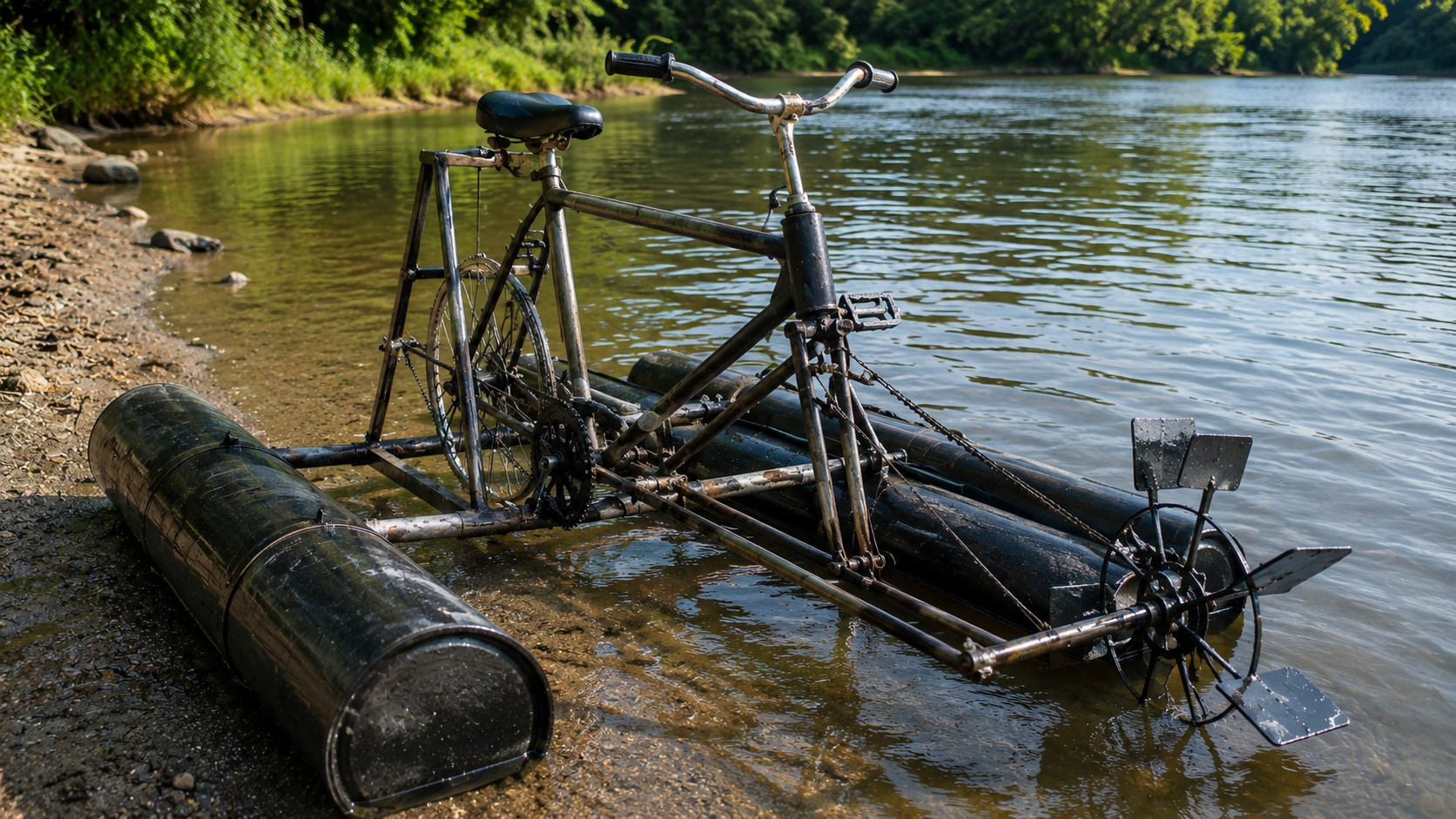


Artisanal project uses discarded metal, welding, and pedal propulsion to show how material reuse can gain practical function
A amphibious bicycle built with metal scrap has been attracting attention for combining mobility, creativity, and sustainability in a single project.
The proposal transforms a regular bicycle into a vehicle capable of traveling on roads and rivers without requiring major adaptations between environments.
The operation uses only leg power, through human propulsion, with the support of floaters and reused components.
-
Orphaned Youth Turns Dismissed Idea into Global Prestige with Innovative Wristwatch

-
English Skills Boost Career Opportunities in the Oil and Gas Industry

-
Brazil Secures Second Place at WorldSkills 2024 in Lyon, with 64 Young Professionals and 8 Medals, Including Gold from a Rio de Janeiro Hairdresser

-
3,000 Military Personnel from 10 Countries, Including US and Chinese Marines, Train Together in Brazil’s Savanna: Operation Formosa Becomes Largest Naval Ground Exercise Before First Cancellation Since 1988



Amphibious bicycle functions as a regular vehicle on the road and changes behavior when entering the water
On solid ground, the bicycle maintains the usage logic of a conventional model.
Upon reaching the water, the behavior changes. Side floaters ensure stability and help keep the structure on the surface.
Wheels, paddles, or propellers connected to the pedaling system transform the chain’s rotation into aquatic movement.
This system allows the vehicle to keep moving forward without the need for engines or fuels.
The first documented records of amphibious bicycles appeared throughout the 20th century. The popularization of these constructions occurred more recently with the growth of the maker culture and the sharing of projects on the internet.
Construction starts with the adapted chassis and requires precision in welding
The process begins with the assembly of the adapted chassis, the structural base of the amphibious vehicle.
This structure is usually made with steel tubes reused from old bicycles, industrial pipes, or discarded metal parts.
Welding defines the main shape of the vehicle and requires attention to alignment.
Any angle error can compromise balance both on land and in water.
The floaters come in the next stage. They can be made with plastic drums, reinforced chambers, or sealed metal boxes.
The aquatic propulsion system is connected to the rear chain. Thus, pedaling moves submerged paddles or propellers.
The final tests conducted in rivers or lakes are usually the most anticipated stage for those following the project’s development.

Metal Recycling Reinforces the Environmental Importance of the Project
The amphibious bicycle also stands out for upcycling, a concept that transforms discarded materials into products with new usage value.
According to data cited by international entities related to metal recycling, the use of recycled steel can significantly reduce environmental impacts compared to the extraction of virgin raw material.
The International Aluminium Institute reports that recycling aluminum can save about 95% of the energy used in conventional production.
Projects of this type help to:
• give new utility to discarded metal parts;
• reduce the demand for virgin raw material;
• avoid the premature disposal of reusable structures;
• stimulate sustainable initiatives in other communities.
Assembly Videos Turn Craft Engineering into a Global Phenomenon
Many independent builders record each step of the assembly on video.
These contents usually present only the real sounds of construction, such as cutting, welding, fitting, and testing.
The format, known as construction ASMR, creates a visual and auditory experience that attracts millions of views on different platforms.
People from different countries can follow the entire process without relying on translation or narration.


Project Shows That Sustainable Innovation Can Also Be Born in a Garage
The amphibious bicycle made from scrap is not just a curious invention.
It demonstrates that innovation can arise from forgotten materials, simple tools, and creative solutions.
Global projections cited by international organizations indicate that solid waste generation will continue to grow in the coming decades, increasing the need for initiatives focused on material reuse.
In this scenario, each recovered piece stops occupying space in landfills and starts to play a new role.
The amphibious bicycle reinforces an idea increasingly present in the environmental debate: creativity can transform discarded materials into useful, functional, and sustainable solutions.