





 Portuguese
  English
  Spanish
  3 min of reading
  0 comments


Duke University project presents Argus, an experimental machine created to move in any direction with similar performance.
A new creation from Duke University in the United States has caught attention in the robotics sector by abandoning the traditional idea of front and back.
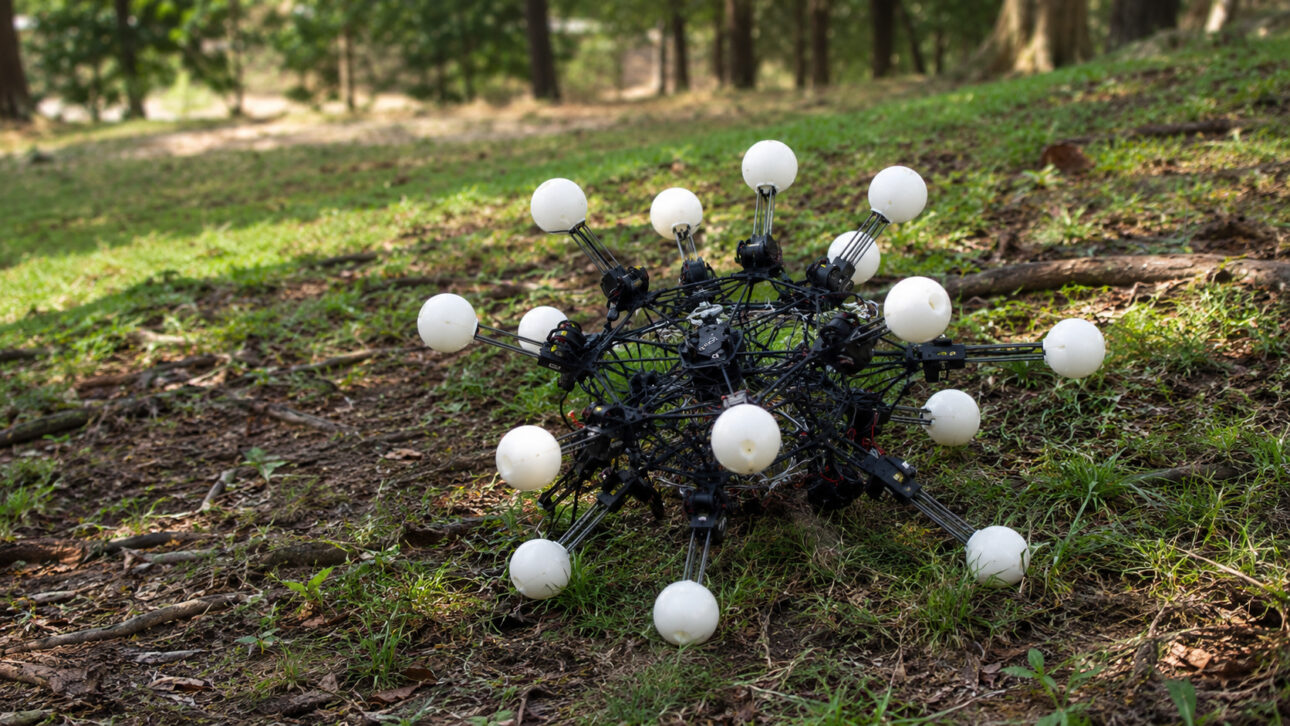
The robot, called Argus, was developed with 20 telescopic legs and 20 depth cameras, also described as “eyes.”
The central proposal of the project is to allow the machine to move in any direction without needing to turn its body before starting to move.
-
Apple has not confirmed anything yet, but iOS 27 raises an alert about a foldable iPhone that could change the future of the brand.

-
With workers dying from heat at construction sites worldwide, a company has created a vest that cools the body by up to 15°C for 8 hours and is already used by Formula 1 drivers and workers in Brazil.

-
YouTube launches “Ask the Studio” in Brazil, an AI that promises to interact with creators, explain channel metrics, reveal audience patterns, and even suggest ideas for upcoming videos.
-
Young Brazilians transform electric skateboards seized by the Federal Revenue into low-cost motorized wheelchairs, which can benefit schools, hospitals, and health centers.




Architecture breaks with the traditional robot format
Argus is based on a concept called dynamic symmetry.
This principle not only prioritizes the balanced appearance of the structure. The main focus is on the ability for uniform acceleration in various directions.
In practice, the robot was designed to maintain similar performance in different directions, even when its orientation changes during movement.
More than 1,500 configurations were analyzed
Researchers at Duke University arrived at the final model after computer simulations with more than 1,500 possible shapes of robotic bodies.
The chosen structure was inspired by a regular dodecahedron, with members distributed uniformly around the central core.
This configuration allows forces to be applied with balance in virtually any direction, reducing the need for body repositioning.
20 cameras transform the body into a perception system
Each of Argus’s 20 telescopic legs has a depth camera.
This distribution creates a vision system spread throughout the entire body, without relying on a single observation point.
The robot’s body itself, therefore, functions as a tool for reading the surrounding environment.
Tests show performance on varied terrains
During the experiments, Argus traversed surfaces such as sand, concrete, vegetation, and uneven terrains.
The robot also demonstrated the ability to continue operating even after losing up to three legs.
In the tests, the machine also managed to carry about 4.5 kg, push large objects, and perform vertical movements between nearby walls.
Project is still a proof of concept
Duke University highlights that Argus has not been presented as a product ready for immediate use.
The researchers’ proposal is to demonstrate the feasibility of a new approach in building mobile robots.
The project shows that, in some applications, performance can be more important than the traditional body form.
What Argus can represent for robotics
Argus reinforces a research trend focused on more adaptable, resilient robots capable of operating in challenging environments.
The combination of omnidirectional mobility, distributed perception, and fault resistance positions the project as a relevant demonstration for the future of experimental robotics.
Duke University’s creation shows that mobile machines can be conceived differently, with less reliance on front, back, or fixed orientation.
Do you believe that robots like Argus, capable of moving in any direction and continuing to function even after failures, can transform areas such as rescue, exploration, and transportation in the coming years?






Be the first to react!