Portuguese
  Spanish


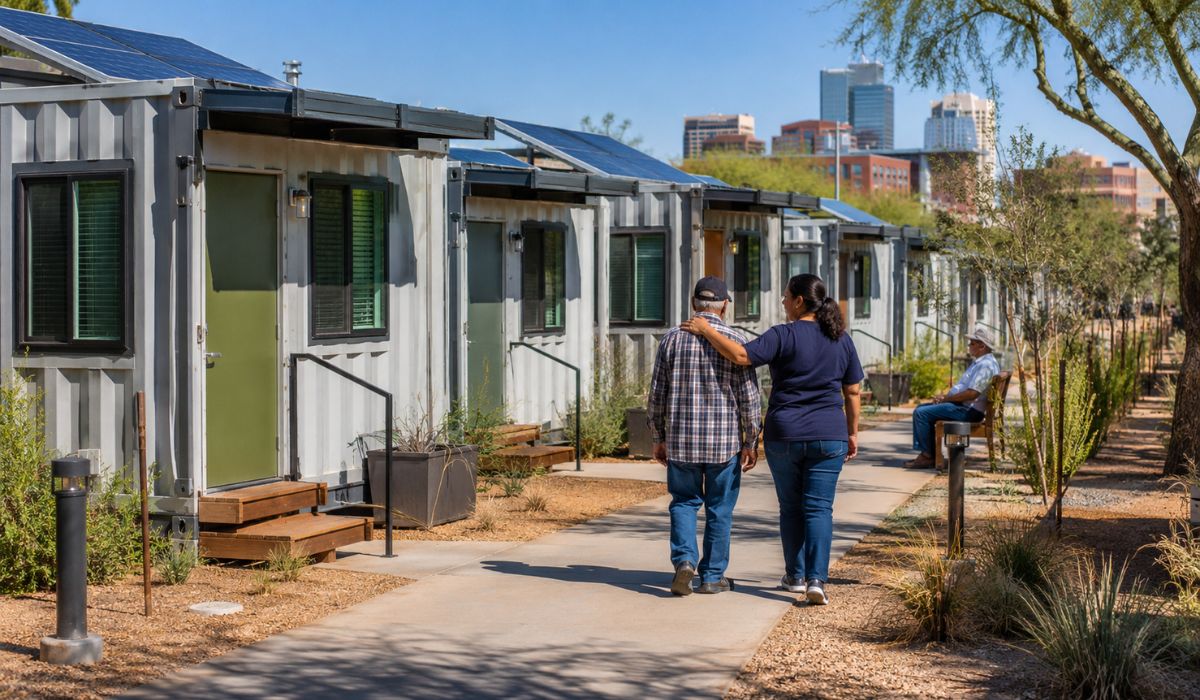

Project in Phoenix combines adapted containers, solar energy, and social services to create transitional housing for homeless seniors while preparing permanent units on the same site and reigniting the debate on modular housing.
Phoenix, in the United States, has opened the first phase of the Senior Bridge, a transitional housing project that uses adapted containers to accommodate adults aged 55 or older who are homeless.
The initiative includes 40 individual units, each about 14.8 m², equipped with a bed, sink, bathroom, shower, microwave, and mini-fridge, in an area near the intersection of 28th Street and Van Buren Street.
The project serves as an intermediate step between emergency shelter and permanent housing.
-
Low-Cost Concrete Panel House Goes Viral: Investor Reveals Prefabricated Kit Structure for Around $1,500, Assembled in 30 Days, with Plans for Rental and Resale Income

-
Brazilian Lottery Winner Ordered by Court to Share $22 Million Jackpot with Ex-Partner, Sparking Major Legal Battle

-
Why Yellow is the Safety Color for Heavy Machinery: Origins and Benefits Since 1931

-
U.S. Channel Highlights 20 Brazilian Innovations Leading Latin America: From Açaí to Modular Homes and Biogas



The initiative involves the City of Phoenix, the Arizona Department of Housing, and the organization Mercy House, responsible for operating the space.
According to the City of Phoenix, the city allocated $750,000 to the first phase and plans a new municipal investment for the next phase, aimed at permanent affordable units.
Modular housing for homeless seniors in Phoenix
The Senior Bridge uses modular construction to expand the supply of individual units in a shorter timeframe than conventional construction requires.
The adopted model replaces collective dormitories with small private spaces, allowing residents to have their own bathroom and a basic support structure for hygiene, rest, and food.
Each unit was designed as a compact studio.
The design includes a sleeping area, bathroom, sink, and basic equipment for storage and simple food preparation.
According to documents submitted to Phoenix IDA, the proposal aims to offer non-collective temporary housing to older people in vulnerable situations.
Mercy House will be responsible for monitoring the residents.
The service includes case managers and referrals to health services, nutritional support, and community activities.
According to the organization, this support can continue after the resident leaves the transitional unit, depending on each case’s needs.
How adapted containers for housing work
The structure of Senior Bridge is based on the reuse of containers converted into habitable units.
The units receive adaptations for plumbing installation, bathroom, support area, and energy systems.
The company Steel and Spark, involved in the manufacturing of the units, participates in the development of the modular structures used in the project.
Besides the compact construction, the complex was presented as a facility powered by solar energy.
According to Axios, the space features lithium battery storage and can operate off the conventional power grid.
The information was attributed by Timothy Huynh, program director at Mercy House, during the project’s presentation.
In an interview with public radio KJZZ, Brian Stark, co-founder of Senior Bridge and CEO of Steel and Spark, stated that making the complex energy-independent reduces one of the main costs for operators of assisted living facilities.
He also said that, in permanent units, this model can reduce the burden of air conditioning expenses for future residents.
This aspect helps explain the project’s interest in discussions about modular architecture, affordable housing, and energy efficiency.
The use of containers, in this case, is associated with the production of compact housing units, with their own bathroom and energy supply from solar panels and batteries.
Why the project serves people over 55 years old
The audience of Senior Bridge consists of people 55 years or older who are homeless and able to care for themselves.
There is no fixed duration of stay, but the expectation informed by Timothy Huynh to Axios is that the transition should ideally occur within 90 days.
During this period, each resident should receive support to seek a more stable housing alternative.
The temporary structure functions, therefore, as a support point to organize documentation, access services, and guide the resident to a permanent housing solution.
The choice of this age group aligns with a relevant segment of local data.
In Maricopa County, where Phoenix is located, the Point-in-Time report of 2026 counted 9,726 homeless people in a single night.
Of this total, 1,417 were between 55 and 64 years old, while 642 were 65 years or older.
In the municipal segment, the City of Phoenix reported that 7,335 people were registered as homeless in the 2026 survey.
The number of sheltered people in the city rose from 3,514 in 2025 to 4,041 in 2026.
Meanwhile, the total number of unsheltered people fell from 3,541 to 3,093 in the same period.
These numbers help contextualize the creation of projects aimed at older adults.
This audience may require specific support due to health conditions, reduced mobility, and greater exposure to environmental risks when living outside shelters or regular housing.
Transitional housing before permanent habitation
Although the units function as small studios, the first phase of Senior Bridge was not presented as definitive housing.
The proposal is to offer a temporary base for residents to be supported until the move to a permanent solution.
The project’s name reinforces this function.
“Bridge” in English means bridge.
In the model presented by the city and the involved entities, the adapted containers serve as a transitional stage, while the social support team works on connecting residents with long-term services and housing.
At the inauguration ceremony, Deputy Mayor Kesha Hodge Washington stated that the city was creating “a model that puts dignity at the center while delivering results.”
The statement was made during the opening event of Senior Bridge, according to Axios.
The phrase was used by local authorities to present the project as a response to the demand for individualized accommodation alternatives.
The result, however, will depend on the ability to direct residents to permanent housing and maintain the support services planned in the operation.
Second phase foresees permanent apartments
The second phase of the complex foresees permanent units on the same land.
The original Axios report stated that this stage would have 54 permanent support apartments, each with about 750 square feet, equivalent to approximately 69.7 m².
The official page of the Phoenix City Hall, published on March 26, 2026, reports investment in a stage with 56 affordable housing units.
According to Kathleen Santin from Steel and Spark, future residents would pay affordable rent and would not be charged for electricity, due to the solar system planned for the development.
The construction of the apartments made with containers was already underway at the time of the report, with the move-in expected to begin around December.
The document presented to Phoenix IDA describes Senior Bridge as a community in two phases.
The first is focused on transitional housing in individual units.
The second should function as permanent affordable housing, maintaining part of the support network for residents in the same location.
The proposal places Phoenix in a broader urban debate about rapid construction alternatives, reuse of industrial structures, and reduction of operational costs in housing projects.
In the case of Senior Bridge, the combination of adapted containers, solar energy, and social support was presented as a specific response for older adults experiencing homelessness.
With the first phase already open and the permanent stage under construction, the project is now being monitored as a practical test of modular housing applied to a vulnerable population.