Portuguese
  Spanish


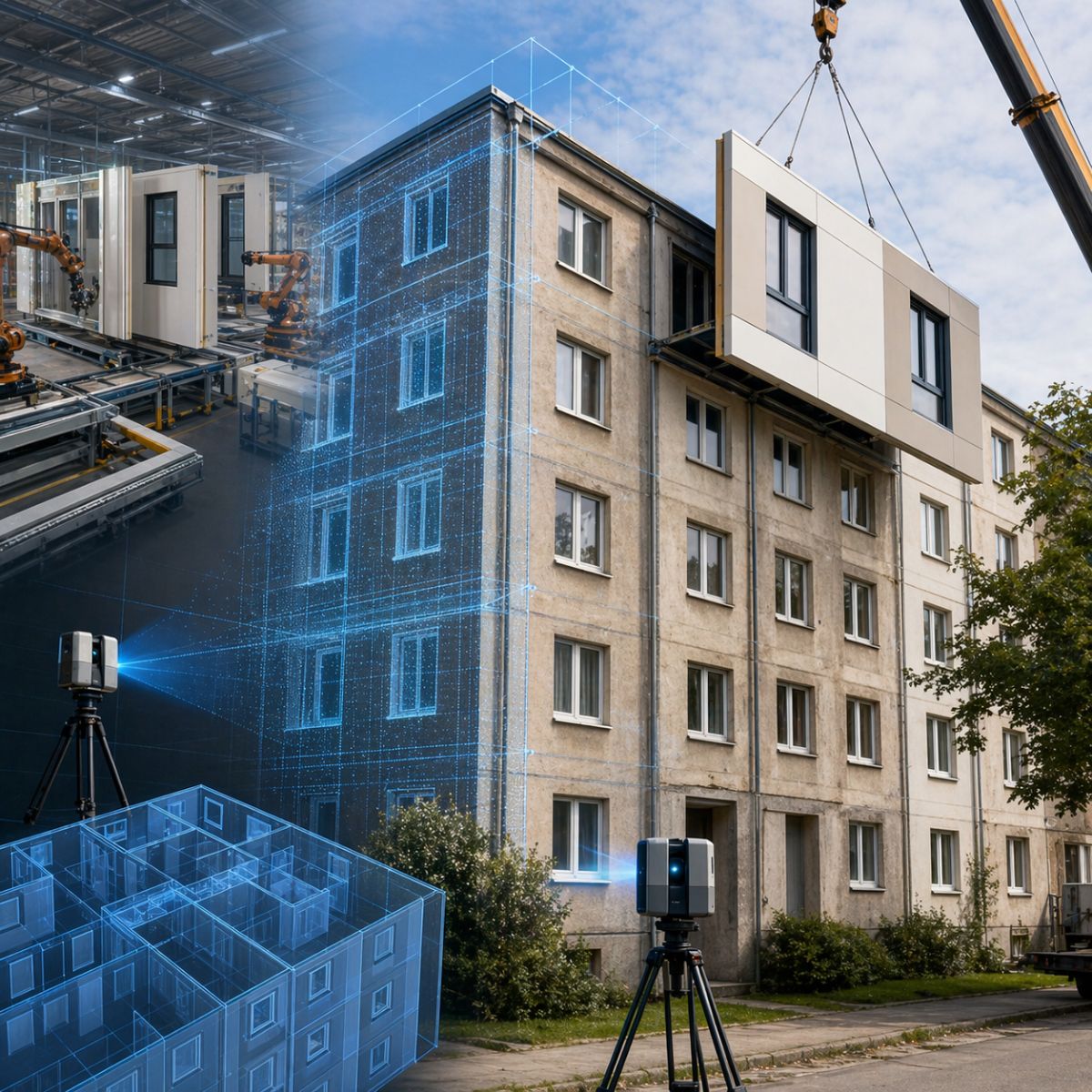

The German company Ecoworks, based in Berlin, has developed a serial renovation method that scans old buildings, creates millimeter-precise digital replicas, and uses robots to manufacture wooden facades with integrated insulation and windows, which are fitted onto the walls without the need for scaffolding and practically eliminate residents’ heating costs.
A company in Berlin is transforming the way old buildings are renovated in Germany, and the method it uses seems straight out of an industrial assembly line, not a construction site. Ecoworks scans buildings inside and out using three-dimensional mapping technology, creates a millimeter-precise digital replica of each structure, and from this data, robots manufacture large facade panels in a factory. The elements arrive ready at the construction site and are fitted onto the walls with a lifting platform, without the need to erect scaffolding.
The most impressive result appears after the renovation: residents almost never need to turn on the heating again. The efficiency of the thermal insulation installed in the panels is so high that the buildings begin to operate close to carbon neutrality, consuming a fraction of the energy they used before. The company, founded in 2019, has already renovated dozens of buildings, holds its own patents, and is pointed out by experts as a candidate to become a unicorn startup, with a valuation exceeding one billion dollars.
How Ecoworks Scans and Digitizes an Entire Building Before Renovation

According to information released by the ntv Magazine Channel, the process begins before any part is manufactured. The company sends teams to scan the building inside and out, capturing every detail of the structure in a three-dimensional model. Irregular walls, out-of-square angles, and deformations accumulated over decades are recorded with millimeter precision, creating a digital replica that serves as the basis for the entire renovation project.
-
72-Year-Old Man Spends Six Years Building a Rotating House for His Wife, Completing a Full Turn in 22 Seconds

-
Chinese Residential Building Surrounded by Circular Overpass After Residents Reject Compensation

-
After 79 Months and $145 Million Investment, Nepal Set to Open First 2.7 km Road Tunnel to Ease Traffic in Kathmandu Valley

-
In China, 23 Families Spent Over 4 Years Carving a 1.2 km Road Through a Cliff to Overcome Isolation and Transform a Remote Village


From this model, Ecoworks engineers design the facade and roof elements that will be manufactured at the industrial plant. Each panel is custom-designed to fit perfectly onto the wall of the original building, eliminating the improvisations that characterize conventional renovations. The prior digitalization is what allows factory production to replace manual work on site, accelerating the process and reducing errors that typically increase costs and delay retrofit projects.
What Robots Manufacture in the Factory and How the Panels Are Installed

At the Ecoworks factory, robots construct large wooden panels that come with integrated windows, thermal insulation, and piping. Each element is a complete facade section, ready to be transported and affixed to the building without residents having to endure months of construction, dust, and noise from a conventional building site.
On-site installation is done with lifting platforms that position the panels directly onto the building’s exterior wall. The process eliminates scaffolding, which reduces costs, execution time, and inconvenience for residents who continue to live in the building during the renovation. In a conventional construction project, erecting scaffolding, applying plaster, replacing windows, and installing insulation can take months. With the Ecoworks method, the same work is completed in a fraction of that time.
Why Residents Almost No Longer Need to Turn on the Heating
The energy efficiency achieved after the renovation is the **company**’s strongest argument. **The insulation of the factory-made panels is so effective that renovated buildings practically do not need conventional heating**, even during the German winter. At the same time, **Ecoworks** installs heat pumps and photovoltaic panels on the roofs, completing the transition to a renewable **energy** system that makes the building carbon neutral.
For tenants, the practical effect is a drastic reduction in the **energy** bill. In a country where heating costs represent a significant portion of housing expenses, **the savings generated by the renovation can make housing more affordable in the long term**, offsetting any rent increases associated with property appreciation. Residents themselves report that, after the intervention, they rarely turn on the heating system.
The billion-dollar market Ecoworks wants to conquer
The potential for serial renovation in Germany is immense. **Experts estimate that 2,700 billion euros would be needed to modernize the entire building stock in the country and achieve the desired energy efficiency standards.** **Ecoworks** currently manages 25 renovation projects, a tiny fraction of this market, but investors like World Fund, one of Europe’s leading climate protection venture capital funds, bet that the **company** can scale rapidly.
Competition exists, but it is still limited. Renovate, a German-Austrian joint venture, also works with complete serial renovation solutions. **However, many traditional construction companies still prefer the conventional method with scaffolding and intensive labor**, which, according to Nils Bohrmann, from the Competence Center for Serial Renovation at the German **Energy** Agency, is one of the reasons why the construction sector is not meeting the federal government’s CO₂ reduction targets.
What serial renovation can teach the rest of the world
**Ecoworks**’ approach solves a problem that is not exclusive to Germany. **Old buildings with poor insulation exist in all cold or temperate climate countries**, and the need to reduce carbon emissions in the construction sector is global. The model of digitalization, robotic manufacturing, and rapid installation can be replicated in any market that has an aging building stock and environmental goals to meet.


Bohrmann highlights that the costs of serial renovation decrease as projects scale up, the opposite of what happens in conventional renovations. **The company has already accumulated awards since its foundation, and the prospect of becoming a unicorn demonstrates that the financial market sees viability in the model.** For the founders, being copied by competitors is the highest possible compliment, because it means that the industrialization of **building** renovation is finally moving out of the laboratory and into the scale that the planet’s climate demands.
Do you think this renovation method with robots and prefabricated facades could work in Brazil, or are the climatic and constructive conditions too different? Tell us in the comments what you think about the idea of renovating entire buildings without scaffolding and practically zeroing out energy costs.