Portuguese
  Spanish


More than 500 life-size human statues have rested for over a decade on the seabed of the Mexican Caribbean, in front of Cancun and Isla Mujeres, in Mexico.
They were deliberately sunk starting in 2009 by British artist Jason deCaires Taylor, who opened the MUSA (Museo Subacuático de Arte) to the public in November 2010. What began as an almost funereal scene, dozens of concrete bodies standing in the dark, turned into a living reef covered with corals that now attracts divers from around the world.
According to the artist Jason deCaires Taylor’s website, there are more than 500 permanent life-size sculptures spread over more than 420 square meters of previously barren seabed, molded in pH-neutral cement that serves as a stable base for coral growth. Meanwhile, the MUSA (Museo Subacuático de Arte), the institution that manages the collection in Cancun, details that its most famous work, “The Silent Evolution,” consists of 45 modules with 10 human bodies each, totaling 450 submerged figures, made of marine concrete and fiberglass rebar. Together, these statues form one of the largest underwater museums on the planet.
The idea that was born from a coral on the brink of collapse
The natural corals of the region, among the most visited in the Caribbean, were being trampled, scratched, and suffocated by the excess of tourists. Thousands of divers descended every year on the same fragile coral, and each careless fin, each thrown anchor, each touch of a hand accelerated the death of a coral that took centuries to form.
-
In a city where every piece of land is worth gold, he began buying plots in the 1960s and built a real estate empire with over a thousand properties.

-
A fossil kept for years in a small museum in Montreal concealed 450-million-year-old soft tissue, a discovery that has only happened once before in history.

-
Engineers spend a decade building a $2.3 million bridge, but the project features a surreal curve, becomes a joke, and ends with seven suspended.

-
7-year-old boy acts without hesitation and saves his 1-year-old brother from drowning in the family pool in Texas: the boy’s courage impressed the sheriff and he may now receive an official police commendation.




It was in this emergency scenario that the strangest and most ambitious idea ever attempted to save a coral was born: if divers insisted on descending, let them descend somewhere else. A new, artificial place, purposely built to receive people and, at the same time, become a home for corals. The answer came in the form of sculptures, hundreds of them, purposefully sunk at the bottom of the sea right in front of Cancun.
The marine park in the region receives more than 750,000 visitors per year, a brutal pressure on every living coral along the coast. Diverting part of this flow from the natural corals and taking it to an artificial reef populated with human figures was, in theory, a way to give rest to the most battered areas. In practice, no one knew if that insane plan would work, and many people thought Taylor had gone completely mad.
Who is the man who turned the seabed into a gallery
The author of the plan was Jason deCaires Taylor, a British artist and diver who combined sculpture, ecology, and diving into a single obsession. Before Cancun, no one had built an entirely submerged sculpture park designed to become a reef. Taylor was the first in the world to do this, and MUSA became the ground zero of this type of art on the entire planet.
To give faces to the figures, Taylor did not invent fictional characters. He molded real people: more than 90 fishermen and residents of the region posed to have their bodies immortalized in concrete at the bottom of the sea. Men, women, young and old became life-sized statues, frozen in common everyday gestures, to later be delivered to the sea and, over time, to the corals.
There was something profoundly disturbing about the scene. Descending and finding hundreds of human statues standing in the blue silence, some facing away, some facing forward, some holding hands, resembled a submerged cemetery, an entire people petrified at the bottom of the sea. Many divers reported a shiver when crossing that immobile crowd in the dim light. But it was exactly this shock that Taylor sought: to make the visitor feel, in their own skin, the fragility of life and the coral they unknowingly destroy.
The human figures of “The Silent Evolution,” molded from local residents and installed by Jason deCaires Taylor at the bottom of the sea in Cancun. (Photo: Reproduction/MUSA)
“The Silent Evolution”: 450 concrete bodies in the dark
It is the largest and most impressive concentration of sculptures in the museum: about 450 human figures arranged in circles and rows on the sandy seabed, like an entire city that would have sunk at once at that point in the Caribbean.
The numbers behind this work are dizzying. It weighs around 120 tons of concrete, sand, and gravel, supported by kilometers of fiberglass rebar that resist corrosion. It took more than a year of work and dozens of hours of underwater effort to lower, position, and fix each of the figures in the exact place, resisting the strong currents and hurricanes that sweep the Caribbean every summer.
Seen from above, the statues form a design that only makes sense from afar, a silent warning about where humanity might be heading. Seen up close, each face has its own expression, a skin detail, a wrinkle, a strand of hair. It is this mix of gigantic scale and human intimacy that makes divers travel across the planet just to float, in silence, among them.
The secret is in the concrete
What sets the statues of Cancun apart from any other sculpture in the world is what they are made of. No marble, no bronze, no metals that rust and poison the water. The sculptures of MUSA were molded in marine cement with a neutral pH, a formula designed not to harm the sea and, more than that, to invite life to settle on them.
The neutral pH is the detail that changes absolutely everything. It makes the surface of each piece welcoming to coral larvae, algae, and barnacles, which attach, cling, and begin to grow. The rough texture and intentional holes in each statue function like the crevices of a real coral, offering shelter to fish, lobsters, and crabs that come to live inside, as if it were natural stone.
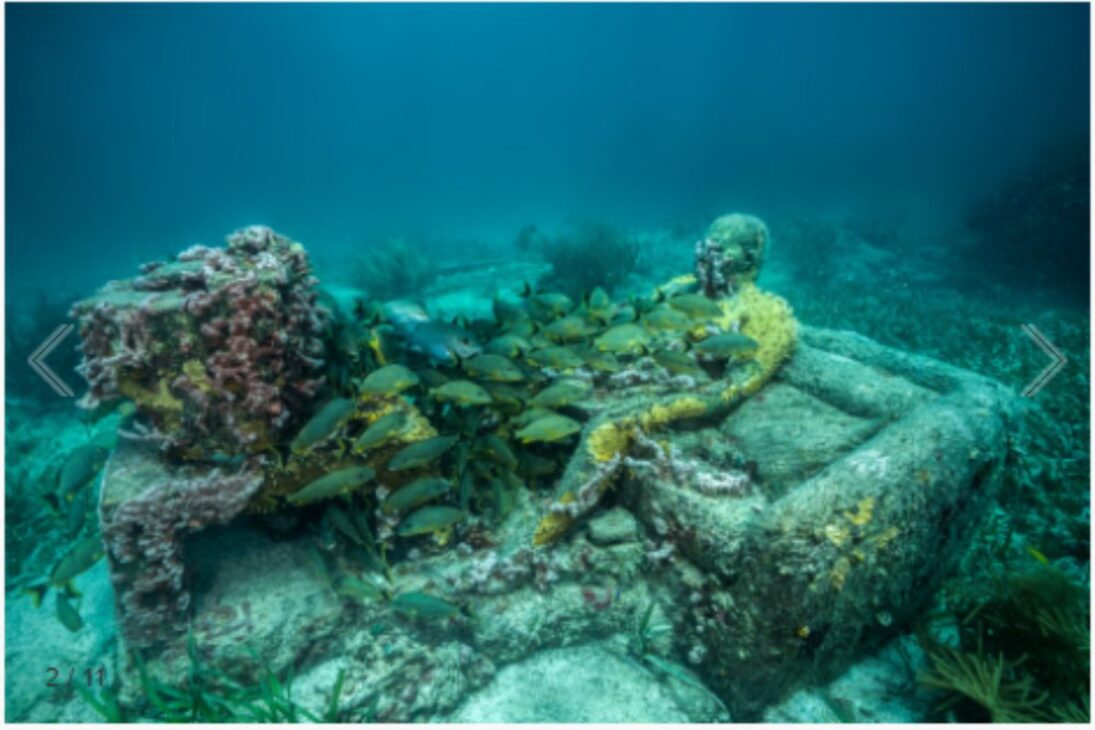
Over time, the concrete completely disappears under the life. The smooth skin of the figures gains a colorful crust of corals, sponges, and algae, and what was gray turns orange, purple, green, yellow. Each statue ceases to be a mere object and becomes a substrate, the solid base on which a new coral is built, brick by brick, polyp by polyp, without any human hand needing to interfere.
Detail of one of the MUSA statues already taken over by corals and algae at the bottom of the sea in Cancun, showing how the neutral pH concrete transforms into living coral. (Photo: Reproduction)
From macabre art to living reef
Time has done with MUSA what no artist could achieve alone. Year after year, the once bare and gray statues have been colonized by marine life. Today, just the installation “The Silent Evolution” hosts over 2,000 young corals growing on the concrete bodies, not to mention the sponges, gorgonians, and algae covering every inch of surface.
What seemed like macabre art, an army of submerged dead forgotten in the dark, turned into exactly the opposite: one of the most lively environments of that stretch of sea. Fish that previously had nowhere to hide found safe shelter among the sculptures. Predators began to hunt there. Turtles, rays, and schools of fish cross the scene all day long. The artificial reef pulses as if it had always existed.
This transformation is the heart of the entire project. The sculptures were not made to remain unchanged like those in a traditional museum, protected behind glass. They were made to change, to be devoured by life, to gradually disappear under the reef they themselves helped create. The work of art here is the very slow process of becoming pure nature.
A museum that exists to save real reefs
Behind the beauty and the shock, MUSA has never hidden its real objective: to protect the natural corals of Cancun. Every diver who descends to see the statues is, in theory, one less diver stepping on the original living coral. The museum acts as a lure, attracting the crowd to itself and sparing what is fragile and irreplaceable a few kilometers away.
The strategy is simple to understand and difficult to execute. Concentrating visitors on an artificial reef of statues relieves pressure on natural formations, which finally gain time to recover. In areas of already damaged coral, still-living fragments have been rescued and replanted on the works, turning conservation into part of the submerged art itself.
The success was so great that the model spread around the world. What started with a handful of statues at the bottom of the Cancun sea inspired submerged museums in various countries, all offspring of the same radical idea born in the Mexican Caribbean. Taylor’s works became a school and proved that art and science can indeed walk together underwater.
Diving among the statues: what the experience is like
Visiting MUSA is not about looking at paintings hanging on a dry wall. It’s about putting on a mask, tank, or snorkel and descending into a world where art is always just a few meters from your face. The statues are divided into galleries with different depths, designed to cater to all types of audiences and levels of courage.
In the Manchones hall, about 8 meters deep, are the statues intended for tank divers, including the bulk of “The Silent Evolution.” In the Punta Nizuc hall, much shallower at about 4 meters, the figures are within reach of those who just want to snorkel on the surface, floating face down over the submerged bodies. There is also a third front of expansion of the collection, a clear sign that the museum has never stopped growing.
For the diver, the effect is hypnotic and hard to forget. The filtered Caribbean light cuts through the water and illuminates rows of figures covered in life, among schools of fish that enter and exit the openings of the bodies. It is an art gallery where silence is absolute, the ceiling is the very surface of the sea, and each work truly breathes. No wonder the place has become one of the most desired diving destinations in the entire world.
What the statues still have to say
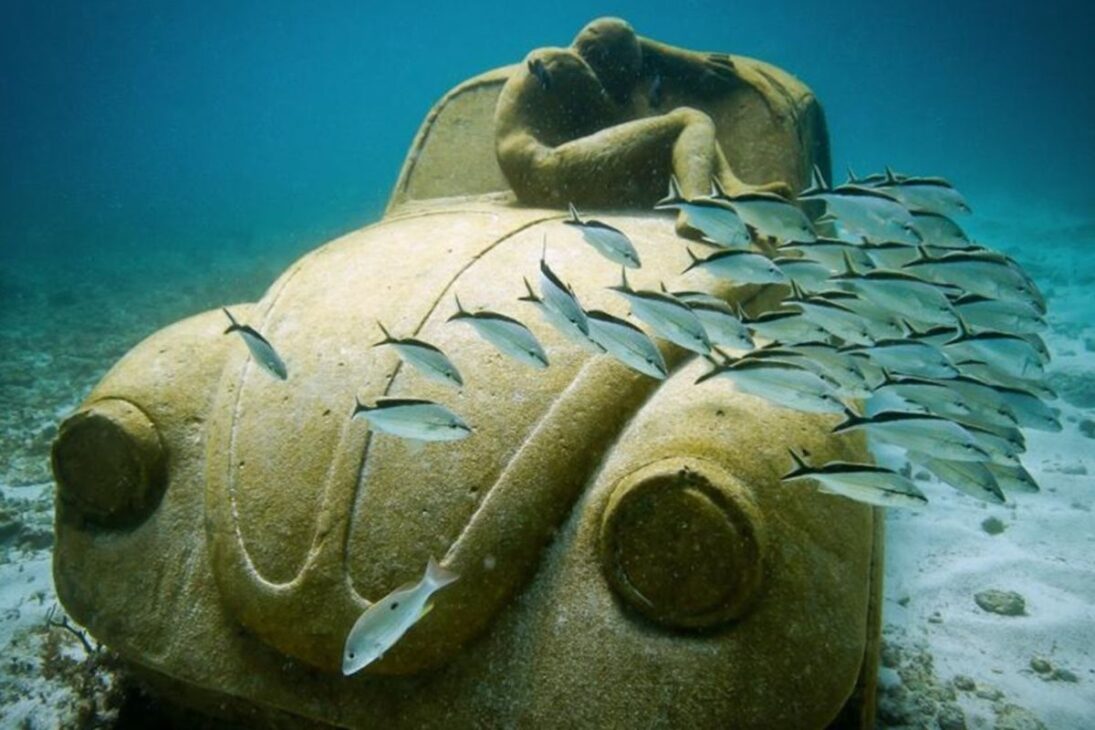
MUSA did not stop at “The Silent Evolution”. Among the hundreds of sculptures and works scattered across the seabed of Cancun, there are pieces that deliberately provoke, like a life-sized Beetle, about nine tons, transformed into a dark shelter for lobsters and crustaceans. Each new work reinforces the same unsettling message: what humans discard, the sea can repurpose, as long as we allow it.
More than ten years after the first immersion, the statues of Cancun continue to change with each season. Each season they are more covered in corals, more integrated into the reef, less like concrete, and more like living, ancient stone. The museum that was born with the mission to disappear under nature is, slowly and silently, fulfilling its final destiny.
In the end, what Jason deCaires Taylor sank in the Caribbean were not just statues. It was a question embedded in the seabed, made of concrete and coral, about what we do with what we love and destroy at the same time. If hundreds of human statues can become a living reef capable of bringing the sea back to life, what else might we be failing to try to save the little that still remains of the oceans?