Portuguese
  Spanish


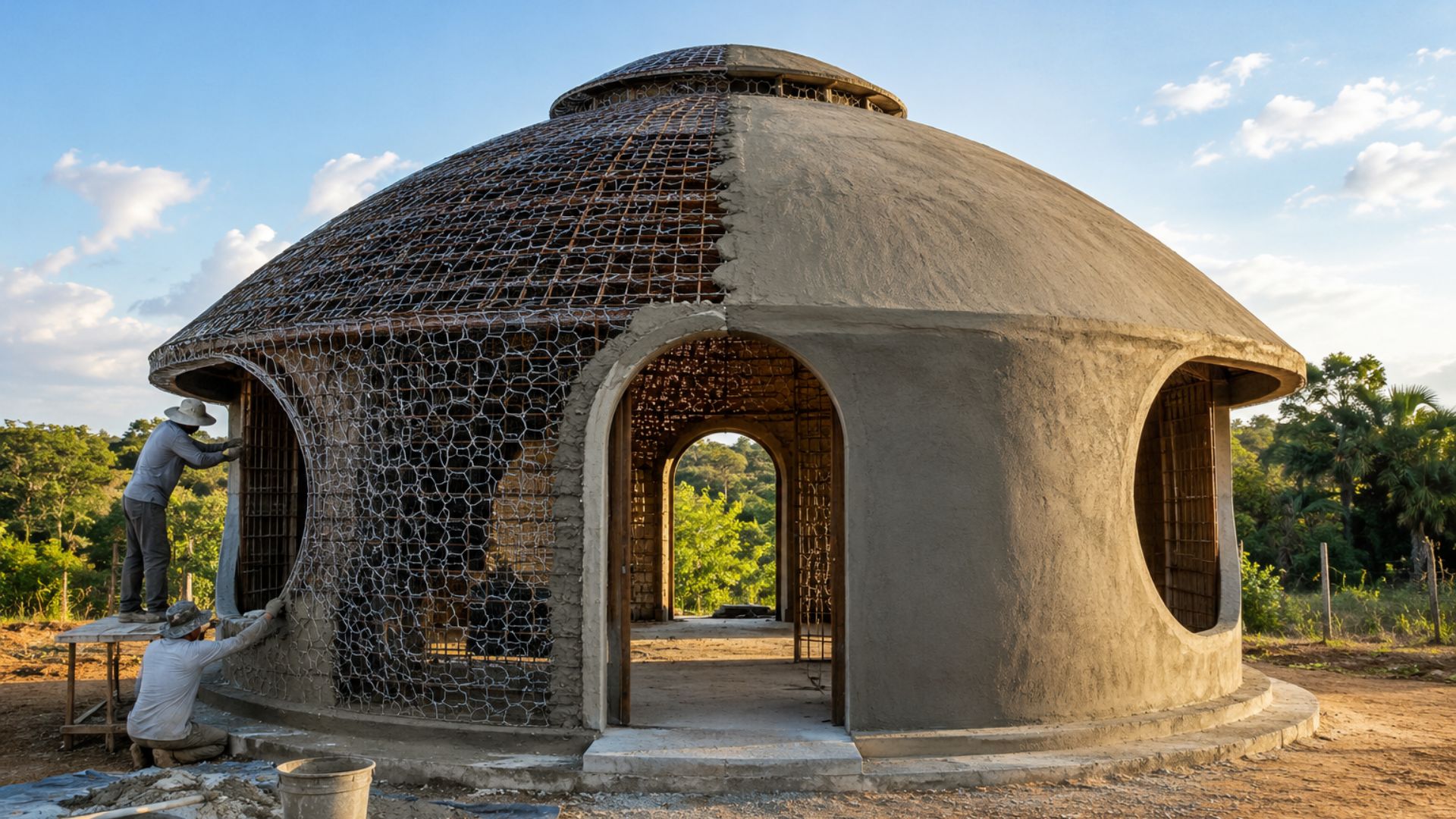

Technique popularized by Pier Luigi Nervi reappears in compact housing projects and curved structures, combining thin metallic meshes and resistant mortar to create light, durable constructions with lower material consumption compared to traditional masonry and reinforced concrete methods.
Ferrocement has reappeared as a low material consumption alternative in light constructions, reservoirs, and compact housing, although the system’s performance remains directly linked to the quality of the structural design, mortar execution, and technical control carried out throughout the construction.
Instead of using thick bars concentrated at a few points, the technique combines thin metallic meshes, such as hexagonal or welded meshes, with mortar rich in cement and sand, forming structures capable of assuming curves and rounded surfaces with fewer conventional formworks.
In addition to allowing for thinner elements, this configuration better distributes structural stresses and favors the creation of domes, vaults, and curved shells used in architectural projects of different scales.
-
France Revamps 530 Social Housing Units with Large Balconies and Glass Facades Without Demolishing Existing Buildings

-
Facing high rent, couple transforms parents’ garage into a fully functional apartment, creating a complete home at a fraction of the market cost.

-
MIT Scientists Develop Method to Transform CO₂ into a Construction Ally, Boosting Cement Strength by 13% in 24 Hours for More Sustainable Infrastructure
-
Canadian City Builds 8 Tiny Homes in 72 Hours for Homeless Youth, Plans 40 Affordable Houses for Female-Led Families Amid Housing Crisis


Although frequently associated with the Italian engineer Pier Luigi Nervi, ferrocement has origins predating the work developed by the designer throughout the last century.
Nevertheless, Nervi played a decisive role in the modern popularization of the technique by exploring light, curved, and highly structurally efficient structures in various 20th-century works.
How a ferrocement structure works
Unlike traditional reinforced concrete, which concentrates thicker bars at specific points, ferrocement distributes the reinforcement in several layers close to the surface, allowing for more uniform structural behavior and greater control over small cracks.
As a consequence, the elements can withstand deformations more evenly, reducing the formation of larger cracks and increasing durability when execution follows appropriate technical parameters.
Thickness can vary according to structural function, span, mesh type, and anticipated loads.
In some applications, there are panels and shells just a few centimeters thick, but habitable walls require calculation, detailing, moisture protection, and verification according to local standards.
During execution, the mortar must completely penetrate the meshes and fill the voids.
Failures at this stage compromise the adhesion between steel and cement, reduce durability, and can lead to infiltrations, stains, and corrosion over the years.
Round houses and curved structures gain space
Ferrocement adapts well to rounded surfaces because the geometry itself helps distribute stresses.
Domes, vaults, and curved shells can span openings with thinner elements, provided the form has been defined by structural calculation.
This characteristic explains the interest in round houses and curved roofs.
Instead of relying solely on the mass of the walls, the structure utilizes the continuity of the surface, which can reduce waste and simplify assembly in certain projects.
Despite the structural advantages, material savings do not occur automatically in all projects.
It depends on the architectural design, labor, availability of meshes, type of cement, finish, and actual comparison with masonry, reinforced concrete, or prefabricated systems.
Corrosion resistance depends on execution
The durability of ferrocement is linked to the low porosity of the mortar, adequate covering of the meshes, and wet curing after application.
When these factors are respected, the structure can offer good protection against water ingress and aggressive agents.
Even with good durability, experts warn that the system should not be treated as completely immune to deep corrosion.
Since the meshes have thin wires, any covering failure, open crack, marine environment, or highly porous mortar can accelerate the degradation of the metallic reinforcement.
For this reason, experts recommend controlling the water-cement ratio, using clean or galvanized meshes when indicated, adequate curing, and periodic inspections.
In residential constructions, moisture protection should receive the same attention given to mechanical resistance.
Where ferrocement can be applied
Ferrocement can be useful in water reservoirs, lightweight roofs, small buildings, pre-cast components, curved elements, and constructions in locations where the transport of gravel, formwork, and heavy equipment increases the cost of the work.
In housing, the system often attracts residents interested in organic forms, a smaller volume of material, and more artisanal construction processes, especially in compact and customized projects.
The technique, however, requires trained labor, because the final quality depends directly on the assembly of the meshes and the application of the mortar.
Single-story houses, compact vaults, and annexes can benefit more from the method than larger buildings or multi-story projects.
The definition depends on a responsible engineer, soil investigation, adequate foundation, and municipal licensing.
Stages require precision and technical control
The construction process typically begins with defining the structural form using thin bars, templates, or auxiliary frameworks responsible for supporting the metal meshes during execution.
Layers of mesh are fixed onto this base, which need to be well-tensioned to prevent deformations during mortar application.
Then, the cement and sand mixture is pressed against the mesh until it completely envelops the wires.
Wet curing for several days is an essential step, as it reduces shrinkage, improves strength, and decreases the risk of premature cracks.
Waterproofing finishes, eaves, ground drainage, and protection against infiltrations also influence the lifespan of the house.
Without these precautions, a thin wall can lose performance even when the initial structure seems rigid.
Thermal comfort depends on the house design
Although curved forms favor ventilation, natural lighting, and integration of spaces, the thermal comfort of a ferrocement house also depends on complementary factors related to the architectural design.
Reduced thickness, solar orientation, shading, insulation, openings, and coatings directly interfere with the internal temperature.
In hot regions, a thin shell without solar protection can heat up quickly.
In cold places, the lack of insulation can reduce comfort.
Therefore, the design must combine the structural system with bioclimatic strategies appropriate to the region’s climate.
The technique offers important architectural possibilities, especially when used with calculation, material control, and qualified execution.
Without this combination, promises such as “half the material,” “3 cm walls,” and “total corrosion resistance” should be treated as design estimates, not as a general rule.