Portuguese
  Spanish


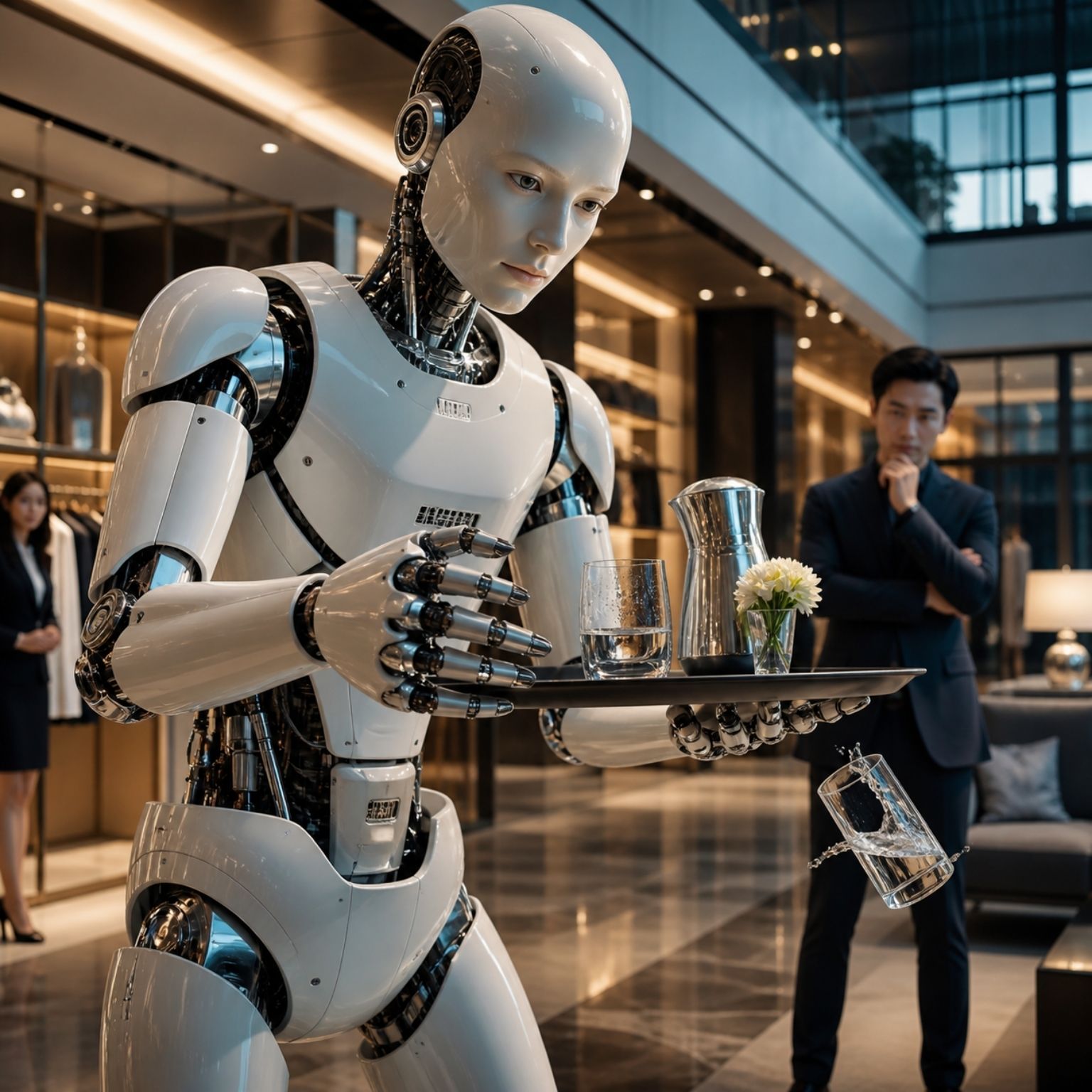

Kai robot presented by China startup promises to bring more degrees of freedom, sensitive touch, and embedded intelligence to homes, stores, hotels, and customer service, with a price below US$ 40,000, but still needs to prove it works safely and stably in the real world.
The new humanoid robot presented in China by the startup Kinetics AI arrived surrounded by impressive numbers and commercial ambition. Named Kai, the model was announced as a human-sized robot with 115 degrees of freedom, 18,000 tactile sensors spread across its body, and a target price below US$ 40,000 per unit, in a strategy aimed not at heavy factories, but at environments such as homes, stores, hotels, and service centers.
The presentation took place during the Gifted conference in Shanzan and drew attention because the company didn’t just show a prototype on stage. It revealed details of the system’s architecture, explained the logic of the robot’s body, sensors, and intelligence, and made it clear that it intends to start mass production by the end of 2026. At the same time, the announcement raised the question that today separates technical promises from truly useful products: will this robot be able to operate reliably outside of controlled environments?
What makes this robot different from humanoids already shown on the market

Kai’s main showcase is its number of degrees of freedom. According to the company, the robot achieves 115, a level that the presentation treated as the highest ever placed in a human-sized body. This data matters because degrees of freedom represent how many independent movements the joints can perform, something central to reproducing more natural gestures in spaces designed for people.
-
Italy Sinks Massive 11-Story Concrete Structures in the Ligurian Sea to Create a 6.2 km Barrier, Clearing the Way for 400-Meter Ships in Genoa

-
Wireless Charging Roads for Electric Vehicles: Detroit Implements Coil Technology, France Successfully Tests 300 kW Transfer Near Paris

-
Scientists Create Lab-Made Cell with Only 36 Genes That Eats, Grows, Copies DNA, and Divides, Raising the Question: Is This Life?

-
World’s Largest Camera, with 3,200 Megapixels, Begins Operation, Capturing Sky Images Every 30 Seconds for the Next Decade




In the comparison presented, advanced humanoids like Atlas from Boston Dynamics and Optimus from Tesla operate between 28 and 56 degrees of freedom. Kai thus appears as an attempt to push this limit much higher. In practical terms, this means a more articulated body, with the potential to bend, turn, reach, tilt, and manipulate objects in a less mechanical way.
The numbers that explain why the project attracted so much attention
The data technical data was the basis for the impact caused by the announcement. Kai was presented with 115 degrees of freedom in a humanoid body, while each hand would have 36 degrees of freedom, with 22 active and 14 passive. The target price below US$ 40,000 also helped place the project at another level of interest, because the suggested value positions it as a real candidate for the services market and not just for laboratories or large industrial centers.
Another decisive number lies in the synthetic tactile skin. The robot was described with 18,000 sensing points spread across its body, capable of detecting forces as small as 0.1 N, approximately equivalent to 10 grams on the surface. This combination of fine mobility, distributed touch, and lower price is what underpins the promise of bringing the robot into environments closer to everyday life.
How the robot’s body was designed to move more naturally
Kai’s physical structure was designed to allow movements that make sense in human environments. The company detailed shoulder, waist, neck, and hand joints with the aim of enabling actions such as picking up objects overhead, reaching the floor, and rotating the torso while walking.
The hands were treated as the most ambitious part of the project. The 14 passive degrees of each hand would function as natural mechanical shock absorbers, distributing force without relying on constant computer calculation. In the company’s explanation, this would help the robot hold fragile or deformable items with more delicacy, bringing the mechanics closer to the behavior of a human hand in fine tasks.
The tactile skin is one of the most important points of the project

If the body is responsible for mobility, the tactile skin is what underpins the promise of safe contact with the world. The system of 18,000 sensors distributed throughout the robot was presented as a key differentiator because it would allow it to perceive light touches, detect the proximity of people, and adjust force in real-time.
In practice, this layer is crucial for any robot that wants to operate near consumers, the elderly, customers, or guests. A humanoid designed for home or hotel use cannot just move well. It needs to understand when it’s touching something fragile, when it gets too close to a person, and when the force used in a task is more than necessary. This is the point the company tries to sell as the basis of what it calls manipulation with tactile awareness.
What’s behind the intelligence that controls the robot
Kinetics AI described Kai’s brain as a system called KAI World Model, divided into three modules: base, action, and evaluation. The first processes the environment. The second generates possible trajectories for movement. The third verifies if the action is safe and stable before execution.
This cycle was presented as a way for the robot to continuously plan, check, and act. The proposal seems simple in its description, but that’s precisely where the most sensitive part of the challenge begins. The more joints and variables a robot has, the greater the demand on the software that coordinates everything without crashing, losing balance, or executing unsafe movements.
How the company wants to train the robot with real-world data
The startup stated it created a device called Kai Halo, worn on the heads of human operators during common daily activities. While these people set a table, carry bags, or organize shelves, the system captures first-person video, body posture, and three-dimensional point clouds of the environment.
The importance of this method lies in the type of data collected. Instead of relying solely on artificial motion capture sessions or computational simulations, the company relies on real examples of how humans move and interact with objects in everyday life. This is relevant because one of the most cited bottlenecks in modern robotics is not just the hardware, but the difficulty of gathering extensive and useful data to teach machines to operate confidently in unpredictable environments.
Why this robot wants to enter homes, stores, and hotels
Unlike several competitors focused on industry and logistics, Kai was presented for service sectors and domestic use. The company wants to bring the robot to homes, stores, hotels, and customer service, that is, places where manual dexterity, close contact, and safe interaction are more important than brute force.
This positioning expands the project’s commercial reach. With a price below US$40,000, Kai is described as an option that could make economic sense for small and medium-sized businesses. Instead of being just a technological showcase, the robot tries to enter a market where reception, home support, environment organization, and simple service have direct demand.
What changes in practice if such a robot actually works
If the promise is confirmed, the impact could be significant. A robot with this level of dexterity and touch could take over some tasks currently linked to receptionists, store assistants, simple customer service, and support in residential environments. It could also gain space in contexts of elderly care and home assistance, especially in countries with accelerated aging, such as China and Japan.
At the same time, the technology also raises questions about work, job displacement, and acceptable limits of autonomy. The base text itself positions Kai as direct pressure on sectors that rely on intensive human labor. This transforms the project into something larger than an engineering novelty and places it within the debate about employment, productivity, and the reorganization of the service sector.
The central question has not yet been resolved


Despite the technical enthusiasm, the main question remains open. Kai may be the most articulated robot ever shown in a humanoid body, but that’s not enough to guarantee it will be reliable in homes, hotels, or stores. The more complex the body, the harder it is to control each movement with stability and safety in real-world situations, outside of planned routines.
Experts remind us that degrees of freedom, sensors, and flashy specifications don’t tell the whole story. It remains to be seen how the system behaves when it encounters unpredictable home environments, varied objects, people in motion, and off-script tasks. More detailed public metrics on autonomy, success rate, operating time without intervention, and failure percentage are also lacking.
Why the Chinese startup’s robot has definitively entered the global radar
Kai appears at a time when China is strengthening its position in the humanoid race and when the debate is no longer just futuristic. The combination of mechanical sophistication, sensory skin, real-world data, and a lower price makes the project stand out in a competitive market, where rivals offer different advantages but don’t always combine all these factors at once.
That’s why the announcement generated both technical admiration and practical skepticism. The robot could be one of the strongest signs that the humanoid market is moving from the demonstration phase to the real competition phase for commercial use. But, for now, the decisive frontier remains the same: it’s not enough to impress on stage. It needs to prove that the machine can handle the world as it is.
Would you trust a robot with 115 degrees of freedom and 18,000 tactile sensors to work inside your home or workplace?