Portuguese
  Spanish


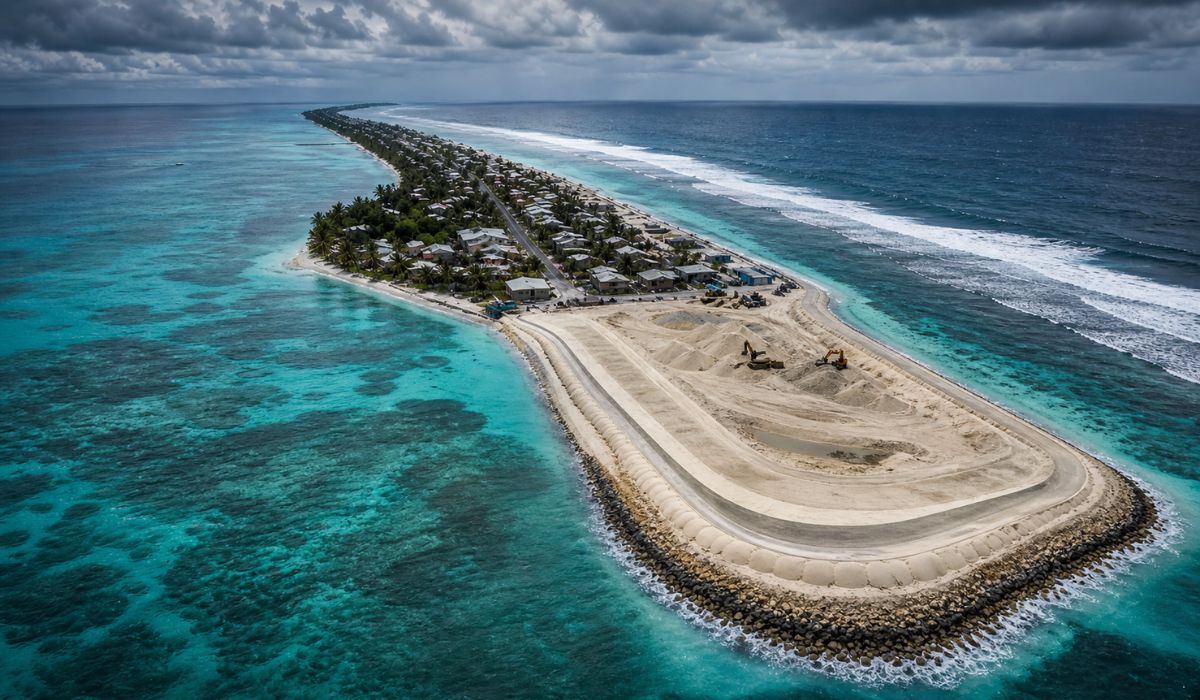

Tuvalu created a new elevated area over the ocean amidst rising sea levels, in a climate adaptation project involving coastal engineering, territorial planning, climate migration, and long-term projections for the Pacific.
Tuvalu, one of the smallest countries in the world, has completed the creation of 8 hectares of elevated land in Fogafale, Funafuti’s most populous islet, the archipelago’s capital.
The project is part of the second phase of the Tuvalu Coastal Adaptation Project, a program aimed at reducing the impacts of erosion, high tides, and sea-level rise on a territory made up of low-lying atolls in the Pacific.
-
Nigeria Dumps 120 Million Tons of Sand into Atlantic to Build Massive City with 8.4 km Sea Wall for Protection Against Ocean Waves and Erosion

-
German Engineer Developed Diesel Engine Running on Vegetable Oil Decades Before Electric Cars Became Popular; Can This Forgotten Idea Work in 2026?

-
James Webb Telescope Uncovers Unexpected Clues on Mysterious Moon, Potentially Redefining Planetary Origins

-
$1.5 Billion Sleipnir Vessel Transforms Ocean into Floating Construction Site with 12 Hybrid Engines and Capacity to Lift 20,000 Tons
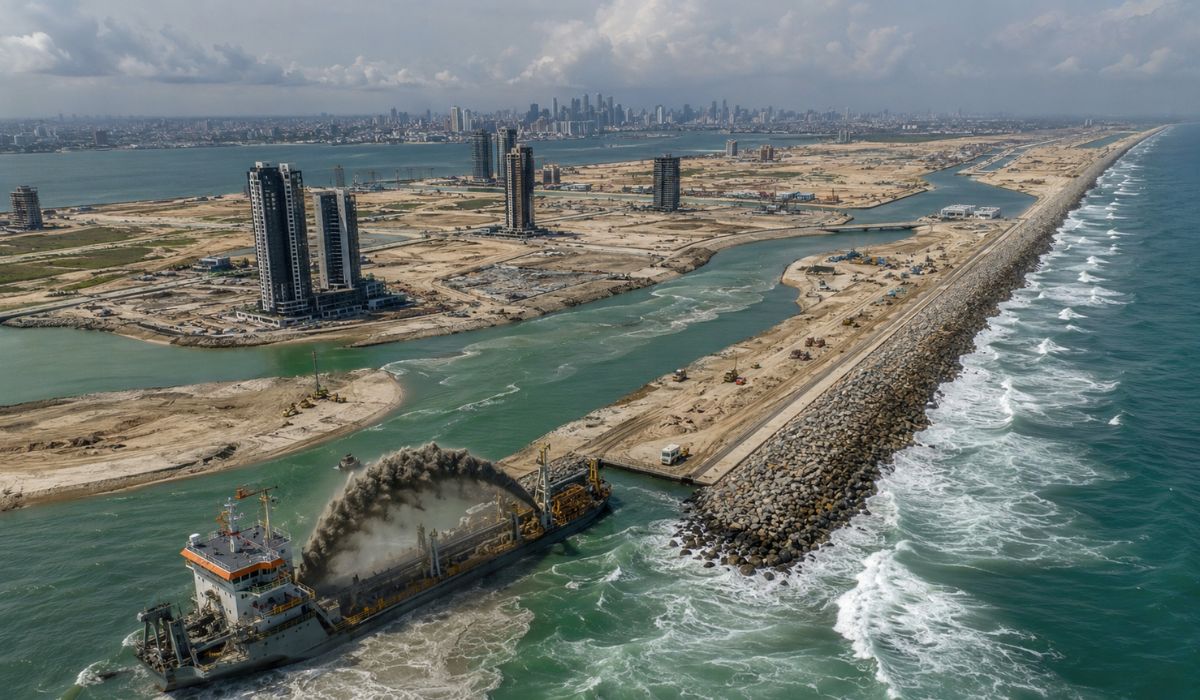


The new area was built on a strip previously occupied by the ocean and, according to the United Nations Development Programme, was designed to remain above sea-level rise projections beyond 2100.
In a country with limited land area, the land is to be used for housing, infrastructure, and community spaces, according to local planning.
How Tuvalu is creating land over the sea
The expansion of the territory occurred through land reclamation, artificial elevation, and coastal protection works.
The second phase of the project also includes interventions along approximately 800 meters of Funafuti’s southern shore, an area exposed to wave action, tides, and extreme weather events.
The strategy combines landfill, coastal line reinforcement, and structures to reduce water encroachment on occupied areas.
The stated objective of the project is to protect communities, public services, and urban areas vulnerable to coastal flooding, a problem that already affects the daily lives of residents in different parts of the archipelago.
Tuvalu has approximately 26 square kilometers of land area, according to the country’s National Adaptation Plan presented in 2025.
The same document describes the archipelago as a small, low-lying island state, with territory and infrastructure exposed to the effects of climate change and sea-level rise.
Tuvalu and the climate crisis in the Pacific
Tuvalu’s case gained international visibility because it brings together, on a reduced scale, challenges faced by low-lying islands and coastal cities.
In 2019, UN Secretary-General António Guterres participated in an action in the archipelago where he appeared in the water to draw attention to the country’s vulnerability to rising ocean levels.
Projections indicate that Funafuti is expected to face sea-level rise in the coming decades.
A technical summary from NASA on the Tuvaluan capital indicates that, in all assessed emissions scenarios, sea levels will continue to rise until 2050, with subsequent evolution dependent on the volume of global emissions.
NASA also reports that much of Funafuti’s land area and critical infrastructure could fall below the mean high tide level by 2050, according to a report cited by the agency’s Earth Observatory.
This type of projection helps explain why Tuvalu has prioritized physical adaptation measures, in addition to diplomatic actions and long-term planning.
A Reuters report, based on climate data and NASA projections, states that the sea level in Tuvalu has risen by approximately 15 centimeters in 30 years, above the global average.
The agency also reported that NASA scientists project that daily tides could submerge half of Funafuti’s main atoll by 2050.


Coastal adaptation project in Tuvalu
The first phase of the Tuvalu Coastal Adaptation Project began in 2017, with funding of US$ 36 million from the Green Climate Fund, in addition to co-financing from the governments of Tuvalu and Australia.
The initiative focused on strengthening the coastal resilience of inhabited areas and reducing risks associated with sea flooding.
In the next phase, the project received US$ 17.5 million from Australia, New Zealand, and the United States.
The focus shifted to include the protection of Funafuti’s southern shore and the reclamation of 8 hectares of elevated land, according to UNDP.
The completion of the area in Fogafale was announced in October 2025 by organizations linked to the UN and UNDP.
The official announcement states that the elevated land adds to an area of 7.3 hectares reclaimed in the previous phase of the program.
Coastal engineering, planning, and population
In addition to physical works, the project includes capacity building and planning actions.
According to the UN in the Pacific, the initiative provides support for the training of Tuvaluan students in climate-related and coastal management areas, training for women and youth in risk management, and information systems to guide future decisions.
This part of the program seeks to expand local capacity to deal with climate risks.
Community participation is also cited by the United Nations as a component of the project, incorporating local knowledge and governance focused on the needs of the affected population.
In Tuvalu, adaptation measures are treated by the government as part of a broader strategy for remaining in the territory.
The 2025 National Adaptation Plan describes the country’s climate response as a government and society process, with actions aimed at resilience, development, and vulnerability reduction.

Climate migration and agreement with Australia
Even with adaptation works, Tuvalu is already negotiating mobility alternatives for part of its population.
Under the agreement known as the Falepili Union, signed with Australia, Tuvaluan citizens can apply for an annual climate migration pathway, with a limit of 280 visas per year.
In 2025, more than a third of the country’s approximately 11,000 inhabitants had registered to try to access the program, according to Reuters.
The measure allows those selected to live, work, and study in Australia, but it does not end adaptation efforts within Tuvalu.
The two fronts occur in parallel.
While the migratory route offers a legal option for some citizens, coastal works attempt to keep areas of the country habitable and functional in the face of rising sea levels.
This combination appears in official documents and communications as a response to the environmental, territorial, and social pressure faced by the archipelago.

Coastal countries follow Tuvalu’s experience
Tuvalu’s experience has been presented by the UN as an example of international cooperation in climate adaptation.
The project involves the Tuvaluan government, UNDP, funding countries, and technical partners, in an attempt to combine science, coastal engineering, and community planning.
During the 80th United Nations General Assembly, Prime Minister Feleti Penitala Teo was quoted by the UN with the phrase: “If we save Tuvalu, we save the world.”
The statement was used in the context of discussions about the impact of sea-level rise on small island states and other coastal regions.
The new land of Fogafale does not eliminate the climate risks identified by studies and international organizations.
It represents a localized adaptation measure, which depends on maintenance, land-use planning, and the continuity of public policies.
It also remains conditioned by external factors, such as the speed of sea-level rise and the future volume of global emissions.
For Tuvalu, the construction of elevated land is a concrete response to a problem that already affects the territory.
For other coastal countries, the case serves as an example of how climate adaptation can require physical changes in urban space, in addition to international agreements and new forms of planning.