Portuguese
  Spanish



A hantavirus outbreak aboard the MV Hondius ship turned a tourist expedition into a tragedy, leaving three passengers dead between the Atlantic and South Africa and forcing British military personnel to parachute onto the planet’s most isolated inhabited island to bring oxygen and doctors to a critically ill survivor, According to information from Diário do Nordeste.
The hantavirus returned to headlines worldwide after an expedition cruise operated by the Dutch Oceanwide Expeditions became the scene of a deadly outbreak during the crossing between South America and the African continent. The MV Hondius ship departed from Ushuaia, in the far south of Argentina, on March 20, and over the following weeks recorded serious cases of the disease among its passengers, resulting in three confirmed deaths due to suspected hantavirus and at least one more case that required intensive care hospitalization.
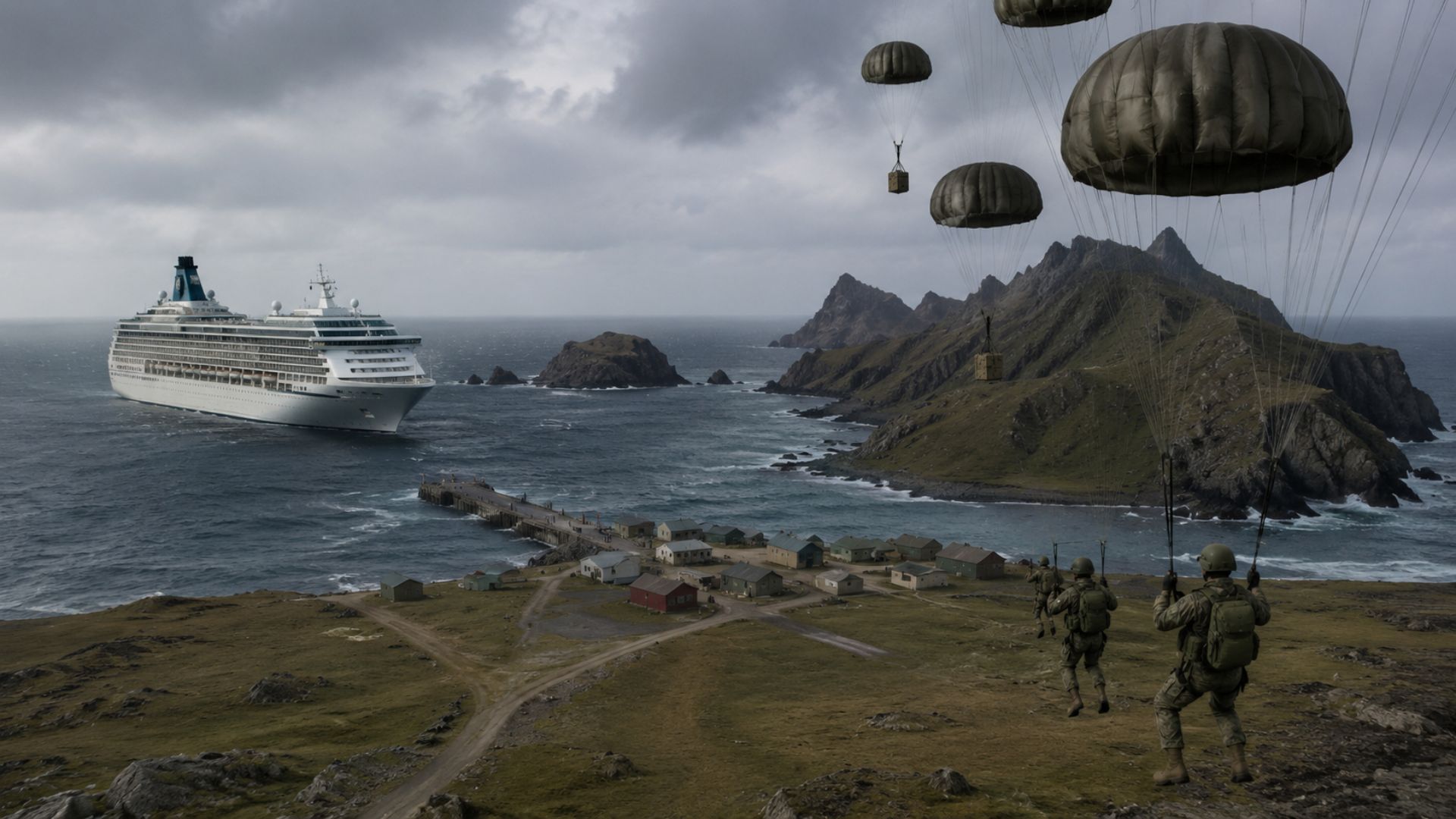
The most extraordinary episode in this sequence occurred in Tristan da Cunha, a British overseas territory considered the world’s most remote inhabited island. A British passenger who was aboard the cruise remained isolated on the island after the vessel passed through the location in April. Without an airport and accessible only by boat, the island of approximately 200 residents was unable to provide adequate care to the patient, which led the United Kingdom to an unprecedented decision: to parachute military personnel with medical teams and supplies onto the territory.
A tourist expedition that turned into a health emergency
The MV Hondius is an expedition ship designed for voyages to polar regions and remote destinations, the type of cruise that attracts adventurers willing to brave rough seas in exchange for untouched landscapes. The voyage that departed from Ushuaia had a route across the South Atlantic with stops at isolated islands before heading towards the African coast. No one on board imagined that the vessel would become a contagion environment for hantavirus.
-
Erected in just 30 minutes over the water that had already engulfed the courtyard, a motorized floating bridge from China evacuated more than 6,000 students trapped inside a school surrounded by the flood in the south of the country, after Typhoon Maysak turned the region into a flooded area.

-
Employee buys a ticket that a customer left behind, discovers a million-dollar prize, tries to claim the fortune, is fired after 20 years, and ends up in a legal dispute with the company.

-
China returned almost 20 Brazilian ships with soybeans and is now back to buying from the USA, but stocks above 9 million tons raise suspicions of a political move, not a commercial necessity.
-
Japan will have a bullet train that levitates at 500 km/h and will cross 90% of the route through tunnels; the project promises trips in just 67 minutes but faces billion-dollar challenges and unprecedented environmental obstacles.




The first signs of the outbreak appeared during the navigation. A 70-year-old Dutch passenger died aboard the cruise and his body was taken to Saint Helena Island, another British territory in the South Atlantic. The victim’s 69-year-old wife, also Dutch, was transferred to a hospital in South Africa, where she did not survive. A third person died on the ship itself. In addition to these three fatalities, a British man required intensive care unit treatment in Johannesburg, South Africa, raising the number of severe cases associated with hantavirus on this trip.
Tristan da Cunha: the island where the world barely reaches

Tristan da Cunha is nestled in the South Atlantic, more than 2,400 kilometers from the nearest coast. The island has no airport, landing strip, or any infrastructure to receive aircraft, meaning that all communication with the outside world depends on maritime vessels, whose journeys can take days. There are about 200 residents living in a practically self-sufficient community, with extremely limited medical resources.

When the MV Hondius cruise passed by the island in April, a British passenger with suspected hantavirus disembarked or was left there. Since then, the patient has remained stable and isolated, according to information from the World Health Organization. However, the situation worsened when the island’s oxygen supplies reached critical levels, endangering not only the isolated patient but also the minimum emergency care capacity for the entire community.
British paratroopers on an unprecedented mission

Photo: Jorge Guerrero/AFP.
In the face of the emergency, the UK Ministry of Defence made a decision that had never been necessary before. Six paratroopers and two military doctors parachuted onto Tristan da Cunha carrying oxygen cylinders and hospital equipment, in an operation that the British government itself classified as the first time paratroopers had been employed in a humanitarian mission of this kind. The absence of an airport made the aerial drop the only viable alternative for getting supplies there in time.
Dropping paratroopers onto a volcanic island in the middle of the South Atlantic is no trivial maneuver. The rugged terrain, unpredictable winds, and limited landing area make the jump considerably riskier than operations in conventional conflict zones. Nevertheless, the team successfully completed the mission, delivering the medical supplies needed to stabilize the patient and strengthen the island’s response capacity to new hantavirus cases.
What is hantavirus and why is this outbreak concerning
Hantavirus causes a disease known as hantavirosis, classified as an acute viral zoonosis. Transmission to humans occurs mainly through contact with particles present in the urine, feces, and saliva of infected rodents. In Brazil, the most common form of the disease is hantavirus cardiopulmonary syndrome, which can rapidly progress to severe conditions with respiratory distress, dry cough, tachycardia, and a drop in blood pressure.
What makes the outbreak on the MV Hondius particularly alarming is the confirmation of a hantavirus strain with the ability to transmit between people. This characteristic is rare and completely changes the disease’s risk profile, which normally depends on direct contact with rodents or their droppings. In a confined environment like a cruise ship, the possibility of interpersonal transmission turns each passenger into a potential vector, which explains the speed with which the outbreak spread and the severity of the registered cases.
Other passengers were also monitored
The MV Hondius cruise ship did not only leave traces on Tristan da Cunha. On Ascension Island, another British overseas territory in the Atlantic, tests were carried out to detect hantavirus in another passenger from the same ship who had disembarked there before being transferred to South Africa. The remaining passengers on the vessel were sent to the Canary Islands as part of the repatriation process coordinated by international health authorities.
The dispersion of passengers across different territories and countries creates a considerable logistical and epidemiological challenge. Every person who was on board the cruise during the outbreak period needs to be traced, tested, and monitored, regardless of whether they show symptoms. For hantavirosis, there is no available vaccine or specific antiviral treatment. Patient management relies exclusively on clinical supportive measures, which reinforces the importance of early detection and rapid isolation of suspected cases.
An outbreak that exposed vulnerabilities and demanded unprecedented responses
The MV Hondius episode connected dots that rarely appear in the same story: an expedition cruise, a lethal virus, an island without an airport, and military paratroopers on a humanitarian mission. The hantavirus outbreak aboard the ship has already left three dead, put dozens of passengers on alert, and forced the UK to improvise an unprecedented logistical operation to attend to a single patient in one of the most inaccessible locations on the planet.
Had you heard of Tristan da Cunha before this story? Leave your opinion in the comments about this episode and how the British authorities’ response exposes both the capabilities and limitations of medical assistance in overseas territories. What caught your attention the most: the cruise outbreak, the paratroopers’ mission, or the extreme isolation of the island?