Portuguese
  Spanish


The Sequence Of Events That Transforms An Underwater Tremor Into Waves Capable Of Crossing Oceans Involves Tectonic Plates, Depth, And Monitoring By Sensors. Understand How The Energy Accumulated On The Sea Floor Changes Scale When It Reaches The Coast.
A tsunami forms when the ocean floor shifts abruptly, pushing a large mass of water and creating waves capable of crossing oceans in a few hours.
In extreme episodes, the energy released by the earthquake that triggers this process has been compared to the equivalent of 23,000 Hiroshima-type atomic bombs, a measure used to gauge the scale of the earthquake associated with the 2004 Indian Ocean tsunami.
Contrary to the image of a “wall” of water, most of the tsunami’s journey occurs in deep water with little elevation at the surface.
-
Almost 1 billion euros, two gigafactories, and a million-dollar public investment, Chinese company aims to turn Spanish city into Europe’s new battery hub.

-
Advancement in the industry: Brazilian company creates ultralight material comparable to steel and paves the way for hydrogen cylinders up to 70% lighter, with a direct impact on logistics, the energy industry, and national competitiveness – learn about Forza Composites

-
In Brazil’s backyard: Tesla, by Elon Musk, announces official operations in Uruguay, where electric vehicles already make up 20% of new cars but still leaves out the largest market in the region.

-
This Mars rover may finally reveal if life ever existed on Mars.



The scenario changes when it reaches the coast, as the wave slows down and can gain height, concentrating energy in coastal areas.
How Energy Accumulates On The Sea Floor
The most common origin of major tsunamis is in subduction zones, regions where one tectonic plate slides beneath another.
At these boundaries, movement can become stuck for long periods while stress builds up at the interface between the plates.
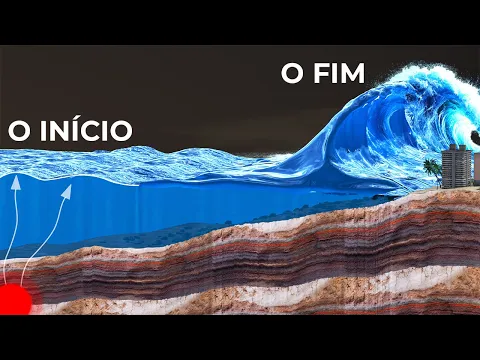

When the rupture occurs, part of the ocean floor rises or falls in seconds.
This jump displaces the column of water above the fault and initiates a set of long waves that spread in various directions, with the potential to reach different countries from a single event.
Propagation Of The Tsunami In Deep Water And Wave Speed
Tsunamis do not behave like regular waves generated by wind.
They involve a larger portion of the water column and have much longer wavelengths, which favors the propagation of energy over great distances.
The speed also depends mainly on the depth.
In deep ocean, monitoring organisms like the United States National Oceanic and Atmospheric Administration, or NOAA, describe that a tsunami can travel at a rate comparable to that of a jet airplane, exceeding 500 miles per hour, about 800 km/h.
These characteristics help explain why an underwater tremor can generate sequential effects over hours, even far from the epicenter, with variations in impact depending on the coastal geography and the energy transferred to the sea.
Why The Tsunami Is Difficult To Perceive In Deep Water
In deep water, the height of the tsunami at the surface is usually low, making it hard for vessels to perceive.
Nonetheless, the energy is present because the wave has a large extent and involves the movement of a significant layer of water, not just the surface.
For this reason, the water does not advance as a single block throughout the trajectory.
What propagates is the energy: the water particles oscillate, and this oscillation sustains the passage of the wave until it encounters shallower waters.
Depth Effect: Why The Wave Grows Near The Coast
As it approaches the shore, the depth decreases and the tsunami loses speed.
With the energy of the system redistributing, the wave tends to shorten and gain height, which can amplify the impact in coastal areas, especially in stretches where the underwater terrain, bays, and estuaries favor the concentration of flow.
The extent of destruction does not depend only on the magnitude of the earthquake.
The shape of the coastline, the slope of the ocean floor, and the presence of inlets can increase the height of the water at specific points, while other areas experience lesser effects.
Causes Of Tsunamis Other Than Underwater Earthquakes
Although earthquakes in subduction zones are the most frequent source of destructive tsunamis, they are not the only one.
Underwater landslides and volcanic eruptions can also displace large volumes of water and generate long-range waves.
Common to these events is the rapid displacement of the ocean floor or sediment masses as the main trigger.
Without this sudden push, there is no formation of a tsunami capable of propagating over great distances.
Tsunami Warning Systems And Response Limits
After the 2004 disaster, monitoring networks were expanded in different oceans.
Technologies used include systems that combine pressure sensors at the ocean floor with buoys on the surface, capable of transmitting real-time data via satellite, such as the DART system, operated by NOAA.

The equipment records small variations in sea level in deep waters and feeds models that estimate height and arrival time in coastal areas.
Even so, the utility of the alert depends on the interval available between the event and the arrival of the first waves, which can be reduced when the epicenter is close to the shore.
In the Indian Ocean tsunami, reports compiled by international organizations describe that areas close to the epicenter were hit in about 20 minutes, while regions such as Sri Lanka and parts of India were reached in approximately two hours.
What The Disasters Of 2004 And 2011 Revealed About The Risk
The Indian Ocean tsunami on December 26, 2004, is cited by humanitarian institutions and reference works as one of the deadliest natural disasters in recent history.
Widely cited sources point to a total of about 230,000 deaths, with variations depending on accounting criteria between countries, missing persons, and revisions over time.
The comparison with 23,000 Hiroshima-type atomic bombs is associated with the energy released by the earthquake that generated the tsunami, and not as a standalone measure of the “strength of the wave.”
The reference appears in news articles and scientific communication materials as a way to contextualize the magnitude of the physical phenomenon.
On March 11, 2011, in Japan, the episode highlighted an additional challenge: the initial estimated height of the waves may fall below what is observed in the following minutes, until new measurements are incorporated into the models.
In a publication of lessons learned, the Japan Meteorological Agency, the JMA, reports that it issued an initial alert about three minutes after the earthquake, but that the initially predicted magnitudes and heights were underestimated, with subsequent updates based on new data.
Regarding protective measures, international reports described the construction and reinforcement of coastal barriers in stretches of Japan after 2011, including continuous structures along hundreds of kilometers and heights reaching about 14 meters in parts of the coastline, according to cited surveys.