Portuguese
  Spanish


A glacier in Antarctica lost 25 kilometers in just 15 months and broke the world record for glacial retreat ever documented, the study published in Nature Geoscience reveals a collapse mechanism that could repeat in giant glaciers and accelerate sea level rise
The Hektoria Glacier in Antarctica recorded the fastest retreat ever documented in a continental glacier: 25 km in 15 months, between January 2022 and March 2023. The study, published in Nature Geoscience in November 2025 by the team of researcher Naomi Ochwat from the University of Innsbruck, identified a buoyancy-driven collapse mechanism that fragmented the glacier at unprecedented speed. The thinning peak reached 80 meters per year, and about 84 km² of ice were lost between November 2022 and March 2023.
A glacier in Antarctica lost 25 kilometers of length in just 15 months and broke the world record for glacial retreat ever documented by modern science. The Hektoria, located in the eastern Antarctic Peninsula, in the Larsen B embayment, shrank between January 2022 and March 2023 at a speed that surprised even the researchers monitoring it. The study, published in Nature Geoscience by the team of glaciologist Naomi Ochwat from the University of Innsbruck, reveals that the collapse was caused by a mechanism that could repeat in much larger glaciers.
“Glaciers don’t usually retreat this fast,” stated Adrian Luckman, professor of geography at Swansea University and co-author of the study, in an official university statement. The Hektoria is a relatively small glacier by Antarctic standards, with an area of about 298 km², equivalent to the size of the municipality of Santos (SP). But the mechanism that destroyed it is what worries scientists: if the same process affects giant glaciers like Thwaites and Pine Island in West Antarctica, the consequences for sea level would be catastrophic.
How the 25-kilometer retreat happened in 15 months

image: NASA
The collapse of the Hektoria was not gradual: it had acceleration phases that made the event even more alarming. Throughout 2022, the glacier lost about 16 km of length, a rate already considered exceptional. But between November and December of the same year, another 8 km detached in just two months, accelerating the process to a point where instruments recorded glacial earthquakes caused by the fragmentation.
-
World Cup Ball Chip Uses Technology to Detect Invisible Touches, Confirms Offside, Secures Portugal’s Victory Over Croatia

-
36-Meter Hydrogen-Powered Superyacht Arrives in Brazil to Debut German Engines and Showcase Future of Clean Navigation

-
Indian Students from Jaipur Win Top Prize at World’s Largest Science Fair with EcoFog, an Affordable Mesh to Harvest Fog Water Without Energy

-
Italy Sinks Massive 11-Story Concrete Structures in the Ligurian Sea to Create a 6.2 km Barrier, Clearing the Way for 400-Meter Ships in Genoa



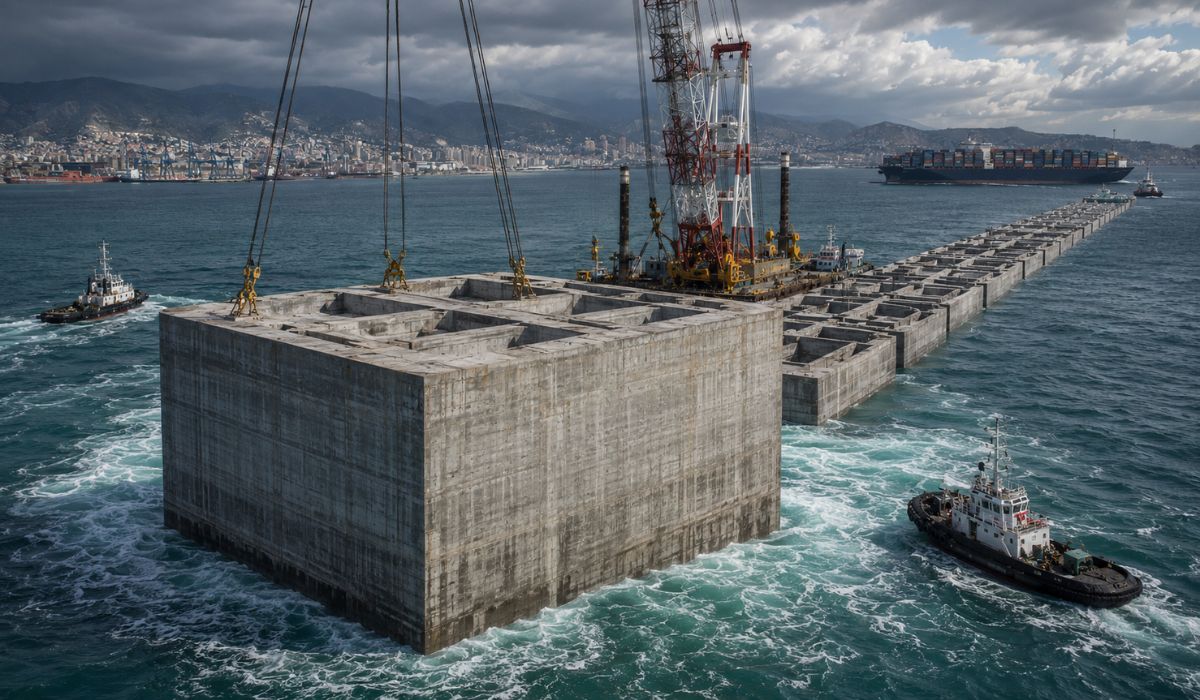

image: NASA
The thinning peak reached 80 meters per year, and between November 2022 and March 2024, about 84 km² of ice were lost. The images released by NASA Earth Observatory show the before and after: where there was solid ice, now open sea advances, transforming the landscape of the Antarctic Peninsula into a visual record of what regional warming can do when it meets the right conditions.
The mechanism that fragmented the glacier from below

The Nature Geoscience study identified that the Hektoria collapse was caused by a process called buoyancy calving. The glacier was resting on an ice plain seated on flat, shallow rock, and when the Larsen B ice shelf’s anchoring ice broke off in January 2022, seawater began to infiltrate underneath during high tides.
This infiltration lifted the basal ice, fragmenting the glacier in sequence like domino pieces. The process is different from the surface melting that most people associate with global warming: here, the ocean attacks from below, destabilizing the structure that kept the glacier anchored to the rock. Naomi Ochwat explained that “Hektoria is small, but such an event in larger glaciers would be catastrophic,” a warning that directs attention to the giants of the West Antarctic.
The climatic context that triggered the collapse
The trigger for the retreat was the loss of the Larsen B ice shelf’s anchoring ice, an event that occurred in January 2022 and is part of a regional warming context in the Antarctic Peninsula. The region is one of the areas on the planet that has warmed the most in recent decades, and the progressive disintegration of the Larsen ice shelves (A in 1995, B in 2002, and now the remnant) is a direct consequence of this process.
It is important to understand that the Hektoria collapse was not caused by an isolated climatic event, but by the combination of oceanic warming, loss of support, and the geometry of the bedrock. The process is natural in the sense that glaciers advance and retreat over millennia, but the recorded speed is unprecedented in the modern era and consistent with the acceleration projections that climate models have been signaling for years.
What this means for Thwaites and Pine Island
Hektoria is small, but the Thwaites and Pine Island glaciers in West Antarctica have similar basal conditions and are incomparably larger. Thwaites, nicknamed the “doomsday glacier,” alone contains enough ice to raise global sea level by more than 60 centimeters if it collapses completely. Pine Island, its neighbor, adds another similar amount. Together, they represent one of the greatest long-term threats to coastal cities worldwide.
Ted Scambos, a senior researcher at CIRES, University of Colorado Boulder, described the event as “a shock” that “changes what we thought was possible” in terms of the speed of glacial retreat. If the buoyancy calving mechanism repeats in Thwaites, the risk timeline for sea level rise moves forward by decades, directly affecting coastal infrastructure, port terminals, and cities that currently operate without considering this scenario.
The scale of the problem: how much ice Antarctica contains
To gauge the risk, Antarctica as a whole contains ice equivalent to about 58 meters of global sea level rise. Hektoria contributed a microscopic fraction of this total, but the mechanism that destroyed it serves as a warning that processes considered slow can accelerate dramatically when conditions align.
The scientific community already monitors Antarctica with high-precision satellites like NISAR (NASA-ISRO partnership) and SWOT, capable of measuring ice displacements with centimeter resolution. These instruments will be essential for detecting early signs that Thwaites or Pine Island are entering the same collapse pattern that transformed Hektoria from a 298 km² glacier into open sea in just over a year.
Did you know that a glacier in Antarctica shrank by 25 km in 15 months and that the same mechanism could affect giant glaciers that would impact global sea levels? Tell us in the comments what you think about the speed of melting and if you believe Brazil is prepared for sea level rise.