






 Portuguese
  Spanish


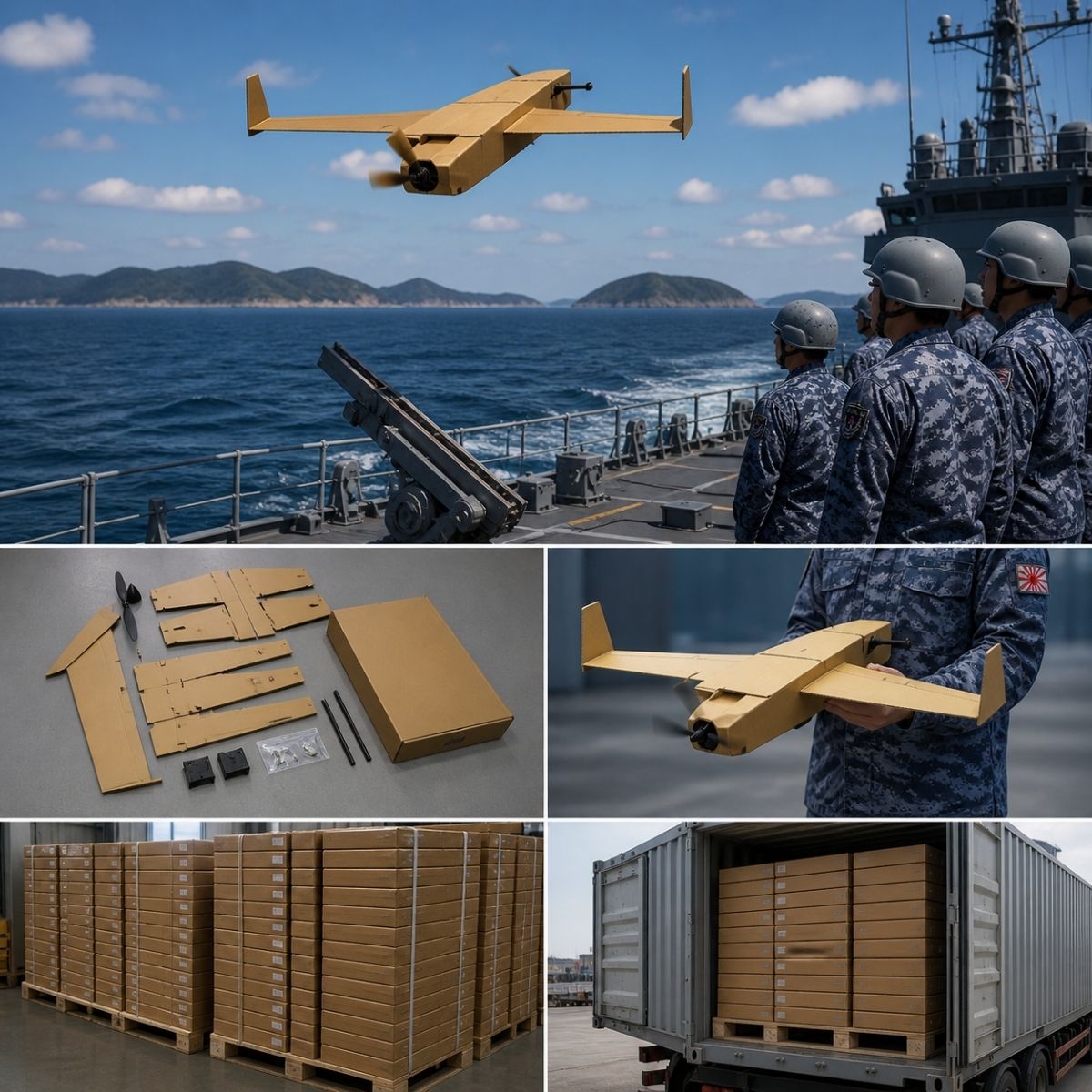


AirKamuy, a startup from Nagoya, Japan, developed the disposable drone AirKamuy 150 with waterproofed cardboard at a cost of US$ 2,000 to US$ 2,500, with an autonomy of up to 2 hours at 120 km/h, assembly in 5 to 10 minutes, and 500 units per container, already used by the Japanese Navy.
The Japanese startup AirKamuy, based in Nagoya, created a military drone that costs less than many laptops and is made from material that any packaging factory produces. The AirKamuy 150 drone has a corrugated cardboard structure with a waterproof coating and biodegradable resins, is delivered disassembled in flat packages that allow 500 units to be shipped in a single standard container, and can be assembled in 5 to 10 minutes without special tools, a combination that makes the Japanese drone in 2026 a practical response to the clearest lesson of the war in Ukraine: in modern warfare, quantity and low cost beat sophistication and high price. “There is a strong demand for low-cost drones capable of operating in large numbers and over long distances. This model can be manufactured in any cardboard plant, ensuring high mass production capacity and a robust supply chain,” said Yamaguchi Takumi, CEO of AirKamuy, in an interview with the Japanese public broadcaster NHK World-Japan.
The drone has already moved past the prototype stage and is in operational use. The Japan Maritime Self-Defense Force uses the AirKamuy 150 drone as an aerial target in military training, an application confirmed by Defense Minister Shinjirō Koizumi in a post on the X network where he stated that strengthening collaboration with defense startups is “indispensable” to make the Japanese Self-Defense Forces “the world’s largest users of unmanned assets, including drones”. The unit cost of US$ 2,000 to US$ 2,500 positions the Japanese drone in a price range that makes each unit lost in training or combat financially irrelevant, a logic that reverses the traditional equation of the military industry where losing equipment represents a loss of millions.
What the AirKamuy 150 drone does and why it is not a “kamikaze drone”

The classification of the AirKamuy 150 as a “kamikaze drone” circulating in some publications is a simplification that distorts the real purpose of the equipment. According to AirKamuy’s chief engineer, Naoki Morita, in a presentation at the Singapore Airshow 2026, the drone was primarily conceived as an aerial target for training, an anti-drone system capable of operating in swarms, a reconnaissance platform with a low radar signature, and a tool for saturating air defenses that forces enemy radars to activate and absorbs defensive fire before more valuable assets come into play. The drone can carry small munitions or electronic warfare equipment on no-return missions, but this is a secondary application and not the focus of the project.
-
Queen Guitarist Brian May Collaborates with ESA Scientists to Study Asteroids Bennu and Ryugu Using 3D Simulations

-
Largest Known Single-Piece Meteorite, Weighing 60 Tons, Puzzles Scientists with Its Intact Fall and Lack of Visible Crater

-
Oceanographer Turns Abandoned Fishing Nets from Brazilian Waters into Bags, Creating Jobs and Earning Over $7,000 Monthly

-
Australia deploys poisoned sausages and uses traps, shooting, and fences in a battle against invasive cats that kill over 1.5 billion native animals annually, threatening more than 200 species.




The difference between the AirKamuy drone and models like the Iranian Shahed is fundamental to understanding the Japanese strategy. The Shahed is an attack drone designed to carry significant explosive payloads and destroy specific targets at a cost of US$ 20,000 to US$ 50,000 per unit, while the Japanese cardboard drone bets on volume: 500 units per container means that for the price of two Shahed, the Japanese Navy can launch a swarm of dozens of drones that saturate enemy defenses, force activation of detection systems, and create a window of opportunity for attacks with more sophisticated equipment. The cardboard drone does not need to destroy: it needs to exist in sufficient quantity so that the adversary cannot intercept them all.
What are the technical specifications of the Japanese cardboard drone

The AirKamuy 150’s figures reveal equipment that combines material simplicity with relevant operational performance. The drone flies at a maximum speed of approximately 120 km/h with an autonomy ranging from 80 minutes to 2 hours depending on the load configuration, reaches a distance of about 80 km, and supports a payload of approximately 1.4 kg (3 pounds), sufficient capacity to carry reconnaissance cameras, electronic warfare sensors, or small payloads on disposable missions. The electric motor equipping the drone contributes to a reduced acoustic signature and eliminates dependence on liquid fuels, a logistical advantage in remote operation scenarios.
The corrugated cardboard structure with waterproof coating gives the drone characteristics that traditional materials do not offer at the same price. The low reflectivity of the cardboard reduces the drone’s radar signature, making detection difficult for air defense systems designed to identify metallic surfaces or carbon fiber composites, and the biodegradable resins used in the structure’s treatment mean that lost or destroyed units degrade naturally without generating an accumulation of technological debris. The comparison with the cost of interception is where the Japanese drone becomes economically devastating: an AIM-9X missile used by Western forces to shoot down drones costs approximately US$1 million, five hundred times the price of the target it destroys.
Why Japan is investing in disposable drones after decades of pacifism
Japan’s bet on military technology like the cardboard drone represents a historical rupture rooted in the geopolitical transformation of the Asia-Pacific. The country has maintained a pacifist constitution since 1947 (Article 9), and for decades the defense industry was treated as taboo among Japanese investors, a reality that AirKamuy itself faced: two-thirds of the venture capital funds contacted by the startup refused to invest due to internal restrictions on the defense sector. Still, the company raised 100 million yen (approximately US$650,000) in a pre-seed round in May 2025 with participation from ANOBAKA, Sparkle Fund, and STATION Ai Central Japan Fund.
The Japanese defense budget for 2026 signals the scale of the ongoing transformation. Japan allocated approximately US$60 billion (9 trillion yen) for defense in 2026, with US$1.9 billion specifically for drones and unmanned systems, an investment that fuels the SHIELD (Synchronized, Hybrid, Integrated and Enhanced Littoral Defense) program, a layered coastal defense network that integrates attack drones, unmanned ships, and submarines to block enemy access to Japanese territory. AirKamuy’s cardboard drone is a piece within a strategy that targets China and North Korea as growing regional threats, a context that accelerates the political and business willingness of a country that for 75 years avoided investing in offensive weaponry.
Who else is manufacturing cheap drones for the same purpose
AirKamuy is not alone in the race for low-cost disposable drones. South Korea adopted the PapyDrone-800 in 2024, also made of cardboard, and another Japanese startup called JISDA launched the ACM-01 Shiraha in April 2026, a drone with a wooden fuselage and a unit cost of only US$450, a price that makes the AirKamuy seem expensive in comparison. Ukraine is developing its own models, including 3D-printed drones for US$1,000, and the United States is working on the Lucas drone with an estimated cost of US$10,000, an intermediate position between the Asian disposables and conventional Western military equipment.
AirKamuy is also expanding beyond the cardboard model. The company is developing the Σ-1 (Sigma-1), a VTOL drone with over 5 hours of autonomy capable of vertical takeoff from ships, a platform with dual civil and military use that serves for infrastructure inspection, natural disaster response, and search and rescue in regions affected by earthquakes and tsunamis, frequent events in Japan. According to a report by the German publication Militär Aktuell, Ukraine will also receive units of the AirKamuy drone, information that connects the Japanese product directly to the conflict that inspired its creation and that will test the performance of cardboard in real combat conditions.
And you, do you think cardboard drones can change modern warfare? Should Brazil invest in similar technology? Leave your opinion in the comments.


This post deserves all the attention and recognition it can possibly get 🔥