






 Portuguese
  Spanish
  5 min of reading
  0 comments


Stargazer is Venus Aerospace’s hypersonic project to fly at Mach 9, using a rotating detonation engine and altitude of up to 110,000 feet.
While companies like Boom Supersonic try to bring back flights above the speed of sound and giants like SpaceX bet on reusable rockets to reduce space access costs, a Texas startup is trying to follow an even more extreme path: building a plane capable of flying at Mach 9, reaching speeds close to 11,000 km/h and crossing oceans in less time than many passengers spend waiting to board at an airport.
The project is called Stargazer and is developed by Venus Aerospace. The proposal mixes characteristics of a hypersonic plane, suborbital aircraft, and high-speed reusable system. According to the company, the goal is to create an aircraft capable of transporting passengers on extremely fast global trips using a propulsion set based on rotating detonation engines and advanced ramjets.
Stargazer aims to reach Mach 9 and enter a speed range where commercial planes have never operated
Venus Aerospace claims that the Stargazer was designed to reach speeds of up to Mach 9. Depending on the altitude, this represents something close to 10,900 km/h to 11,000 km/h, a value far superior to the performance of any commercial aircraft ever put into service.
-
Space technology used to search for water on Mars is now hunting for invisible leaks under the streets of São Paulo, using satellites, AI, and chlorine signals to help Sabesp recover up to 6.7 billion liters of water.

-
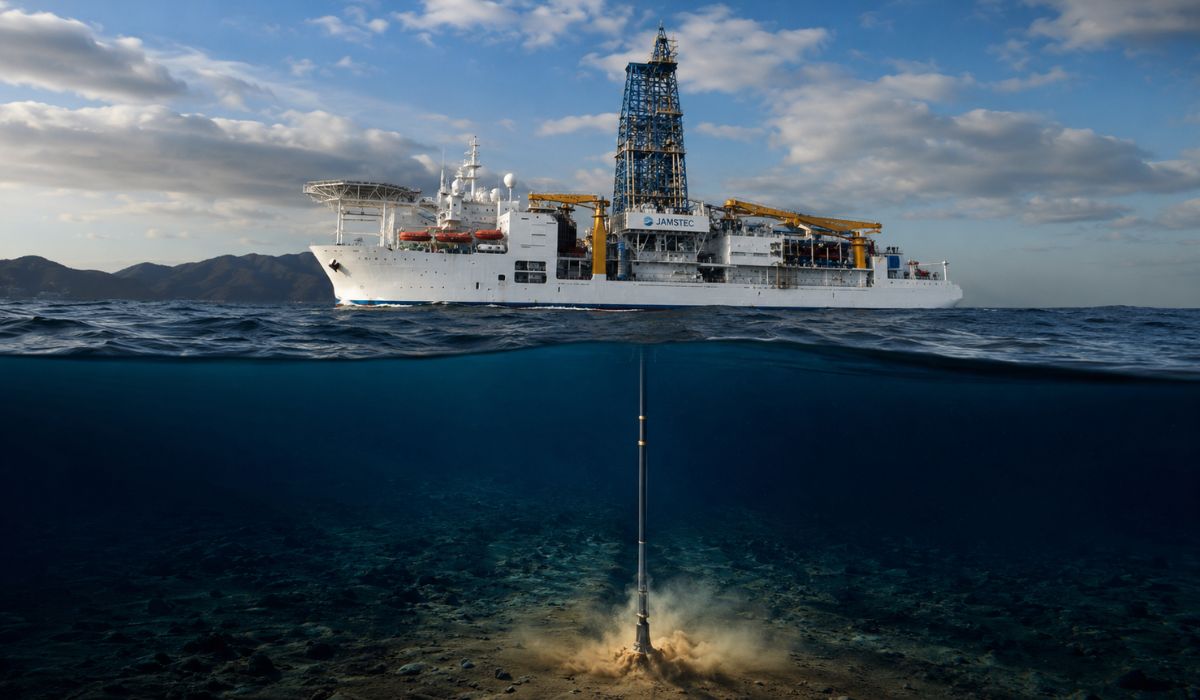
Japan sends ship to extract mud rich in rare earths at nearly 6,000 meters deep in the Pacific, attempts to lift 350 tons per day from the seabed, and transforms sediments near Minamitori Island into a strategic weapon to reduce dependence on China.
-
Venus Aerospace promises a rotating detonation hypersonic engine that takes the Stargazer to Mach 9 and crosses oceans in 1 hour, but the flight that made history barely surpassed the speed of sound.

-
Brazilian student creates a cheap formula that makes plants grow up to 90% faster and wins an award in a global scientific competition.




For comparison, the Concorde operated around Mach 2.04, equivalent to approximately 2,180 km/h.

In practice, the Stargazer intends to fly more than four times faster than the legendary Franco-British supersonic.
Company talks about New York–Paris in less than an hour and global trips in record time
The main argument of Venus Aerospace is the drastic reduction of travel times. The company claims that its technology could allow routes like New York–Paris in less than an hour and intercontinental trips of about 5,000 miles in approximately one hour of flight.
Today, a conventional commercial flight between New York and Paris typically takes between seven and eight hours. According to materials released by the company, the ambition is to transform transoceanic routes into journeys comparable to short domestic flights.
It is important to highlight that these estimates represent future goals of the project and not capabilities already demonstrated in flight.
Planned altitude exceeds 33 km and places passengers near the edge of space
Another impressive number of the Stargazer is the proposed operational altitude. Venus Aerospace claims that the aircraft will be able to fly at approximately 110,000 feet, equivalent to about 33.5 km in altitude.

This is more than twice the typical altitude of the Concorde and almost three times that of a modern commercial airplane.
In promotional materials, the company claims that passengers could observe the curvature of the Earth and the darkness of space during part of the flight.
Engine uses rotating detonations instead of conventional combustion
The core technology of the project is the so-called Rotating Detonation Rocket Engine (RDRE). Unlike conventional rocket engines, which use relatively stable continuous combustion, RDREs operate with supersonic detonation waves circulating within an annular chamber.
According to researchers and companies in the sector, this architecture can offer significant gains in efficiency and power density.

Frequently cited estimates point to theoretical improvements of 10% to 15% in efficiency, as well as a reduction in the size and mass of the propulsion system.
First flight of the rotating detonation engine occurred in 2025
The project gained international relevance after a test conducted in May 2025. Venus Aerospace announced the completion of the first demonstration flight in the United States using a high-power rotating detonation rocket engine. The experiment took place at Spaceport America, New Mexico.
According to the company, the test was conducted to demonstrate that the engine can operate outside the laboratory environment and withstand real flight conditions.
Aerospace America reported that the flight registered acceleration close to 4 g, about 7 seconds of active propulsion, and an ascent of over 1,200 meters, validating important elements of the proposed architecture.
Final system combines rocket and ramjet to accelerate beyond the limitations of common engines
The Stargazer should not rely solely on the RDRE. Venus Aerospace is working on a concept called VDR2, which stands for Venus Detonation Ramjet.
According to technical descriptions released by the company, the proposal is to combine characteristics of rocket engines and ramjets to create a system capable of operating at extremely high speeds.


The logic is similar to that faced by various hypersonic programs: conventional turbines stop functioning properly at certain speeds, requiring completely different propulsion architectures.
It is precisely in this transition that the company is betting on its main innovations.
Project is still far from transporting passengers
Despite recent advances, the Stargazer remains a program in development. The test conducted in 2025 validated only one component of the propulsion system and did not represent the flight of a complete hypersonic aircraft.

There are still enormous challenges involving thermal protection, aeronautical certification, structural materials, passenger safety, and economic operation. No commercial Mach 9 aircraft currently exists.
Therefore, the goals announced by Venus Aerospace should be interpreted as future technological objectives, not as already proven operational capabilities.
Military and space interest also helps to drive development
The advancement of rotating detonation engines is not only of interest to the civil transportation sector. The technology is attracting increasing attention from space programs, defense, and strategic hypersonic applications.
The Washington Post highlighted that American companies have been accelerating research in this field amid technological competition with China and Russia in high-speed systems.
Moreover, more compact and efficient engines can be useful for reusable vehicles, space launchers, and future extreme flight platforms.
Technical specifications of the Stargazer concept
- Company: Venus Aerospace
- Country: United States
- Category: reusable hypersonic aircraft in development
- Projected maximum speed: Mach 9 (approximately 10,900 km/h to 11,000 km/h)
- Planned operational altitude: about 110,000 feet (33.5 km)
- Main propulsion: system based on RDRE and VDR2
- Core technology: Rotating Detonation Rocket Engine (RDRE)
- Travel goal: New York–Paris in less than an hour
- Disclosed range goal: about 5,000 miles in approximately one hour
- Current status: project in development; engine flight-tested in 2025
For decades, the promise of commercial hypersonic flight has been stuck between laboratories, futuristic presentations, and prototypes that never came close to carrying passengers. Venus Aerospace believes that rotating detonation engines can change this story.
The challenge now is no longer to prove that the idea works for a few seconds, but to demonstrate that it can survive the much more difficult path between an experimental test and an aircraft capable of crossing oceans at nearly 11,000 km/h.


-

-

9 people reacted to this.