






 Portuguese
  Spanish
  6 min of reading
  0 comments


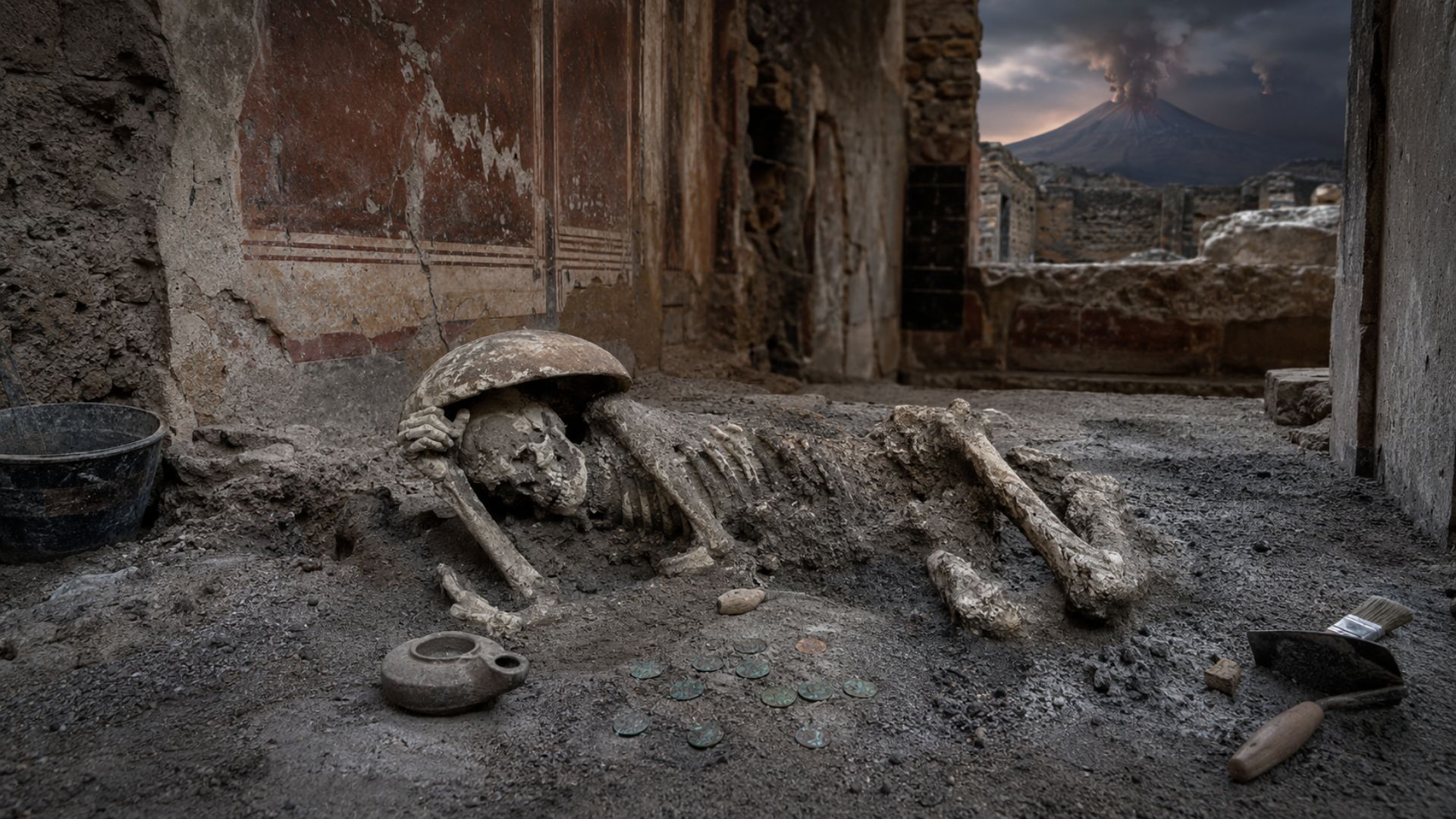
The objects tell the story of a decision made in seconds: light to see in the dark, improvised shelter for the head, and money to start anew far from there. He was not only fleeing from death, but escaping towards a new life that never came. The bowl he held was, in fact, a heavy kitchen mortar.
Archaeologists discovered in Pompeii the remains of a man who faced the eruption of Vesuvius holding a terracotta bowl over his head as a shield, a lamp to light the way, and ten bronze coins to restart life. The find is so impressive that it confirms, in the body of a real person, the account written by the witness Pliny the Younger, almost 2,000 years ago, about how the inhabitants tried to escape the tragedy.
It is worth situating the chronology of the discovery. The skeletons were found in 2024, in a necropolis outside the walls of ancient Pompeii, in southern Italy, but the detailed study was published in April 2026, in the scientific journal Scavi di Pompei, gaining worldwide repercussion. The eruption of Mount Vesuvius that killed these men, in turn, occurred in the year 79 AD, burying the city and freezing that moment of panic in time.
What the archaeologists found in Pompeii

Outside the walls of Pompeii, near the necropolis of Porta Stabia, researchers unearthed the remains of two men who were trying to escape when Vesuvius erupted, probably seeking to reach the sea to flee along the coast.
-
Federal Police involved in the case to identify the person responsible for hacking the Civil Defense system, which sent ten false alerts, frightened residents of different capitals, and turned messages about real risks into notifications with “misanthropy” and even alien attacks.

-
Extreme drought causes ghost village to reappear at the bottom of the reservoir that supplies Athens, revealing houses, a school, and ruins swallowed since the 1980s as the lake shrinks and exposes the water crisis threatening the capital of Greece.

-
An entire village lay asleep at the bottom of a lake for 3,000 years: divers suction sediments in Italy and reveal more than 600 wooden stakes, bronze tools, and traces of a Bronze Age settlement hidden underwater.
-
They call it the “Shopee house” and even cardboard, but the R$ 20,000 house is a certified Wood Frame from Alea, financed by Minha Casa Minha Vida: understand if it’s worth more than masonry.



The main character is the older one, a man about 35 years old, found crouched, with his arm raised, still holding a clay bowl over his head. A short distance from his hand, a small oil lamp. Next to him, a second man, much younger, estimated to be between 18 and 20 years old. The two, separated by a short distance, died at different moments of the same catastrophe, as science managed to reconstruct.
The bowl that was actually a mortar
A clarification is needed about the most symbolic object of the discovery. What has been called a “bowl” is, more precisely, a terracotta mortar, a heavy vessel used in the kitchen for grinding food, which the man raised over his head as an improvised helmet against the rain of stones that fell from the sky during the eruption.
From the sky rained lapilli, small volcanic stones, and hot ash non-stop. Without any protective equipment, the man used what he had at hand to try to shield his head from the debris. The mortar was found fractured, a sign of the weight and force of what fell on it. It was pure ingenuity amidst despair, a decision made in a split second in the face of the end of the known world.
The lamp, the coins, and the touching detail
Each object found tells a survival decision, and together they form a deeply human portrait. The oil lamp was used to see in the total darkness of the eruption, when the sky turned pitch black, and the ten bronze coins, along with a small iron ring, reveal something touching: he was not fleeing just to escape death, but to restart life elsewhere.
This is the detail that transforms an ancient skeleton into a universal story. The man took with him what he thought he would need for the next day: light for the path, shelter for the head, and money for the new life. He was someone driven both by fear and hope, carrying his few belongings while trying to cross the inferno. Almost two thousand years later, these small belongings speak directly to our hearts.
Two deaths, two moments of the tragedy
The analysis of the bodies revealed a tragic and precise chronology. The older man, the one with the mortar, died at the very beginning of the eruption, buried by the rain of ash and stones of the so-called Plinian phase, the first stage of the disaster, named precisely in honor of the one who described it, Pliny the Younger.
The younger man, however, had a different fate. He seems to have survived the first hours and tried to run during a pause in the volcano’s activity. But the calm did not last: hours later, pyroclastic currents, devastating waves of gas and superheated rock descending at high speed, swept everything and reached him. The two bodies, dead hours apart in the same location, help scientists understand how Vesuvius may have claimed even more victims than previously thought.
The letter that predicted the scene 2,000 years ago
The most chilling aspect of the discovery is how it confirms an ancient text. Everything these skeletons show had already been described by Pliny the Younger, who witnessed the disaster from the other side of the Bay of Naples, from the city of Misenum, and years later wrote a letter narrating the horrors he saw.
In his account, Pliny described people tying cushions and pillows over their heads to protect themselves from the rain of stones, and carrying torches and lamps to see in a darkness that was, in his words, denser than any night. Almost 2,000 years later, the discovery of the man with the mortar on his head and the lamp in his hand confirmed, in a real body, exactly what the letter narrated, an impressive encounter between archaeology and ancient literature.
The controversy of the image made with artificial intelligence
To bring the scene to life, the researchers turned to technology, but with an honest caveat. The Pompeii Archaeological Park, in partnership with the University of Padua, created an image with artificial intelligence showing the man running through the streets with the bowl on his head and the volcano exploding in the background, but it is essential that the reader knows: this image is an artistic recreation, not a photograph nor an exact scientific record.
The responsible parties themselves recognize the risks. The park’s director, Gabriel Zuchtriegel, argues that AI, when used well, can help renew classical studies and make the ancient world more accessible to the public. At the same time, some warn that this type of image can oversimplify real data and sound sensationalist, resembling video game art. The intention is to help people imagine the past, but the faithful record remains what the rocks and bones reveal, not the computer-generated illustration.
Why Pompeii preserves the past so well
The richness of these discoveries has an explanation in the tragedy itself. When Vesuvius erupted, Pompeii was buried under layers of ash and pumice in a short time, and this material sealed the city like a time capsule, freezing objects, buildings, and even the contours of bodies, in a state of preservation unique in the world.
That is why, even today, we can know not only how those people died, but how they lived, what they ate, what they wore, and even what they carried on the worst day of their lives. Pompeii, now a UNESCO World Heritage Site, remains one of the most extraordinary archaeological sites on the planet, revealing, with each new excavation, human stories that span two millennia and still move us.
The discovery of the man with the bowl on his head in Pompeii is much more than an archaeological find: it is a reunion with a real person who, almost 2,000 years ago, made desperate decisions to try to survive. The lamp, the mortar, and the coins transform cold statistics of a catastrophe into an intimate story of fear and hope. And the fact that all this confirms the letter of Pliny the Younger shows how the past, when well preserved and studied with seriousness, remains alive and capable of deeply touching us.
And you, were you impressed by the story of this man who faced the eruption of Vesuvius in Pompeii? What would you take if you had a few minutes to escape a catastrophe? Leave your comment, tell us what moved you the most in this discovery, and share the article with those who love history, archaeology, and the mysteries of the ancient world.





Be the first to react!