Portuguese
  Spanish


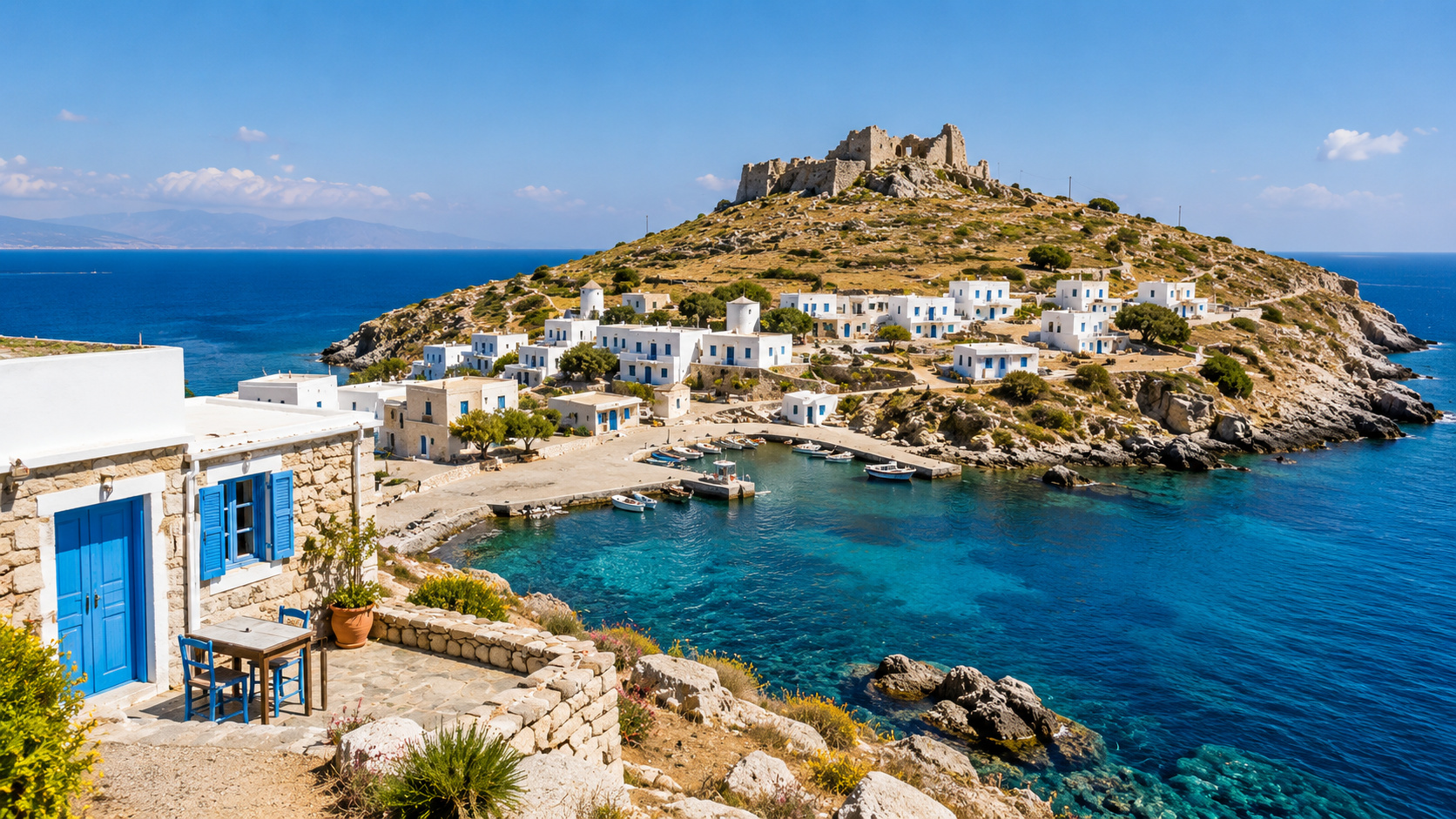

Greek island of Antikythera offers house, food, and €500 per month to attract families and combat extreme depopulation.
In the far south of the Aegean Sea, between Crete and Kythera, the small Greek island of Antikythera has become a symbol of a problem advancing in isolated areas of Europe: the risk of slowly disappearing due to lack of residents. According to the AFP Fact Check, on November 22, 2023, the island had only 39 inhabitants in the 2021 census, compared to 120 a decade earlier, and local authorities had been studying for years a limited initiative to attract families and try to curb demographic emptying.
The point that requires caution is that the proposal was not confirmed as an open program for anyone to move to the island. AFP itself reported that authorities in Kythira and Antikythera denied, in 2023, the existence of a general call with indiscriminate housing, land, and payment, explaining that the plan under study targeted five large Greek Orthodox families, with possible support for housing and a monthly allowance of €500 for three years.
Still, the case gained traction because it exposes a larger reality: small island communities, with fragile services and an aging population, are trying to find ways to attract permanent residents before local life collapses.
-
Teen from Brazil Turns School Snack Sales into Million-Dollar Confectionery Business Projected to Earn Nearly $1.9 Million in 2024

-
Why Do Electrical Outlets and Switches Turn Yellow? Understanding the Impact of Light, Temperature, and Materials on Color Change
-
Former Brazilian laborer and ice cream vendor turns struggling company into $16.5 billion giant with 90,000 employees.

-
New Cyclone Expected to Hit Brazil, Changing Weather Within 72 Hours


Antikythera has fewer inhabitants than many urban buildings
The island’s population scale is striking. Antikythera has an extremely small permanent population, estimated at around 45 residents in recent surveys cited by the Greek press.
This means the island has fewer inhabitants than many urban condominiums or small residential buildings in large European cities.


The central problem is that the local population has aged over the past decades. Young people have left the island in search of universities, jobs, and more accessible services on the mainland or in larger urban centers in Greece.
As a result, basic activities began to be threatened, including the maintenance of local commerce, public services, and even the continuity of the school.
Program offers monthly allowance of €500 per family for three years
The financial incentive offered to new residents has become the main point of international repercussion. According to information released by Greek and international media, families accepted into the program can receive €500 per month for a period of three years.
Over this period, the accumulated amount can reach €18,000 per family unit, without considering the other benefits associated with the program.
In addition to the monthly financial aid, the initiative provides support with housing, land offers, and the provision of basic foodstuffs in certain situations. The goal is to reduce some of the initial economic barriers for families willing to live on an island extremely isolated from the Greek mainland.
Orthodox Church participates in initiative to try and save local community
Unlike some purely governmental programs seen in villages in Italy and Spain, the case of Antikythera has strong participation from the Greek Orthodox Church.
According to reports, the Church of Kythera helped structure the program as a way to strengthen the survival of the local community.

The concern is not just economic. Small Greek islands have been facing severe population reduction, which threatens local traditions, the functioning of churches, schools, and historical community structures.
In this context, the financial incentive functions as part of a broader strategy for territorial and social preservation.
Island located in isolated region between Crete and the Peloponnese
Geographical isolation helps explain why the island has lost so many residents over time. Antikythera is located between Crete and Kythera, in an area relatively far from major Greek urban centers. Access primarily depends on ferries and sea connections subject to Mediterranean weather conditions.
The small territorial dimension also limits the supply of jobs and services.
Despite this, the island holds significant historical and scientific importance. The site became world-renowned after the discovery of the Antikythera Mechanism, an ancient artifact found in a shipwreck and often described as a kind of “analog computer” from antiquity.
Program seeks young families and professionals useful to the community
According to reports released by the Greek press, the program’s main focus is on young families and people with professions useful to small communities.
This includes workers involved in agriculture, fishing, construction, maintenance, and basic services. The goal is to gradually rebuild a minimal local economy capable of keeping the island functional.
The initiative does not aim to transform Antikythera into a mass tourist destination, but rather to ensure that it continues to exist as a permanently inhabited community.
Europe faces demographic crisis in islands, villages, and rural regions
The case of the Greek island is part of a broader phenomenon affecting several European regions. Various small towns, mountain villages, and islands face population decline due to an aging population and the migration of young people to larger urban centers.
In recent years, similar programs have emerged in Italy, Spain, Switzerland, and Ireland, offering everything from cheap houses to financial subsidies to attract new residents.
The problem is considered especially serious in remote regions, where the loss of even a few inhabitants can compromise the functioning of schools, medical services, and local commerce.
Living on an almost empty island involves challenges beyond the paradisiacal scenery
While the Mediterranean scenery and financial incentives are appealing, living in Antikythera involves significant limitations.
Access to hospitals, universities, and large markets is limited. During periods of bad weather, sea connections may experience delays or interruptions. Furthermore, employment opportunities outside of local activities are limited.

Internet and digital services have improved in recent years on several Greek islands, but geographical isolation remains one of the biggest obstacles to population retention.
Greece tries to prevent the silent disappearance of small communities
The depopulation of small islands has concerned Greek authorities for years. In some regions, the risk is not only economic but territorial. Very small communities can lose the ability to maintain basic infrastructure and administrative representation.
Furthermore, isolated areas often hold strategic and historical importance for the country. Therefore, residency incentive programs have come to be seen as a tool for community survival.
Financial aid does not eliminate the high cost of adapting to island life
Despite the monthly aid, moving to an isolated island requires financial planning and adaptation. Greece is still facing prolonged economic effects from the crisis that hit the country in the last decade, and many remote regions have limited infrastructure.
This means that the program functions more as an initial incentive than as a guarantee of automatic economic stability.
Interested candidates also need to assess job availability, access to services, and integration with an extremely small community