






 Portuguese
  Spanish


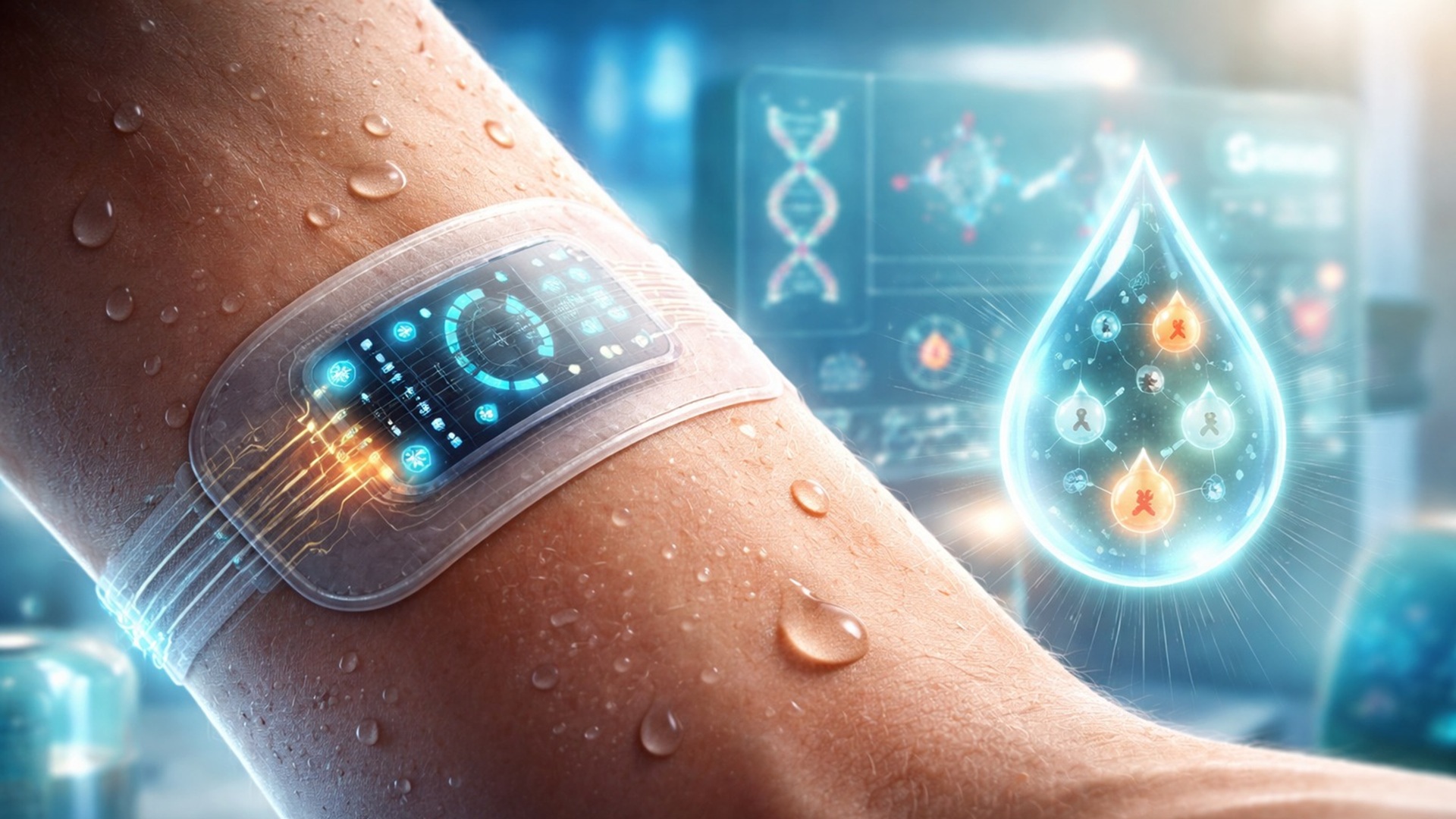

Study Published on October 21, 2025 Details How Wearable Sensors Aided by Artificial Intelligence Can Analyze Biomarkers Present in Sweat in Real-Time, Opening the Way for Continuous Monitoring of Hormones, Medications, and Early Signs of Chronic and Neurodegenerative Diseases
Applied artificial intelligence to wearable sensors is enabling the decoding of biological signals present in sweat to monitor health in real-time, according to a study published on October 21, 2025, with the potential to track hormones, medications, and early detection of diseases such as diabetes, cancer, and Parkinson’s.
Sweat as a Continuous Source of Biological Data
Researchers highlight that sweat contains a rich variety of biological signals capable of reflecting physiological states in real-time. The combination of advanced sensors and artificial intelligence enhances the capacity to read these signals.
The study was published in the Journal of Pharmaceutical Analysis and explores how sweat can be used to monitor hormonal changes, various biomarkers, and medication levels continuously.
-
Survey of 2,500 professionals reveals AI concerns: 39% feel it makes them less intelligent, 41% fear long-term career impact.

-
Panasonic Shifts Strategy in the U.S., Focuses on AI Data Center Batteries as Global Energy Demand Surges
-
Brazilian Entrepreneur Develops Device to Provide Companionship and Health Monitoring for Elderly, Alerting Families to Potential Health Issues

-
AI Customizes Burgers for Individuals and Impresses in Blind Test with Over 100 Participants, Matching or Surpassing Fast-Food Chains’ Approval Ratings


According to co-author Dayanne Bordin from the University of Technology Sydney, sweat collection is painless, simple, and non-invasive, making it a viable alternative to blood or urine.
Wearable Sensors and Real-Time Monitoring
The recent advancement in microfluidics, flexible electronics, and wireless technology has driven a new generation of wearable sensors. These lightweight patches adhere to the skin and allow for continuous sweat collection.
Commercial examples already exist, such as the Gatorade patch, a disposable device that connects to an app to analyze sweat rate and sodium loss, providing personalized recommendations to the user.
People using wearable devices to track heart rate, steps, or blood pressure, such as the Apple Watch, represent an audience interested in the new information sweat can provide.
Diagnosis Enabled by Artificial Intelligence
When integrated with artificial intelligence, sweat sensors can identify specific metabolites and interpret complex biochemical signals. This capability paves the way for personalized health information and early indicators of medical conditions.
For athletes, the technology can enable real-time monitoring of electrolyte depletion during training and assist in verifying drug absence before sports competitions.
In the case of people with diabetes, future versions of these sensors may monitor glucose levels directly through sweat, reducing the need for traditional blood tests.
Advances in Algorithms and Multiple Biomarkers
According to Janice McCauley, also from UTS, sweat is an underutilized diagnostic biofluid. The ability to measure multiple biomarkers simultaneously expands the potential for preventive health.
She notes that 2023 marked a significant advancement in artificial intelligence, enabling more accurate algorithms for pattern analysis and classification, with a direct impact on diagnostic precision and therapeutic accuracy.
These algorithms can associate subtle molecular signals present in sweat with specific physiological states, even in large volumes of continuously collected data.
Prototypes, Challenges, and Future Perspectives
Researchers at UTS are working to understand the basic physiological aspects of sweat and develop microfluidic devices capable of detecting minimal amounts of biomarkers like glucose and cortisol.
While many systems are still in prototype phase, commercial interest is growing as technology advances in miniaturization, low energy consumption, and secure data transmission.
According to Bordin, a scenario is not far off where wearable devices indicate elevated stress hormone levels and, with monitoring over time, point out the risk of chronic disease development.
The research, titled “Sweat as a Diagnostic Biofluid: Analytical Advances and Future Directions,” was authored by Dayanne Mozaner Bordin, Janice Irene McCauley, Eduardo G. de Campos, David P. Bishop, and Bruno Spinosa De Martinis, with DOI 10.1016/j.jpha.2025.101473.









I stopped most of my Parkinson’s disease medications due to severe side effects and I started on herbal treatments from Limitless Herbs Centre (Limitlesshealthcenter. com), the treatment has made a very huge difference for me. My symptoms including body weakness and Swallowing difficulties disappeared after few months on the treatment. I am getting active again since starting this treatment.
My husband was diagnosed of Parkinsons disease 2 years ago, when he was 49. He had a stooped posture, tremors, right arm does not move and also a pulsating feeling in his body. He was placed on Senemet for 8 months and then Sifrol was introduced and replaced the Senemet, during this time span he was also diagnosed with dementia. He started having hallucinations, lost touch with reality. Suspecting it was the medication I took him off the Siferol (with the doctor’s knowledge) and started him on PD-5 natural herbal formula we ordered from AKNNI HERBAL CENTRE, his symptoms totally declined over a 3 weeks use of the AKANNI HERBAL Parkinson’s disease natural herbal formula. He is now almost 51 and doing very well, the disease is totally reversed! (Visit w w w.aknniherbscentre .com)