






 Portuguese
  Spanish
  4 min of reading
  0 comments


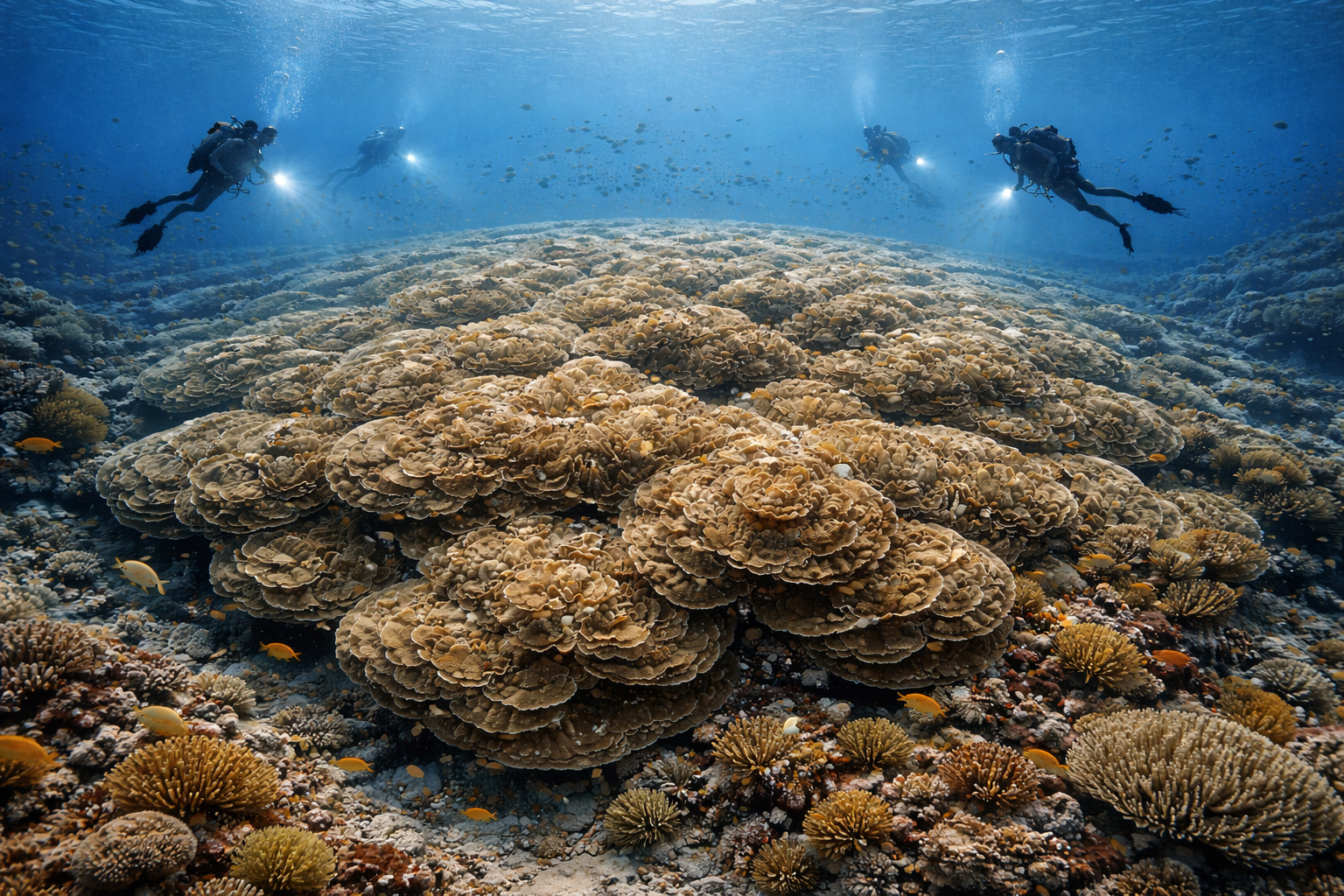
A colossal structure at the bottom of the sea has been identified as a single coral colony, highlighting the capacity for continuous and silent growth of marine life
A marine discovery of great scientific impact caught attention after divers accidentally identified a gigantic structure at the bottom of the ocean.
Initially, the formation seemed just part of the underwater terrain. However, after more careful analysis, it was confirmed that it was a single coral colony of the species Pavona clavus.
According to field records released in 2023 by institutions such as the National Oceanic and Atmospheric Administration (NOAA), the structure surprised by its size and the characteristic of being a continuous organism.
-
They wanted artificial intelligence, but they drained the water from a village in Mexico: the water consumption of data centers caused a hepatitis outbreak, and big tech companies Amazon, Microsoft, and Google were forced to halt billion-dollar projects.

-
System created to save lives in disasters turned ‘against’ Brazilians overnight: a hacker attack sent out a false alert from Civil Defense with the word “misantropia” that went off on the phones of half the country, even in silent mode, and took down the Cell Broadcast.
-
In the cold desert of Ladakh, where it hardly rains, engineer Sonam Wangchuk created the ice stupa, a tower that freezes winter water and stores it for irrigating crops in the spring, a simple engineering feat that mimics nature.
-
For the first time in history, solar and wind energy generated more electricity than natural gas worldwide in a single month, April 2026, a milestone in the energy transition that shows renewable sources taking the lead in the global electric system.




This type of finding reinforces that, even in areas already explored, the ocean still holds structures that are not well understood.
Investigation reveals unusual structure at the bottom of the sea
The identification occurred during an expedition where the divers were not searching for something of this magnitude.
At first glance, the formation was mistaken for a rock or elevation of the seabed, which explains why it remained unrecognized for so long.
Later, with detailed observation, researchers realized that the structure exhibited typical characteristics of a living colony.
Moreover, the broad and wavy shape reinforced the visual illusion that it was just part of the underwater landscape.
Dimension and composition make Pavona clavus unique
What impressed researchers the most was the size of the colony.
The structure has dimensions comparable to a football field, which makes it visually striking on a human scale.
Unlike common reefs, it is not a collection of colonies, but rather a single continuous organism.
This characteristic is considered rare and relevant for marine studies.
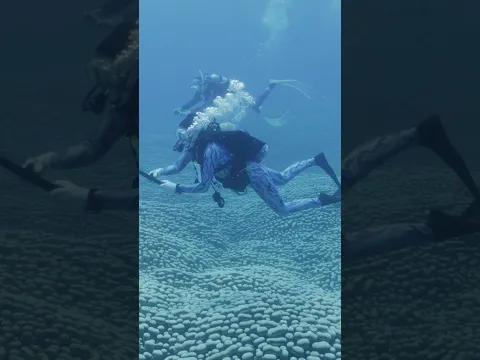

Among the factors that explain the impact of the discovery, the following stand out:
-
“`html
- Dimension equivalent to a football field;
- Continuous formation, without separation between colonies;
- Ability to survive for centuries in variable environments;
- Function as a habitat for various marine species.
Thus, the observed Pavona clavus represents a clear example of the resilience and longevity of corals.

Slow growth explains permanence for centuries
The relevance of the discovery is also related to the age of the structure.
According to recurring studies from institutions like UNESCO, coral colonies can grow slowly over centuries, expanding continuously.
In this context, growth occurs through polyps, small organisms that live fixed and build the structure over time.
Moreover, these polyps remain attached to the base they themselves form.
Thus, the coral grows without the need for locomotion.
Why the colony does not move and is still alive
Many people associate marine life with constant movement.
However, corals follow a different logic.
Even immobile, they are complex living organisms, formed by thousands of polyps.
Among the main characteristics, the following stand out:
- The polyps remain fixed in the structure;
- Growth occurs through continuous expansion;
- The colony houses other marine organisms;
- Even without locomotion, it responds to the environment.
Thus, the Pavona clavus may seem like part of the landscape, but it is, in fact, an active organism.
Discovery reinforces the limits of knowledge about the ocean
The identification of this colony reinforces that human knowledge about the ocean is still limited.
According to analyses from NOAA and UNESCO, a large part of the seabed remains little explored, allowing for unexpected discoveries.
“`Furthermore, the fact that a structure of this size was identified almost by chance highlights gaps in marine observation.
Therefore, even in regions that have already been visited, new discoveries continue to be possible.
What this colony reveals about marine life
The image of a coral colony the size of a football field draws attention not only for its size.
It also represents the capacity for permanence and silent growth of marine life over the centuries.
The Pavona clavus does not move, does not change its position, and shows no visible movement.
Still, it continues to grow and sustain ecosystems around it.
In light of this, an inevitable reflection arises: how many other giant structures remain hidden on the ocean floor, waiting to be identified?








Be the first to react!