Portuguese
  Spanish


Record made in Aliança do Tocantins shows bird with different plumage, observed by professor and photographer Clóvis Cruvinel alongside other blue-and-yellow macaws
A rare scene caught attention in Aliança do Tocantins, a city located 164 kilometers from Palmas, during an observation made late in the afternoon. The geographer, university professor, and nature photographer Clóvis Cruvinel recorded, around 6:30 PM, a blue-and-yellow macaw of very rare color perched on the dry branches of a tree. The bird was alongside at least 12 animals of the same species and still stood out immediately due to its different plumage.
Rare record surprises photographer in Tocantins
The observation occurred when Clóvis Cruvinel was following a group of blue-and-yellow macaws in Aliança do Tocantins. When he stopped to observe the birds, he noticed one with lutino plumage, but only confirmed it was a blue-and-yellow macaw after getting closer. The photographer took advantage of the moment and made the record before the group flew away, knowing he was in front of an important and rare image. The most relevant detail, in this case, is that the bird was seen in its natural habitat, among others of the same species.
Lutino explains unusual coloration of the blue-and-yellow macaw
The appearance of the macaw might initially resemble an albino condition. The explanation, however, is linked to lutino, a genetic phenomenon characterized by the total absence of melanin in the birds’ plumage. This condition also involves the presence of yellow or reddish pigments, which can make the bird appear more yellow with red eyes. The lack of melanin synthesis in the feathers results from the deposition of carotenoids, making this mutation rare and visually striking.
-
World’s Fastest Tractor, the JCB Fastrac Two, Hits Nearly 247.5 km/h with Over 1,000 Horsepower

-
At 86, mountaineer Carlos Soria becomes the oldest person ever to summit an 8,000-meter peak, reaching the top of Manaslu in Nepal.

-
Brazil Secures Spot in International Mathematical Olympiad as Students Excel in One of the World’s Most Competitive Selections, Highlighting Growth in STEM Education Among Young Talents
-
June 2026 Heatwave in France Depletes “Blanc de Meudon” as Residents Use Chalk Powder to Cool Homes by 3 to 7°C Without Air Conditioning



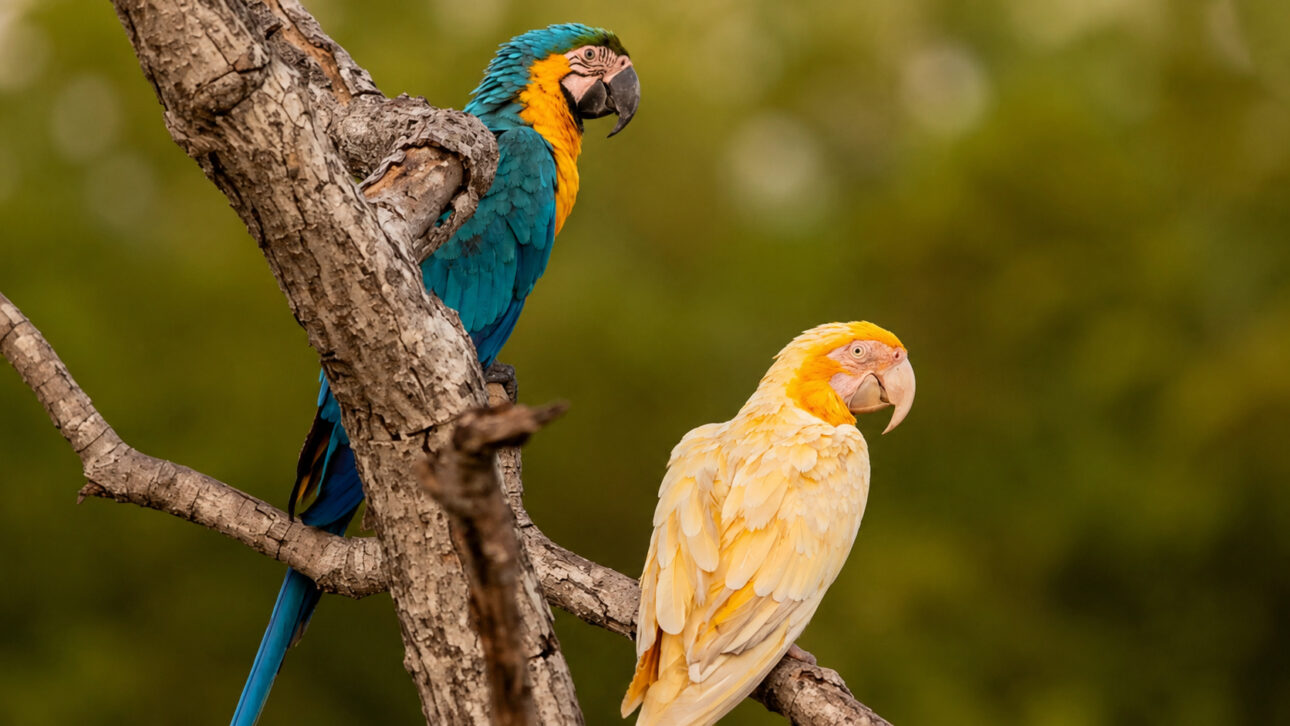
Bird stood out among 12 other blue-and-yellow macaws
The contrast between the rare bird and the rest of the group reinforced the uniqueness of the sighting. The other macaws displayed the traditional coloring of the species, while the macaw observed by Clóvis Cruvinel stood out from the group due to its unusual appearance. The scene gained even more impact because it occurred at sunset, with the group gathered on the dry branches of a tree before taking flight. The sighting, therefore, combined a known species, a rare genetic alteration, and direct observation in nature.
UFT Professor Made the First Record of This Type
Clóvis Cruvinel is a professor at the Federal University of Tocantins and also works as a nature photographer. Even though he is accustomed to capturing images of wildlife, he stated that this was the first time he encountered a blue-and-yellow macaw of a different color. The experience drew attention precisely because of the bird’s visual rarity and the context in which it appeared. The sighting in Aliança do Tocantins thus came to represent an unusual record of Brazilian fauna.
Genetic Mutation Makes the Record Even More Relevant
Lutism is considered a rare alteration because it changes the bird’s natural appearance without altering the species identification. The recorded macaw remains a blue-and-yellow macaw but presents an unusual genetic characteristic that makes it exotic compared to the others. This type of occurrence draws attention by showing how natural variations can arise within known groups. The record also highlights the importance of careful observation of animals in their natural environment.

A Rare Sighting of Brazilian Fauna
The image taken by Clóvis Cruvinel gained prominence because it showed a known bird in an uncommon visual condition. The case also drew attention for occurring in a natural habitat, without direct human interference in the group’s behavior. The rare blue-and-yellow macaw was seen among 12 other birds of the same species, making the contrast even more evident.
How many other species with unusual genetic characteristics still go unnoticed in nature?