






 Portuguese
  Spanish
  4 min of reading
  19 comments


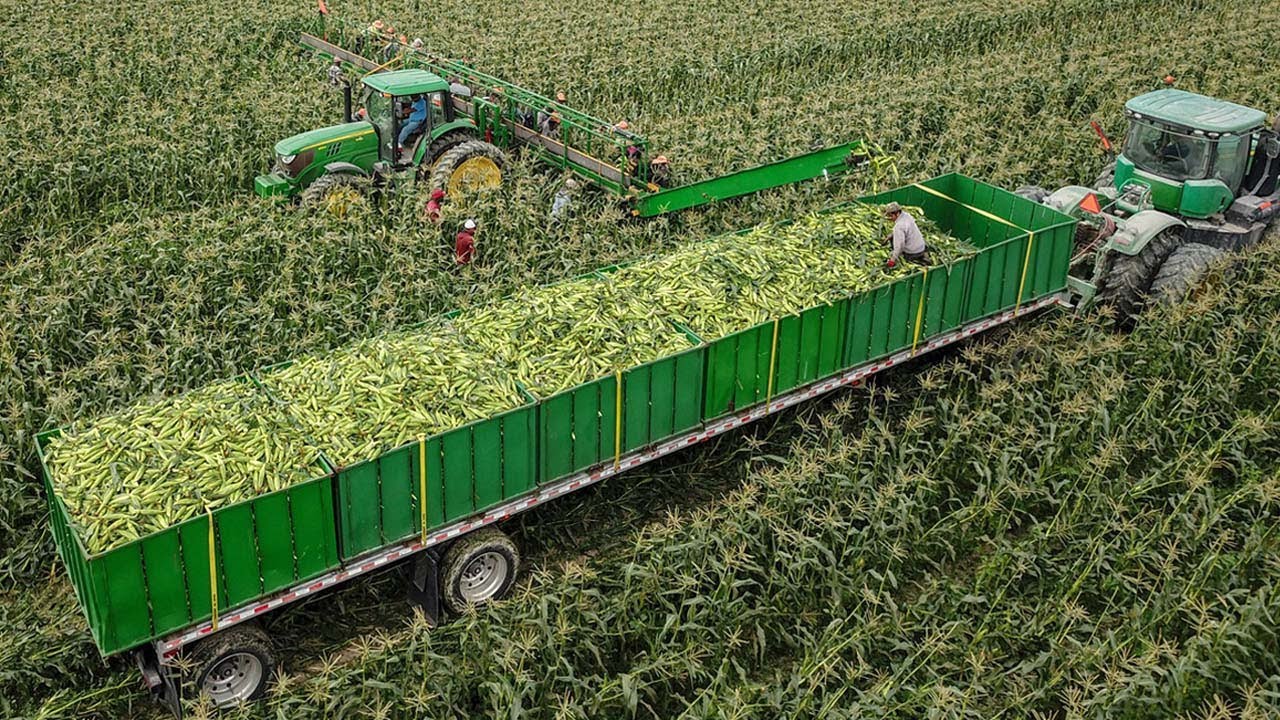


The US Corn Belt Concentrates the Largest Maize Production in the World, with Millions of Mechanized Hectares, Record Productivity, and Logistics that Supply Dozens of Countries Every Year.
The so-called Corn Belt is a vast agricultural region located in the heart of the United States, mainly encompassing the states of Iowa, Illinois, Indiana, Nebraska, Minnesota, Ohio, Missouri, and parts of Kansas and South Dakota. It is one of the most productive agricultural areas ever organized by humanity, functioning cohesively as a true open-air industrial system. This region combines rare factors: extremely fertile soils (mollisols), temperate climate with regular rainfall, flat terrain, and decades of investment in mechanization, genetics, and logistics. The result is continental-scale maize production, difficult to replicate anywhere else on the planet.
Millions of Hectares Planted as a Single Gear
The Corn Belt concentrates over 38 million hectares planted with maize every year, a number that varies according to market conditions, climate, and agricultural policies. In many states, maize occupies more than 40% of the total agricultural area, creating continuous landscapes of crops that extend for hundreds of kilometers without interruption.

The planting is highly synchronized. In just a few weeks of spring, thousands of machines commence operation almost simultaneously, guided by centimeter-accurate GPS, soil sensors, and real-time weather data. The harvest follows the same pattern: fast, coordinated, and highly efficient.
-
While other coffees escape the American tariff hike, Brazilian instant coffee is excluded, raising an alert in the sector and may become up to 37.5% more expensive in the United States.

-
Degraded lands could become São Paulo’s new asset to expand planted forests, strengthen wood, cellulose, and biomaterials, as well as keep the state competitive in the international market.
-
Iran and Russia announce that they are working on creating a grain exchange for BRICS countries, with support from Moscow, one of the world’s largest grain producers, and call on central banks to simplify payments to boost agricultural trade.

-
Even without an official rural area, Florianópolis maintains family farming in Ratones, Ingleses, and Ribeirão, producing cassava, honey, oysters, and organic products, transforming farms into schools and rural tourism, but faces an uncomfortable question: how long can the countryside withstand within a growing capital?


This synchronization transforms the region into something closer to an agricultural assembly line than traditional farming.
Productivity that Redefines the Concept of Scale
The average maize productivity in the Corn Belt is among the highest in the world. In states like Iowa and Illinois, it is common to find averages exceeding 11 tons per hectare, with top producers surpassing this number in specific areas.

Overall, the United States produces over 380 million tons of maize annually, with the Corn Belt accounting for the majority of this volume. This makes the country the largest maize producer in the world, ahead of China, Brazil, and the European Union.
This production is not solely for human consumption. Maize from the Corn Belt supplies animal feed, ethanol production, the food industry, bioplastics, and entire industrial chains, both domestically and abroad.
Total Mechanization and High-Tech Agriculture
The operation of the Corn Belt would be impossible without almost total mechanization. Farms operate with:
– multi-row planters
– high-capacity harvesters
– self-propelled sprayers
– tractors guided by autopilot
– precision agriculture systems
– real-time data analysis
The direct labor on the field is relatively small compared to the volume produced. A single operator, with modern machinery, can manage hundreds of hectares, something unthinkable in less industrialized agricultural models.

Additionally, the intensive use of genetically improved seeds, resistant to pests and adapted to different climatic conditions, ensures productive stability even in more challenging years.
Logistics that Connect Farms to Dozens of Countries
Mass production is not enough. The differentiator of the Corn Belt lies in its extremely efficient logistics. The region is crossed by one of the largest networks of railroads, highways, and navigable waterways in the world, especially the Mississippi River, which serves as a true agricultural export artery.
The maize harvested in the interior of the US quickly reaches river terminals, giant silos, ports in the Gulf of Mexico and the Atlantic, being exported to dozens of countries in Asia, Europe, Africa, and Latin America.
This system reduces costs, increases competitiveness, and ensures that maize from the Corn Belt reaches the international market in volumes and timeframes that are difficult to match.
Direct Impact on Global Food Prices
The Corn Belt does not only influence the United States. It directly impacts the global price of maize, and consequently, of meat, eggs, milk, biofuels, and numerous processed foods.
Crop failures, droughts, or excessive rainfall in the region often trigger immediate reactions in international markets, such as the Chicago Board of Trade (CBOT), a global reference for agricultural commodities.
In other words, decisions made on farms in Iowa or Illinois can reflect on the prices of chicken, pork, or ethanol in countries on the other side of the planet.
Corn Belt versus Other Maize Powers
Although countries like China and Brazil have made significant advances in maize production, the Corn Belt remains an absolute reference in efficiency, average productivity, and integrated logistics.
While other regions face transportation bottlenecks, extreme climatic variations, or technological limitations, the Corn Belt operates with structural stability, the result of decades of public and private investment.
This does not mean it is free from challenges. Climate change, input costs, environmental pressures, and trade disputes are part of the current landscape. Still, the model remains one of the most robust ever built in global agriculture.
An Agricultural Factory that Redefines the Concept of Food Production
The Corn Belt is not just an agricultural region. It represents a new level of organization in food production, where science, engineering, logistics, and markets operate in an integrated manner.
Few places in the world can produce so much, so quickly, predictably, and on such a monumental scale. That is why the US Corn Belt is seen not just as a granary, but as a central cog in the global food system.
And as the planet seeks to feed a growing population, what happens in this agricultural belt continues to be closely monitored by governments, businesses, and markets around the world.







No
An interesting report but poorly written (Do you have an editor?).
Siembram maiz sobre maiz o rotan?